LÆLIA DAYANA. [Plate 132.] Native of Brazil.
Reading edition
LÆLIA DAYANA. [Plate 132.] Native of Brazil.
Epiphytal. Stems short, clustered, oblong, somewhat clavate, invested by dry membranous pale brown scales, the stronger and younger flowering stems with two or three blunter sheaths of a pale green colour. Leaves elliptic-oblong, acute, three inches long, fleshy coriaceous, solitary. Scape terminal, one-flowered, issuing from a leafy spathe. Flowers nearly four inches across, showy, on account of the rich and strongly contrasted colouring of the lip; sepals lanceolate acute, entire, recurved at the top, pale lilac-mauve; petals ovate acute, broader and somewhat deeper coloured than the sepals; lip three-lobed, the lateral lobes having the sides convolute over the column, of a pale lilac-mauve, the truncately rounded denticulate front edge recurved, and together with the subquadrate emarginate undulated and recurved front lobe of a rich purple-magenta, contrasting strongly with the diluted mauve-purple of the sepals, petals, and base of lip; the throat is white, marked by seven deep purple carinæ, which are depressed and more or less wavy on the edges. Column quite enclosed, angulate on both sides at the apex.
Lælia Dayana, Reichenbach fil., in Gardeners’ Chronicle, N.S., vi., 772.
Lælia pumila Dayana, Burbidge, Floral Magazine, N.S., t. 249.
This species belongs to a group of small-growing Lælias, several of which are most beautiful. That of which we are at present treating is, however, one of the best of this group. There are several forms of it to be met with in gardens, but that which we have figured we consider to be the type. It was first flowered by and named in honour of John Day, Esq., of Tottenham, and was imported by Messrs. Low & Co., from Brazil, some years ago, together with a batch of L. pumila, so that it is now well distributed, and is to be seen in nearly all collections of any importance. It is a most useful plant, and has many good qualities to recommend it, amongst which we may mention that it is dwarf-growing as well as free-blooming, and it is of easy cultivation, thriving under the cool treatment given to Odontoglots, which it seems to enjoy. Our drawing was taken from a well-grown plant in the collection of J. Buchanan, Esq., of Oswald Road, Morningside, Edinburgh, who has some well-grown specimens of the different classes of Orchids which are well cared for by Mr. Grossart, the gardener.
Lælia Dayana is a compact evergreen plant, growing about six inches high, the stems being terminated by the short oblong leathery green leaves; it produces its flowers with the young growth from the top of the stem, and these are of 72 large size, the sepals and petals being of a light lilac-mauve and the lip of an intensely dark magenta-purple, with a light throat, the crest much darker in colour. It blossoms during the autumn months, and lasts about four weeks in bloom if the flowers are kept dry.
This, as we have said, is a cool-house plant, doing well with the Odontoglots if placed in pans or shallow pots amongst rough fibrous peat with good drainage, filling the pots three parts full with a layer of moss on the crocks, and the pot being then filled up with the peat, adding some lumps of charcoal, which will encourage them to root more freely. They will also do well in baskets suspended from the roof with the same material, and they will thrive on blocks of wood, but grown in the latter way they require more water in the active season.
When in pots or baskets they require to be kept moist in their growing season, which continues during their period of flowering and some time after. When their growth is completed less water will suffice, but their stems must not be allowed to shrivel. Moreover, the soil must always be kept in a sweet condition. If the soil decays remove it and supply fresh, but in doing this carefully avoid injuring the roots. They must be grown near the glass, with very little shade—just sufficient to keep the burning sun-rays off them.
Insects must be well sought after and battled with. The White Scale will attack them, and must be eradicated, as small-growing plants like this cannot endure such enemies. Cleanliness is the chief virtue, not only in cultivating Orchids but most other plants, and clean objects are always worthy of admiration.
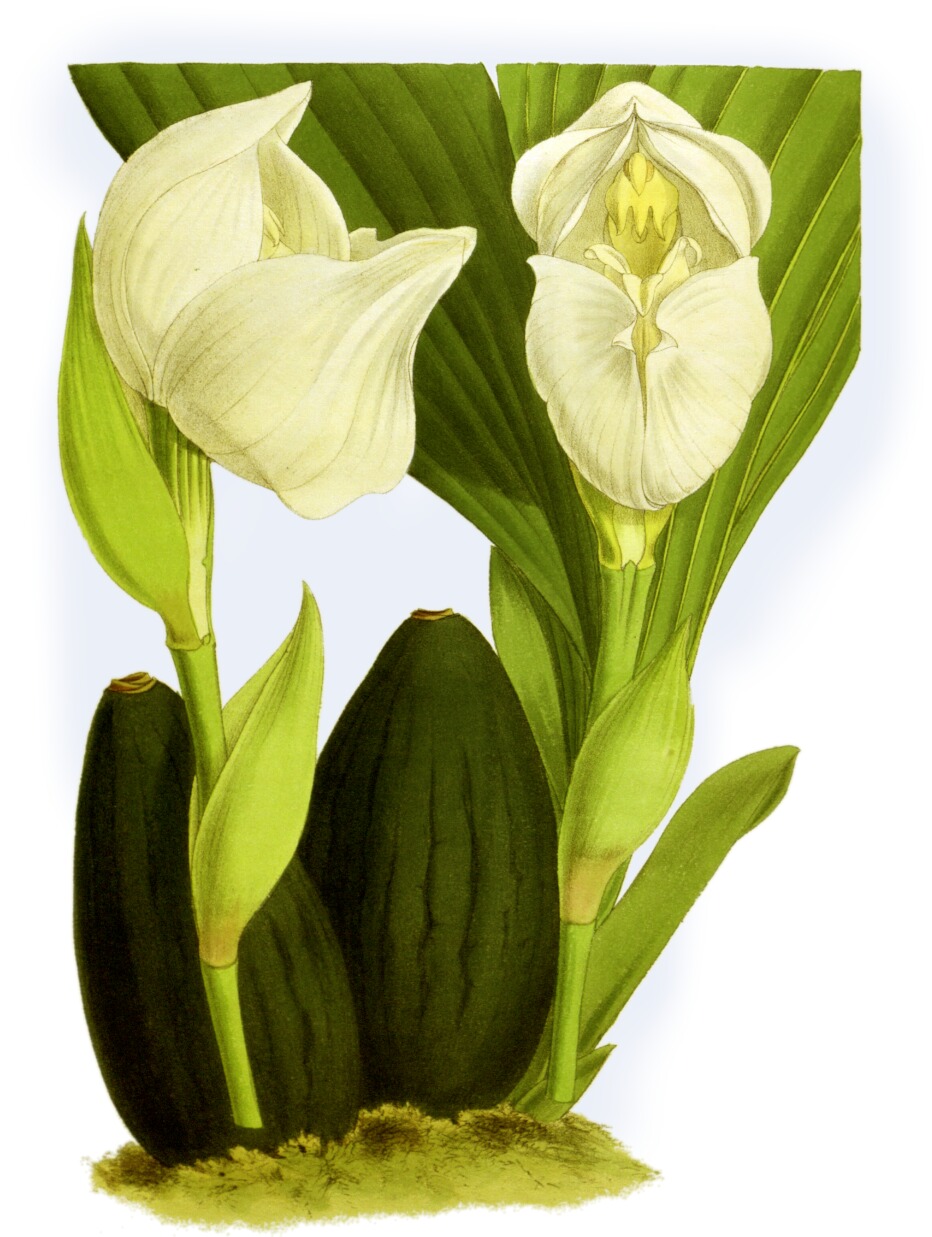
PL. 133. ANGULOA EBURNEA.
73