LÆLIA HARPOPHYLLA. [Plate 117.] Native of Brazil.
Reading edition
LÆLIA HARPOPHYLLA. [Plate 117.] Native of Brazil.
Epiphytal. Stems slender, terete, six inches to a foot high, invested with sheathing bracts, monophyllous. Leaves ligulate, acuminate, about an inch in breadth, dark green. Peduncle issuing from a longish terete sheath, and having raceme about six inches long. Flowers four to seven in a raceme, rather small in size, but highly coloured, and very attractive; sepals lanceolate, acute, one and three-quarter inch in length, and of a bright orange-vermilion; petals similar in size, form, and colour; lip three-lobed, the side lobes erect plane, of the some orange colour as the sepals, with the acute upper front angle whitish and somewhat drawn out, the margins just meeting over the column, the middle lobe creamy white, the disk marked with four orange-coloured lines, about twice as long as the side lobes, linear acuminate, recurved, with a crispy margin; keels nearly obsolete.
Lælia harpophylla, Reichenbach fil., in Gardeners’ Chronicle, 1873, 542; Floral Magazine, N.S., t. 372; Garden, xxiii., 116, t. 400.
This, observes Professor Reichenbach, is one of those curious plants which “are not decided species, and yet they must be named and registered. It would be Lælia cinnabarina, if it had not a stem as thin as that of a showy Pleurothallis, a single acuminate leaf, and much narrower and straighter parts of the flower.” * * * “Perhaps it is a mule between a Brassavola and Lælia cinnabarina?” Whatever its origin and direct relationship, there is no doubt that it is one of the most distinct and beautiful of Orchids, as it affords a colour that is not only rare, but exceedingly effective. The flowers may be considered small as compared with the majority of the species of Lælia, which, indeed, are generally large-flowered, and rank among the most gorgeous and showy of Orchids, but even in this species they measure fully three inches across. It is a singular fact, that most of the orchidaceous species with orange-vermilion flowers have blossoms smaller than those of other colours. We have often noticed this fact amongst the Orchids that we have met with, and, indeed, it my be observed through nearly all the genera, that there are no large-sized flowers of this orange or vermilion colour. We are, however, hopeful that our energetic collectors may succeed in importing some having this character. It is true the Sophronites grandiflora bears highly coloured vermilion-scarlet flowers which may be considered large in proportion to the size of the plant, and a most charming Orchid it is, but we should, nevertheless, welcome some examples, at least, of these brilliant and startling colours among those larger-growing subjects which produce larger flowers.
42
Our figure of this charming Lælia was taken from a finely-bloomed specimen in the well-grown collection of F. A. Philbrick, Esq., of Bickley, under the care of Mr. Heims, who has succeeded in flowering it very successfully. It was a very rare plant a few years ago, and then commanded a high price; but of late years there have been received large importations of it, and it may now be purchased at a more reasonable cost. The varieties vary to some extent in the size of their flowers and in the particular shade of colour, which is found to be the case with nearly all the imported Orchids.
Lælia harpophylla is an evergreen species, with thin stems and long narrowish pointed foliage, of a dark green colour; it grows a foot or more in height, the flower-spike proceeding from a sheath at the top of the stem, and rising about six inches above it, several flowers growing together on the spike. The blossom is of a beautiful bright orange-vermilion, and the lip is edged with white. It is a free-flowering plant, blooming in March, April, and May, and continuing its inflorescence for four or five weeks.
We find it to succeed well potted in fibrous peat, to which must be added good drainage, and a liberal supply of water during the time of its growth. The soil should also be kept moist through the resting season, so that the bulbs and foliage may be kept plump, as the bulbs being very thin, they require a more constant supply of nourishment than those of plants which have bulbs of a more substantial character. We have grown these plants in the Cattleya house, as near the light as possible, for they grow weakly if far off the light, though they require shading from the burning sun. They must also be kept free from insects.
Lælia amanda (Cattleya Rothschildiana).—This fine species, or natural hybrid, is cultivated under the two names above quoted, as we learn from a letter which accompanied some flowers of the plant, for which we are indebted to W. E. Brymer, Esq., Ilsington House, Puddleton, near Dorchester, and of which our artist has taken advantage to secure a drawing for the Orchid Album. The flowers somewhat resemble in character those of Cattleya maxima, but the stems (pseudobulbs) and foliage are quite distinct, being two-leaved, while the flowers are more chaste-looking than those of that species. The plant is very beautiful, and is a decided acquisition to this class of Lælias, the flowers being bright rose veined with rosy purple, and produced in October, at a season when there are but few Orchids in bloom, which makes it all the more valuable.—B. S. W.
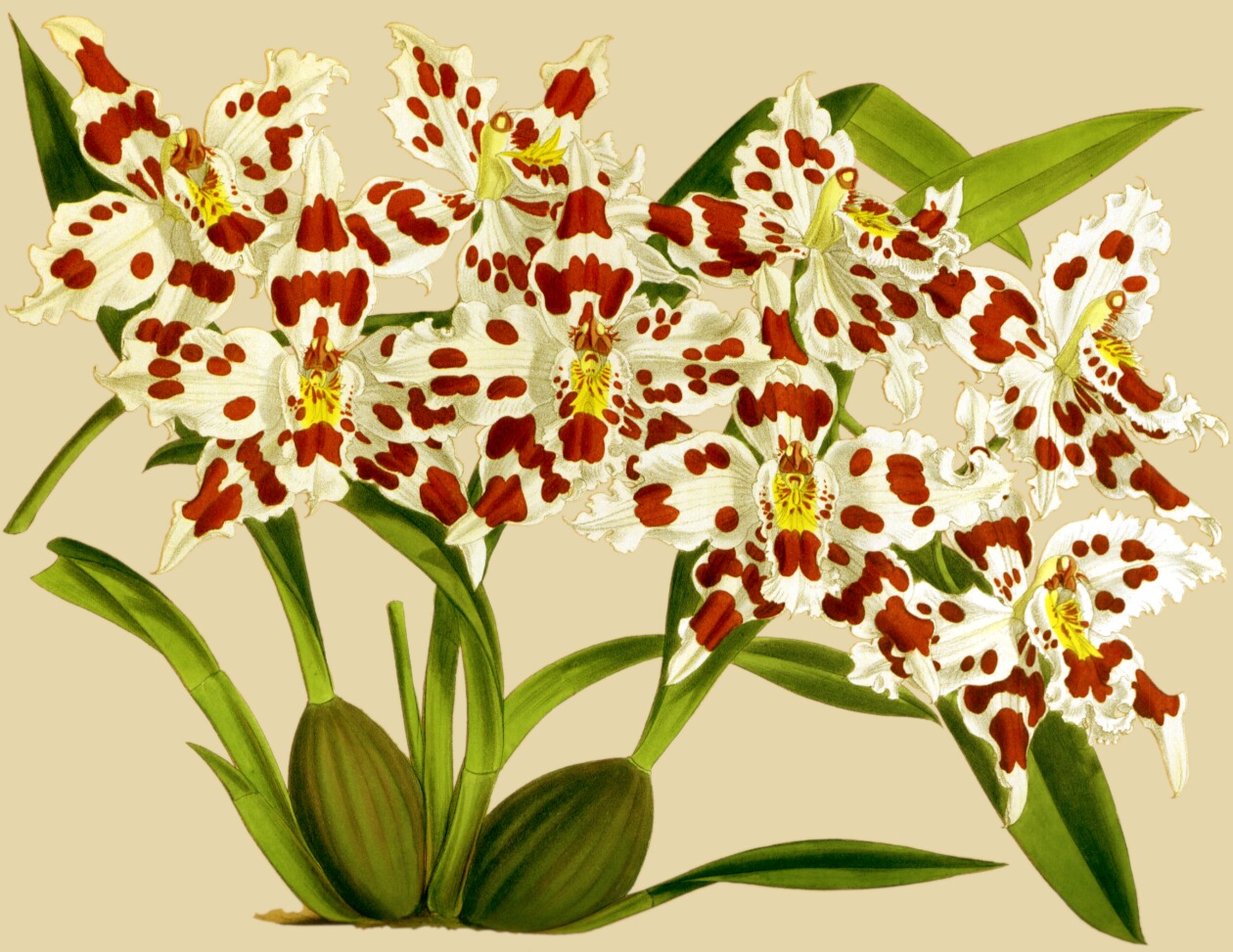
PL. 118. ODONTOGLOSSUM ALEXANDRÆ COOKSONII.
43