DENDROBIUM DEAREI. [Plate 120.] Native of Mindanao, Philippine Islands.
Reading edition
DENDROBIUM DEAREI. [Plate 120.] Native of Mindanao, Philippine Islands.
Epiphytal. Stems stoutish, many-leaved, two to three feet high, marked by numerous furrows, and invested by the sheathing leaf bases. Leaves densely placed, oblong-ligulate, emarginate at the apex, leathery in texture, two inches or more in length, sub-deciduous. Racemes numerous (six to nine) on one stem, issuing from the uppermost joints, each bearing from ten to eighteen flowers, terminal or sub-terminal. Flowers three inches across, pure white, exceedingly chaste and delicate, attached by three-winged ovaries; sepals lanceolate, acuminate, keeled; petals rhomboid-oblong obtuse; lip oblong obtuse, apiculate, the anterior part crenulate, with an obtuse angle on each side towards the base, which is somewhat cucullate, pure white, like the rest of the flower, but with a small blotch of pale green on the disk, crossed by about half a dozen green lines; spur or chin extinguisher-shaped. Column much dilated at the base.
Dendrobium Dearei, Reichenbach fil., in Gardeners’ Chronicle, N.S., xviii., 361.
This new species, which was imported last year, has now bloomed in many collections, and has proved to be one of the most beautiful and chaste amongst white-flowered Orchids—one that every Orchidophilist will admire, since it has so many good qualities to recommend it, being free-blooming, of a pure white, and lasting long in flower; moreover, each flower can be cut separately for button-hole or bouquet use, and the plant is also very effective for decorative and exhibition purposes during the summer months. Thus, by having a goodly number of plants, it may be brought in for several successive months; and the stronger the plant is grown the finer will be its flowers. The individual plants vary somewhat, which may be caused partly by some specimens being weakly, and in that case they will improve as they gain strength. It appears to be a very free grower, but time must prove that, and also if the plants are of long duration or not. Many of our Dendrobes last but a few years, and then require to be re-imported. Our sketch is from a well-grown plant in the grand collection of Sir Trevor Lawrence, Bart., M.P., where we saw several other examples in bloom, some of them being very strong, and bearing as many as thirty flowers on a single stem.
Dendrobium Dearei, named in compliment to Colonel Deare, by whom it was first brought forward, is partly deciduous, losing the older leaves after it has bloomed; this is its aspect at present, but when we get it into a good growing state its foliage may perhaps stand for a longer time. It produces its flowers in 48 spikes from the top of the stem, and also from the side towards their upper end, many together on the spike; they are pure white, with a little delicate green blotch and veins in the hollowed-out throat. The blooming season occurs during the summer months, and the individual flowers last for several weeks in beauty.
This species will do either in baskets or pots, filled with rough fibrous peat, sphagnum moss, and good drainage, to which a few small lumps of charcoal may be added. It will also thrive on blocks, with live sphagnum moss about the roots; but cultivated in this manner the plants require a more abundant supply of moisture during the growing season. It is a plant that likes to be grown near the light, and the East India house seems to suit it well. Both those in pots and those in baskets require to be kept moist at the roots during their period of growth; and, like other species of Dendrobe, this enjoys a good season of rest to cause it to flower more freely. The plants must be kept free from insects, and can be propagated by dividing the clusters of stems, leaving two or three to each division. After they are separated they should be put into a shady place until they begin to grow, when they may be allowed more light.
Masdevallia Chimæra.—We saw a wonderfully fine plant of this curious Orchid in the collection of the Marquis of Lothian, at Newbattle Abbey, Dalkeith, N.B. The plant was suspended from the roof of the house, and bore several finely expanded flowers, each measuring twenty inches across from the tip of one tail to that of the opposite one. The flowers were large in all their parts, of a dark purple colour, beautifully spotted and clothed on the interior surface with dark hairs, which is a peculiar feature of this section of the Masdevallias. Mr. Priest was kind enough to send us some flowers of this species for figuring, but unfortunately they withered before they reached us. It has always been so when flowers of this species have been sent to us, as they last for so short a time when cut from the plant.—B. S. W.
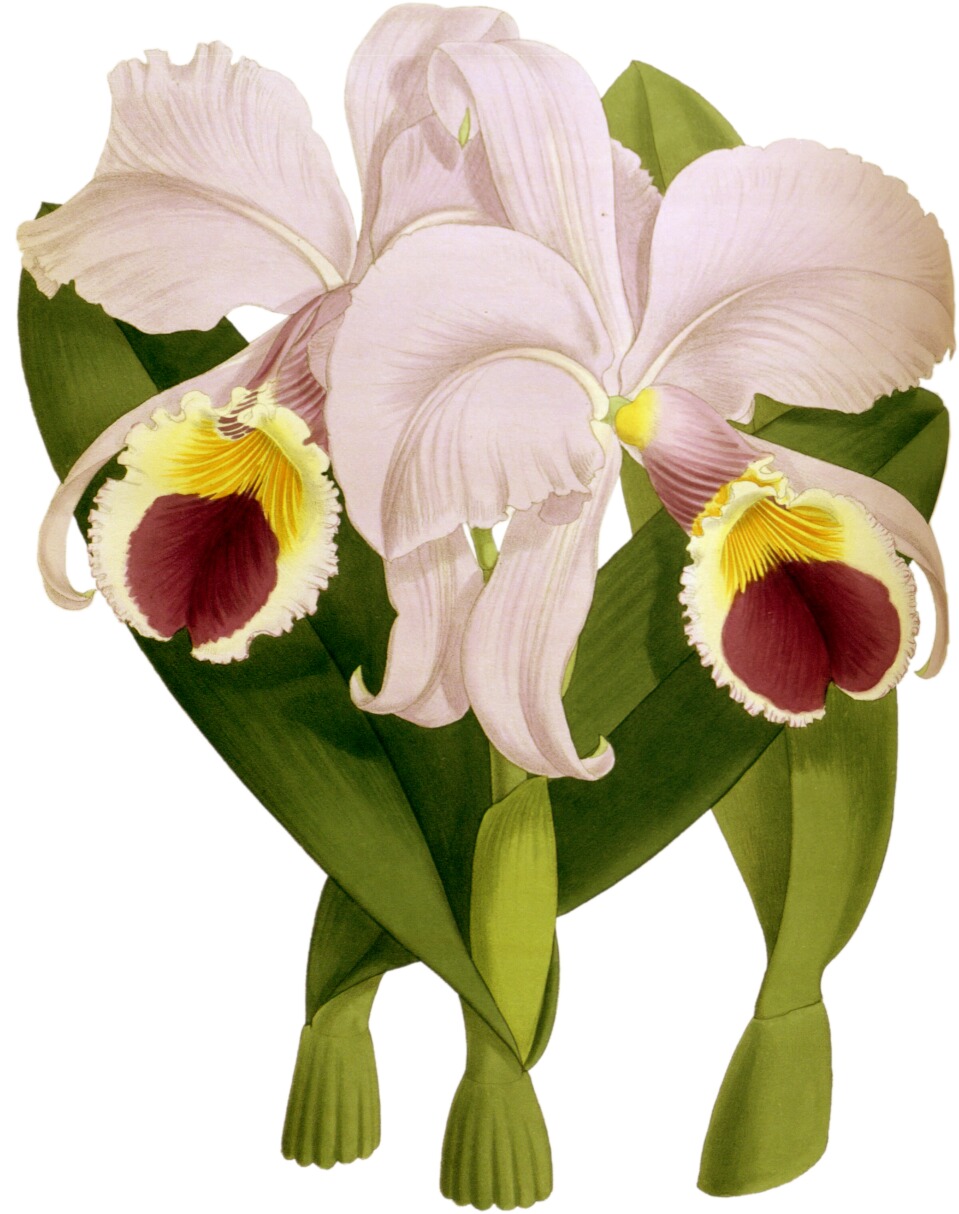
PL. 121. CATTLEYA LABIATA PALLIDA.
49