CŒLOGYNE BARBATA. [Plate 143.] Native of India: Bhothan, Khasya, &c.
Reading edition
CŒLOGYNE BARBATA. [Plate 143.] Native of India: Bhothan, Khasya, &c.
Epiphytal. Pseudobulbs roundish-ovate, plump, two-leaved, with brownish lanceolate bracts at their base. Leaves narrowed below into a petiole, elliptic-oblong, with a stout costa, plicate, leathery, one and a half-inch wide, and from six inches to a foot long including the petiole, of a lively green. Peduncles erect, rigid, springing from between the leaves, terete, terminating in a dense raceme of flowers, below which are several pairs of abortive imbricated pale brown bracts. Flowers large, white, with a peculiar sooty or pitchy stain covering the inner side of the lip, breaking out into fine pencillings towards the margin; sepals white, oblong-ovate, broadish at the base, narrowed to the acute point; petals white, lanceolate acute, broadest at the base; lip white, oblong, three-lobed, saccate at the base, fringed with brown-based hairs on the anterior margins, and bearded with hairs entirely dark brown on the three veins of the disk, forming three shaggy crests, the side lobes tinged with pale flesh colour or pink outside. Column white, deflexed, bilobed at the end.
Cœlogyne barbata, Griffith, Itinerary Notes 72; Id. Notulæ ad Plantas Asiaticas, iii., 280, t. 291, fig. 2; Lindley, Folia Orchidacea, art. Cœlogyne, No. 21; Reichenbach fil., in Walpers’ Annales Botanices Systematicæ; vi., 229.
Of our present subject Dr. Lindley remarks (Folia Orchidacea, l. c.)—“This is, perhaps, the finest of this fine genus. The coriaceous leaves are more than fifteen inches long; the scapes are erect, very stiff, as long as the leaves, and furnished at the apex with an imbricated sheath of bud scales, out of which appears a flexuous raceme four to six inches long, composed of very large blunt deciduous bracts. The flowers are fully two inches and at half in diameter, pure white, except very long hairy fringes which are brown at their base, where they border the lip, and wholly brown where they cover the veins, and form three shaggy crests.” The only figure previously published is a very indifferent one of Griffith’s quoted above.
In the Cœlogyne we now bring to the notice of our readers we have one of the most useful species of a comparatively large genus, and one that blooms during the winter months, when white flowers are sought after. It is one, moreover, the flowers of which stand well when cut. We are indebted to Mr. W. Bull, of Chelsea, for the introduction of this species; which is a free bloomer when the bulbs are strong. It is a plant which possesses many good qualities, being a free grower as well as a free bloomer, and having the advantage of bearing fine evergreen foliage; it will thrive well in the cool house with Odontoglots; and besides all 94 this, it is a cheap plant, so that everyone having a cool house can procure and grow it without much expense or trouble. Our drawing was taken from a specimen which flowered in the Victoria and Paradise Nurseries.
Cœlogyne barbata is, as we have just said, an evergreen plant, with short pseudobulbs and stout foliage, which grows about a foot long, and is of a lively green colour. The sepals and petals are white; the lip is sepia-brown, distinctly bearded with long fringes of coloured hairs, which give it a very distinct and quaint appearance, the fringe and beard contrasting very strongly with the white sepals and petals. It blooms during the autumn months, and continues flowering for a long time, if the flowers are kept free from damp. The plant should, therefore, be placed at the dry end of the house when in bloom, or be removed to a drier house than that in which it has been grown. We find it to grow well in a pot, if allowed perfect drainage, and planted in rough fibrous peat, allowing it a moderate supply of water during the growing season, but reducing the quantity when the plant is at rest.
There were three very interesting New Orchids exhibited by Sir T. Lawrence, Bart, M.P., at the meeting of the Royal Horticultural Society on April 22nd last, all being remarkably distinct and pretty:—
Angræcum fastuosum.—The growth of this species is somewhat similar to that of A. articulatum, but the leaves are rounder and broader. The spikes are short and drooping, the flowers pure white, sweet-scented, with the lip larger than the petals; very distinct.
Odontoglossum cinnamomeum.—A new species, much resembling the true and rare O. odoratum. The sepals and petals are, however, broader, and the markings are much denser; the lip is yellow, with a large brownish crimson blotch in the centre, and the margin faintly spotted with the same colour, the whole surface being covered with fine downy hairs; very strongly scented.
Dendrobium Harveyanum.—This is a great surprise, being in the way of Dendrobium Brymerianum, but it has this peculiarity, that the petals are fringed in the same way as the lip, thus practically giving to the flower the appearance of three lips instead of one, although somewhat modified. The flowers are smaller than those of D. Brymerianum, but the plant resembles it in growth; and, indeed, it was imported with that species, so that possibly it may be a sport from it, which has become fixed. This plant has been named in honour of E. Harvey, Esq., Riversdale Road, Aigburth, Liverpool, in whose collection it first bloomed.—H. W.
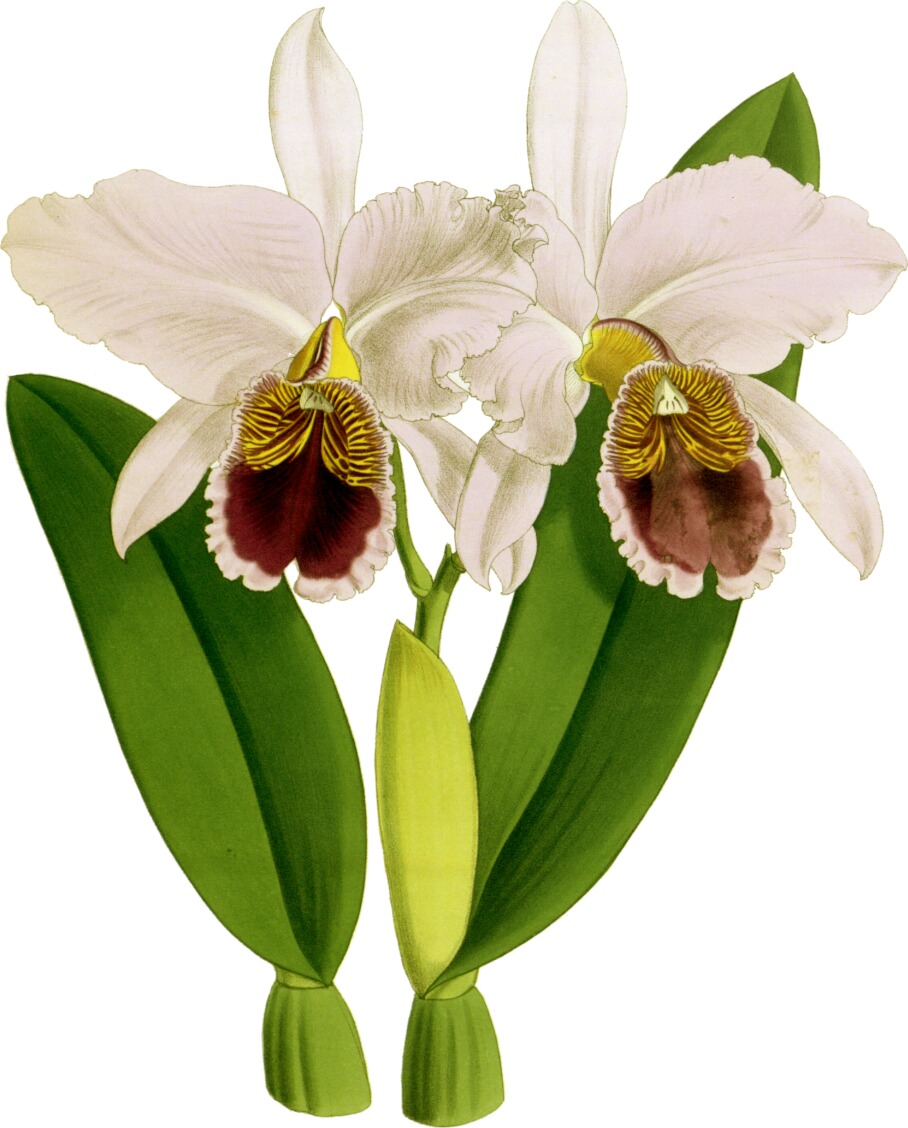
Pl. 144. CATTLEYA LABIATA PERCIVALIANA.
95