AËRIDES VANDARUM. [Plate 116.] Native of India.
Reading edition
AËRIDES VANDARUM. [Plate 116.] Native of India.
Epiphytal. Stems terete, flexuose, rooting, clothed with the sheathing bases of the leaves, growing two feet or more in height, of it purplish brown colour. Leaves distant, harsh in texture, four to six inches long, as thick as the stem, subulate, terete narrowed to an acute point, with a narrow furrow on the upper side, evergreen. Peduncle lateral, opposite the leaves, one or two flowered. Flowers rather large, delicate but durable, white; sepals spreading, the dorsal one ligulate with a stalk-like base, the lateral ones subcrenulate united to the foot of the column, the margins always undulated; petals obovate cuneate, undulated; lip tripartite, the lateral (basal) divisions linear-falcate, toothletted, the middle one deeply two-lobed, the lobes reniform, concave, crenate narrowed at the base into a claw, with a small toothed segment on each side and a sharp keel between; spur extinguisher-formed. Column short, wingless. Pollen-masses two.
Aërides Vandarum, Reichenbach fil., in Gardeners’ Chronicle, 1867, 997.
Aërides cylindricum, Hooker, Botanical Magazine, t. 4982, non Lindley; Gardeners’ Chronicle, N.S., iii, 537, fig. 115.
There is no doubt that the species of Aërides rank among the most beautiful of the East Indian Orchids. The one we now introduce to the notice of our readers is very distinct in its manner of flowering, and also in its foliage, the general aspect of the plant being much like that of Vanda teres, whence the name given it by Professor Reichenbach of Aërides Vandarum. The flowers are large and the manner of its growth makes it a very interesting subject. Few cultivators, however, have seen it in blossom. Our artist took a sketch last March from a plant blooming at the Victoria and Paradise Nurseries, where it flowered for several weeks.
Aërides Vandarum is an evergreen species and grows about two feet in height. The foliage is terete and acutely pointed, like that of a small growing Vanda teres and the stem is of a purplish brown colour. It produces two flowers on a spike, and these are of a pure white colour; it blooms in March and April, and lasts three weeks in perfection.
This plant requires the heat of the East India house, with all the light possible. It will thrive in pots or baskets with sphagnum moss, or even on rafts of wood, but when grown on these it requires more frequent supplies of moisture. 40 It should have about the same treatment as Vanda teres, growing well during the summer if provided with plenty of moisture over the foliage and roots during the growing period, and having a good rest during winter, when it needs only just sufficient moisture to keep the stems and leaves from shrivelling. When it begins to show flower, it should have a little water to plump the stems and encourage them to throw out the blossoms freely and to develope growths for the summer season. We find it thrive best suspended near the glass, so that it can have all the light possible.
Orchids at Eastwood Park, Glasgow, the residence of David Tod, Esq.—This collection of Orchids is doing well, especially the cool kinds, and the Cattleyas which latter are special favourites with Mr. Tod, since they do not require so much heat as some others. There are here many hundreds of Odontoglots, and we noticed some fine forms in bloom, especially in the large house, in which was a grand display of Odontoglossum Alexandræ, many of the plants with well furnished spikes. Of O. Pescatorei there are also some fine examples with vigorous branching panicles, and other wonderfully fine specimens, having massive pseudobulbs, which had produced noble spikes of blooms. Mr. Ewart, the gardener, takes great interest in the plants, which have much improved during the last two years.
There are two other houses filled with Odontoglots and Masdevallias. Here many of the Odontoglots are smaller, but they are doing well. We noticed two very fine specimens of Odontoglossum Andersonianum showing well for bloom, and these, Mr. Tod informed us, are very fine varieties. By their side stood the rare O. Ruckerii, just coming into flower. The collection also includes many other rare Odontoglots. In another house, half-span roofed, there is a numerous collection of miscellaneous Orchids, including some fine specimens of Phalænopsis Schilleriana and others. There are also good plants of Cattleyas of most of the leading kinds, as well as Lælias and Dendrobiums; and fine specimens of Cypripedium caudatum on the front stage are doing well, and had produced many flower spikes. In this house Odontoglossum Roezlii grows very freely, and is in a clean and healthy condition, the plants seeming to get the treatment they like. Mr. Tod parted with his fine specimens of this species last year, but the pieces that are left are making good plants.
Adjoining this house is a most splendid Fernery, beautifully laid out, and planted with the best Ferns, Palms, Begonias, &c., which are in vigorous health.—B. S. W.
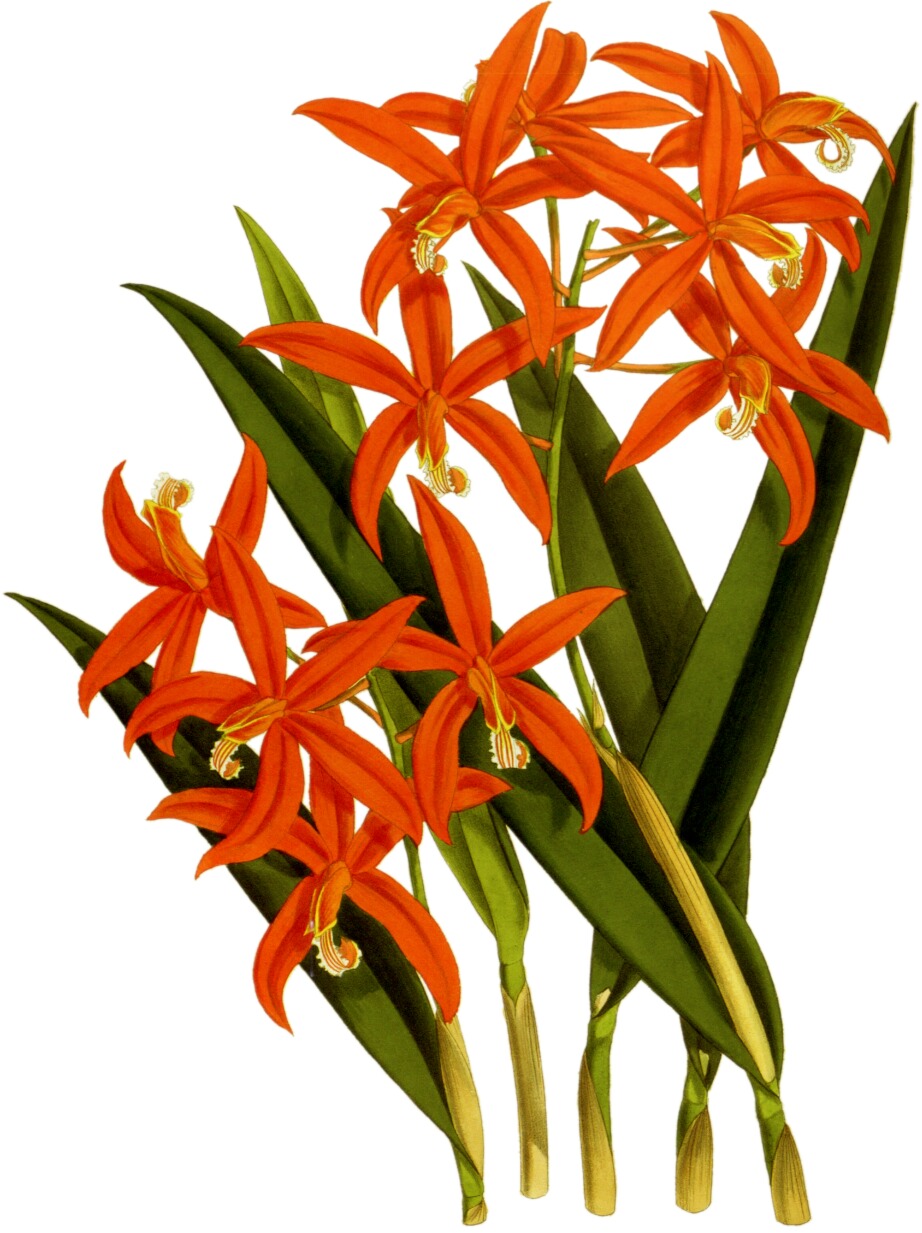
PL. 117. LÆLIA HARPOPHYLLA.
41