ANGULOA EBURNEA. [Plate 133.] Native of Colombia.
Reading edition
ANGULOA EBURNEA. [Plate 133.] Native of Colombia.
Epiphytal. Pseudobulbs oblong attenuated at the apex, four inches high, furrowed, dark green, sheathed while young with large leafy scales, which gradually pass into the true leaves, becoming leafless in age. Leaves broadly elliptic-lanceolate acute, strongly ribbed and of thin herbaceous texture. Scape stout, springing from the base of the pseudobulbs, eight to ten inches high, with one or two distinct sheathing ovate acuminate pale green bracts. Flowers large, solitary at the top of the erect scape, subglobose, of a clear ivory white; sepals broadly orbicular-ovate, acute, cucullately concave, the margins of the dorsal and the tips of the connivent lateral ones recurved, white; petals smaller, enclosed, concave, also white; lip white spotted with pink, turned up so to be parallel to the column, three-lobed, the lateral lobes broad narrowed to a point which is recurved, the middle lobe small, triangular, deflexed with a furrow down the centre. Column clavate, the apex with three projecting subulate-triangular teeth directed downwards.
Anguloa eburnea, Williams, Orchid Grower’s Manual, 3 ed., 67; Id., ed. 5, 91.
Of this small Orchidic genus there are but few species known in cultivation. All those we have seen bear curiously-formed flowers, and are very showy. The species now before us has the flowers of an ivory white, and these when in bloom form a good contrast with the yellow flowers of Anguloa Clowesii and the beautifully spotted flowers of A. Ruckeri and its variety A. Ruckeri sanguinea, a figure of which latter plant will be found at Plate 19 of our first volume. There are besides other species, but those we have mentioned are among the most showy.
Anguloa eburnea, our present subject, is an exceedingly rare and a very distinct species, which indeed we have seen in very few collections. We are indebted to Sir Trevor Lawrence, Bart, M.P., of Burford Lodge, Dorking, whose collection, as is well known, abounds in rare Orchids, for the opportunity of publishing the accompanying figure.
Like the other Anguloas this is a plant of bold and majestic habit, producing large dark green pseudobulbs several inches high, crowned with the ample lively green foliage, which attains a foot and a half in height. The flowers, which are ivory white, proceed from the base of the pseudobulbs on scapes eight to ten inches in height. The character of these plants is to show their flowers after their pseudobulbs are well matured, and when the resting season has been completed, the young growth also appearing at the same time. The flowers are generally 74 produced during the months of May and June, and last for several weeks in beauty. It should, however, always be borne in mind that in order to preserve them for any lengthened period, the flowers must be kept free from contact with moisture, inasmuch as white blossoms seem to have a greater tendency to spot than those of any other colours. Our present subject makes a grand exhibition plant, and moreover, one which is quite distinct in character.
We find the Anguloas very accommodating, for in regard to their cultivation they will do equally well either in the Cattleya house, or in the cool Odontoglossum house. We cultivate them under both these conditions, but when grown in the cooler atmosphere we generally take them into the warmer house as they begin to show flower, and take them back to the cool house after they have finished blooming. At this time of the year—say June—the weather is warm, and we find that the cool house suits them, and the conditions thus secured induce them to make strong bulbs, which is a necessity if it is desired that they should bloom freely.
We find rough fibrous peat to suit them as a compost, and they must have good drainage. They should, moreover, be grown in pots. The roots require to be kept moist during the time the plants are in vigorous growth, but when their pseudobulbs are fully grown, which is the time for rest, very little water is required, merely sufficient to keep the bulbs plump. We find the best time for potting,—that is, if they require it—to be just as they begin to grow, and show their flower buds. The plants must be taken carefully out of their pots, and the soil being dry it will readily fall from the roots; the old roots, then dead, must be carefully cut away, and fresh ones will appear to supply their place. After potting, the roots will become vigorous, which will enable them to swell up their large pseudobulbs, and to perfect their flowers. They must be grown near the glass in order to ripen their bulbs and thoroughly mature their foliage, which, however, requires to be shaded to keep it from getting scorched.
Insects should be always looked after to keep them in check. Sometimes the scale attacks them, but this may easily be kept under by a sponge and clean water. In this work of cleansing always avoid rubbing the foliage too much, as this will cause bruises, which are very detrimental to the plant and cause it to look unsightly; moreover, perfect and uninjured foliage is a great adornment to a plant, and gives evidence of good cultivation and judicious care. These plants are propagated by dividing the pseudobulbs just as they begin to grow, leaving one or two at the back of the leading one. The divided portions must be placed in pots, using for compost the same kind of material as that recommended above.
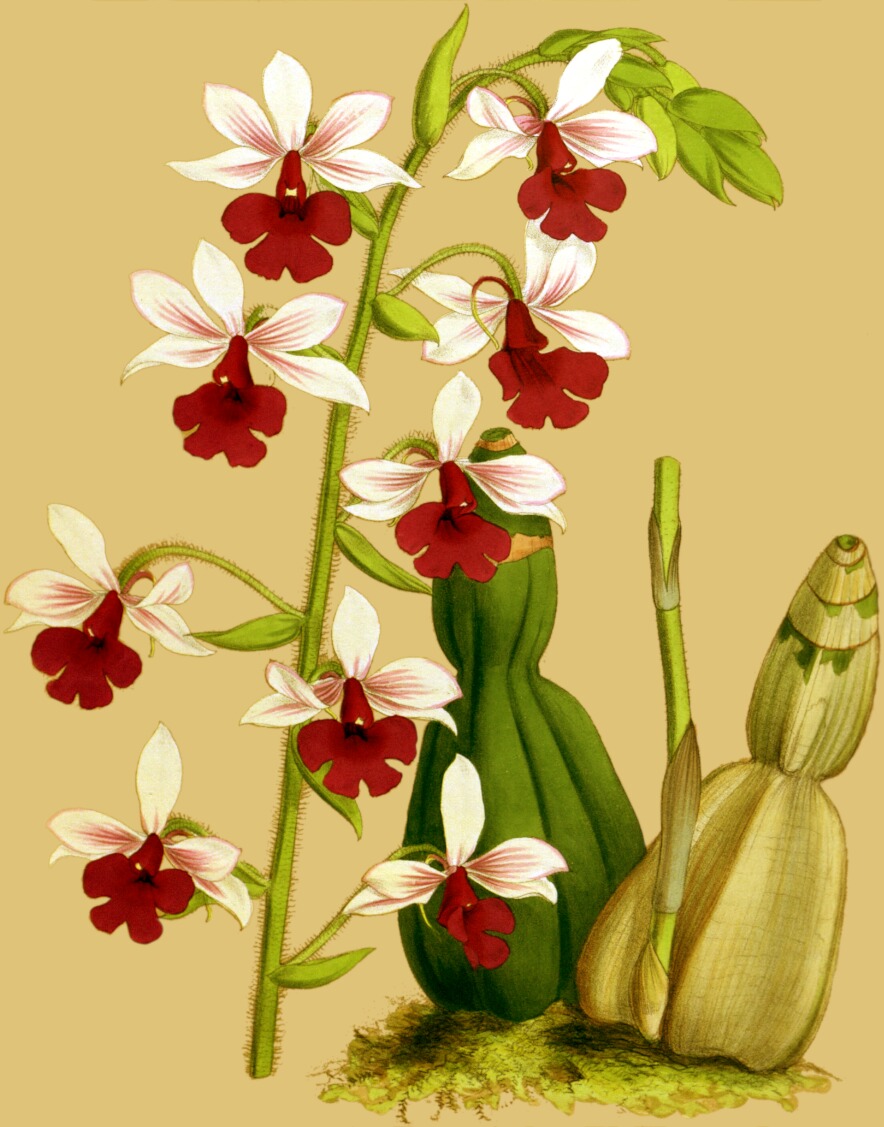
Pl. 134. CALANTHE VESTITA WILLIAMSII.
75