ODONTOGLOSSUM NEVADENSE. [Plate 131.] Native of New Grenada.
Reading edition
ODONTOGLOSSUM NEVADENSE. [Plate 131.] Native of New Grenada.
Epiphytal. Pseudobulbs large, oblong-ovate, compressed, about three inches high and two inches broad, diphyllous. Leaves lorate-lanceolate, keeled, very much narrowed to the base, of a dark green. Scapes radical, bearing drooping racemes of from twelve to fifteen blossoms. Flowers large and pleasingly coloured; sepals spreading in a narrow triangle, lanceolate, slightly grooved in the centre, clear bright chestnut, with a narrow even edge of yellow; petals smaller, lanceolate, spreading, an inch and a half long, of the same colour as the sepals but with more distinct yellow tips, and about two forked bars of a pale yellow colour at the base, opposite the lateral lobes of the lip, the margin slightly wavy; lip white, three-lobed, the lateral lobes erect, crescent-shaped, spotted with chestnut, the broad rounded front lobe deeply fringed, cuspidato-acuminate, the base cuneate, channelled, the disk with a bifid crest, and three obcuneate conical brown spots. Column erect, half-an-inch long, galeate, spotted with red, and having two short horn-like lateral auricles.
Odontoglossum nevadense, Reichenbach fil., MS. in Horto Lindeniano ac Mendeliano; Id. Xenia Orchidacea, ii., t. 191, figs. 1, 2; Id. Gardeners’ Chronicle, N.S. xv., 136; André, L’Illustration Horticole, 3 ser., t. 45.
The Odontoglossum nevadense is a very distinct and also a very rare and beautiful species which was first discovered in 1868, by Mr. G. Wallis, when travelling for Mr. Linden in the Sierra Nevada of New Grenada. It is not often met with, as there are very few plants of it in cultivation, so far as we know, but we may hope that our energetic collectors will be fortunate enough to meet with and send home a further supply of so lovely a plant. We are indebted to Dr. Boddaert, of Gand, Belgium, for the materials which have been used in preparing our illustration, the plant from which our plate was copied having been grown in his fine collection of Orchids; this was the best specimen of the kind which we have seen, and was, when in bloom, an object of attraction of which Dr. Boddaert might well be proud.
In this Odontoglossum nevadense we have a compact-growing evergreen species, with small pseudobulbs, and light green foliage; it grows about ten inches in height, and produces its spikes of elegant flowers during the spring and summer months. The sepals and petals are reddish-brown, margined and tipped with yellow; the lip is white, its side lobes spotted with brown inside. It lasts about six weeks in beauty.
70
This species is best grown in a pot, with rough fibrous peat as a compost, and good drainage. It should have the same treatment accorded to it as that given to Odontoglossum Alexandræ as regards water, and the temperature of the Odontoglossum house. Dr. Boddaert grew his specimen with the rest of his Odontoglots, and found it to succeed well under this régime, the plant continuing to increase in size and in value.
The following New Orchids were exhibited at the meeting of the Royal Horticultural Society at South Kensington on February 12th, and were severally awarded First Class Certificates:—
Cattleya Percivaliana alba.—A most chaste and beautiful variety of this novelty, having pure white sepals and petals, and a white lip marked with a blotch of yellow in the throat. Exhibited by R. P. Percival, Esq., Birkdale, Southport.
Lælia anceps Williamsiana.—A new variety of Lælia anceps, exhibited by Messrs. F. Sander & Co., of St. Albans. The sepals and petals are pure white, of good form, and stout substance; the lip white, having a yellow patch at the base, and a yellow throat striped with deep crimson-purple.
Odontoglossum Alexandræ (crispum) aureum.—A very striking novelty, with clear yellow flowers. The sepals and petals are of a deep lemon yellow, the sepals spotted with brown, and the lip having one or two spots of a similar colour. Exhibited by F. A. Philbrick, Esq., Bickley.
Odontoglossum Pollettianum.—This plant was much admired on account of the distinct markings of the flowers. The sepals and petals were white, tinged with purple, and heavily spotted with reddish brown; the lip being wedge shaped, as in O. Andersonianum. It is, doubtless, one of the many natural hybrids between O. Alexandræ and O. gloriosum. Exhibited by H. M. Pollett, Esq., Bickley.
Oncidium anthrocene.—In growth this plant somewhat resembles Miltonia Warscewiczii (O. Weltoni), but it is quite distinct in the character of its flowers, and in its branched inflorescence. The sepals and petals are much undulated, brown, faintly barred with yellow towards the base; the lip is yellow, spotted with brown, and very distinct. Exhibited by Messrs. F. Sander & Co., St. Albans.
Oncidium Jonesianum.—A new and distinct species, having terete foliage eight to twelve inches long. The flowers are about two inches across, greenish yellow, with reddish brown spots, the lip white spotted with red. Exhibited by A. H. Smee, Esq., Wallington.
The following were also submitted to the meeting:—
Vanda Cathcartii.—There was a well-grown specimen of this fine species exhibited by Mr. Aldous, gardener to G. Heriot, Esq., Highgate, bearing three spikes consisting of eleven flowers. It is a pity we so seldom see this plant, as it is a real beauty. The plant was deservedly awarded a Cultural Commendation.
Mr. Philbrick exhibited flowers of a fine series of Cattleya Trianæ, among which some very nice varieties both of the light and dark coloured sections.
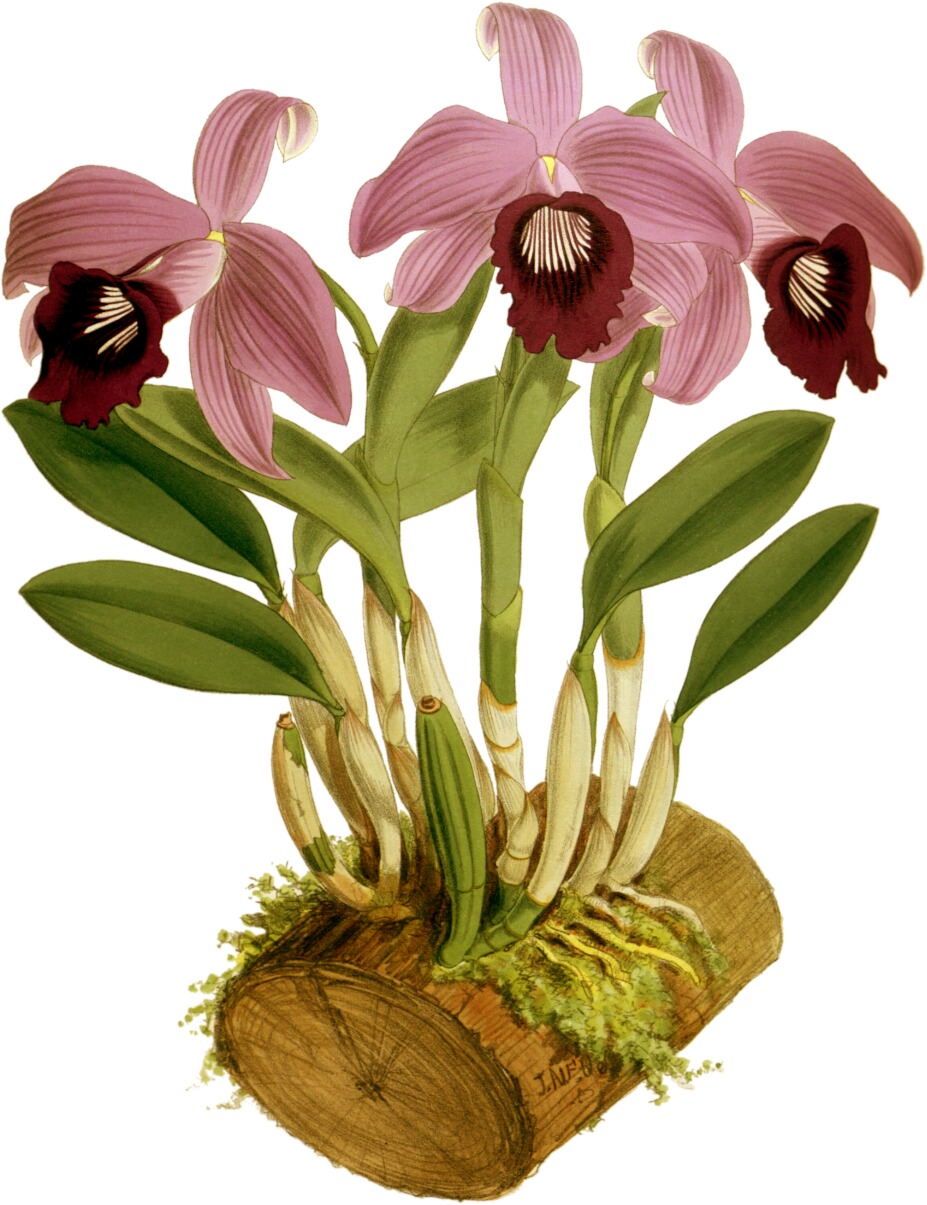
PL. 132. LÆLIA DAYANA.
71