LÆLIA ELEGANS PRASIATA. [Plate 97.] Native of Brazil.
Reading edition
LÆLIA ELEGANS PRASIATA. [Plate 97.] Native of Brazil.
Epiphytal. Stems erect, clustered, terete, clavate, jointed, about one and a half foot high. Leaves in pairs at the top of the stems, linear-oblong, obtuse, coriaceous, deep green. Racemes short, erect, six to eight-flowered, issuing from an oblong purplish compressed bract, the peduncles and pedicels green. Flowers large and showy, five inches across; sepals about three inches long, oblanceolate, the edges revolute and the tips recurved, of a light magenta-rose, paler towards the base, having a greenish tint along the centre, and a distinct flush of purple; petals obovate-lanceolate, acute, an inch broad, of a deeper rose than the sepals, and having a flush of green, the margins undulated; lip three-lobed, the lateral lobes elongate, white, rolled over the column, tinted with rose at the edges; and of a bright rosy crimson at the tips; the front lobe an inch and three-fourths in breadth, transversely-reniform, crenate and much undulated at the margin, of a rich magenta-crimson, traversed by veins of deeper crimson, the veins most evident in the centre where the ground colour is paler; disk smooth. Column clavate, marginate, enclosed.
Lælia elegans prasiata, Reichenbach fil., in litteris, 1863; Id. Botanische Zeitung, October, 1864; Id. Gardeners’ Chronicle, N.S., xix., 11 (sub-variety).
The Lælias form a glorious class of Orchids, including many noble species which certainly rank amongst the most beautiful of the whole family. Their flowers embrace nearly every shade of colour, including bright orange, yellow, pure white, magenta, rose, and many others. They are all extremely beautiful, notwithstanding that some of them produce large flowers, while those of others are much smaller, for the latter are often of a more brilliant colour than the larger kinds, which is an ample compensation. The whole family, without exception, is well worth growing.
The particular form we now bring before the notice of our readers is a very handsome variety, and when first bloomed had the flowers prasiato aspersis; it is of the same type as Lælia Turnerii, of which there is a grand plate in the first series of Mr. Warner’s Select Orchidaceous Plants. Our illustration was prepared from a drawing taken from a specimen, bearing two spikes, and which produced six beautiful flowers on each, in the select collection of Baron Schröder, The Dell, Staines.
Lælia elegans prasiata is an evergreen plant, producing stems or pseudobulbs about eighteen inches high, furnished with two leaves which are six inches long and of a dark green colour. It produces its flowers from the new bulb when it has completed its growth, and they issue from a sheath, six or more together. The sepals and petals are of a dull magenta, tinged with green, the lip being of a bright magenta, while the external port of the lateral lobes, where they roll inwards over 2 the column, is white. The flowers are very fragrant, the scent being a mixture of “May” and “Gardenia.”
This plant blooms during September and October, and lasts in beauty for about three weeks. We find it requires the same treatment as Lælia purpurata. It should, moreover, be grown in similar material, namely, good fibrous peat, with perfect drainage, and as much light as possible. Mr. Ballantyne, the gardener at the Dell, cultivates this with his Cattleyas, which are well grown, there being among them some wonderful specimens, many having over a hundred pseudobulbs. When in bloom, these plants are quite worth a journey to see.
The Manchester Whitsuntide Exhibition of 1883 was a great success. Over £2,000 was taken at the gates. We generally make a point of jotting down a few notes concerning this show, as its chief attraction consists of the Orchids, in which of course our readers are most interested. Although the show had lost several of its largest supporters, such as Mr. Percival, Mr. Hardy, and the late R. B. Dodgson, Esq., of Blackburn, there were others who exhibited in strong force. We will mention a few of the most noteworthy of the plants. O. Schneider, Esq., showed a very fine collection, including Cattleya Mendelii, a grand variety with sixteen flowers; also a splendid plant of C. Mossiæ, with over twenty beautiful flowers; and Dendrobium Devonianum, a splendid plant with its long stems bearing over two hundred flowers; in front of this was Odontoglossum Pescatorei, with fourteen spikes of its lovely white and spotted flowers; and a fine Lælia purpurata, with its rosy sepals and petals, and bright crimson-purple lip. Dr. Ainsworth exhibited some very fine specimens of Dendrobium thyrsiflorum, with fifteen of its beautiful spikes; the pure white Phalænopsis amabilis, a splendid mass with twelve spikes and a hundred flowers; a wonderful specimen of Vanda suavis, with twelve spikes; Phalænopsis grandiflora, with more than fifty flowers; and Aërides Fieldingii, a fine specimen with five spikes and six branches. Mrs. Leach, of Gorse Hall, Stalybridge, exhibited six good plants, among them was a fine Cattleya Mossiæ, with a splendid dark lip; also Dendrobium nobile, fine, and the beautiful Odontoglossum Hallii. There were some fine specimens exhibited from the collection of W. Leach, Esq., Fallowfield, among which was a wonderful plant of Dendrobium Falconeri, with two hundred flowers; next to this was the curious Cypripedium caudatum, with six spikes, also Aërides crasssifolium, and other good Orchids. Mr. Upjohn exhibited a wonderful Vanda tricolor, the finest-grown plant we have seen, with five spikes. Mr. Hodgkinson exhibited a very fine variety of Vanda suavis with three spikes. Mr. James, of Norwood, Surrey, exhibited two fine collections, including a wonderful plant of Dendrobium Paxtoni; Cattleya Mendelii, with ten flowers; Masdevallia Harryana, a fine variety; a good plant of Dendrobium Jamesianum, with thirty-six flowers, and many other fine specimens. Mr. Cypher, of Cheltenham, also showed some good plants, among which we remarked a fine Dendrobium Freemanii, with one hundred flowers of a beautiful colour; D. Devonianum, with two hundred of its lovely blossoms; also some other good plants. Messrs. Ireland & Thomson, of Edinburgh, also exhibited a very fine collection of cut Orchids that was much admired.—B. S. W.
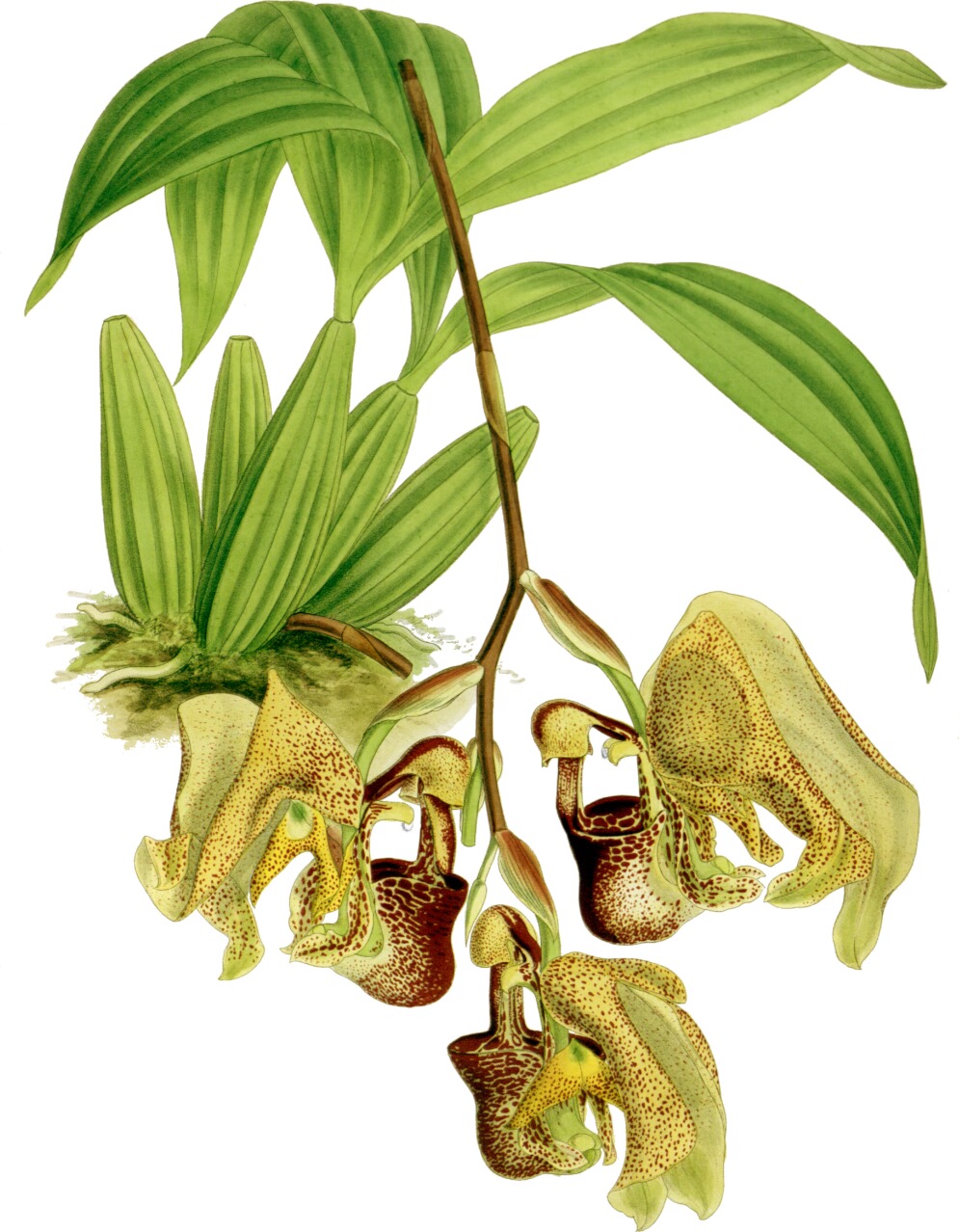
PL. 98. CORYANTHES MACULATA PUNCTATA.
3