PILUMNA NOBILIS. [Plate 128.] Native of Colombia.
Reading edition
PILUMNA NOBILIS. [Plate 128.] Native of Colombia.
Epiphytal. Pseudobulbs elongate-oblong, compressed, narrowed to the top, three to four inches or more in length, clustered, monophyllous. Leaves broadly oblong, acute, narrowed to a cuneate base, keeled. Scape radical, from four to six inches high, about four-flowered, with two or three oblong acute scarious bracts below the raceme. Flowers half expanded, white, with two orange-coloured spots in the centre, the club-shaped furrowed ovary decurved; sepals linear-lanceolate acuminate, undulated, narrowed to the base, pure white; petals similar to the sepals both in size, form, and colouring; lip indistinctly three-lobed, subquadrate, the rounded side lobes meeting over the throat, the front lobe larger, retuse, one and three-quarter inch broad, having on each side of the throat an orange-coloured blotch, the blotches meeting to form a central eye, and a slightly elevated line at the narrow base; the claw adnate to the base of the column, and then involute, so as to enclose the upper part of this organ. Column clavate, terete.
Pilumna nobilis, Reichenbach fil., in Linnæa, xxii., 843; Id. in Walpers’ Annales Botanices Systematicæ, iii., 541.
Pilumna fragrans grandiflora, Linden, Catalogue.
Trichopilia fragrans nobilis, Linden et André, L’Illustration Horticole, 3 ser., t. 94.
This small genus was established for the Orchid known as Pilumna fragrans, a species bearing considerable resemblance to our present subject but having smaller flowers. The great authorities—Reichenbach, Bentham, &c.—now refer these plants to the genus Trichopilia, but we have hesitated to follow them, as they appear sufficiently different from the Orchid growers’ point of view to be allowed to enjoy the distinct appellation which was originally given to them by Dr. Lindley, the greatest of English authorities on Orchidaceous plants.
This pretty epiphyte, then, may be taken to represent a small genus of interesting and useful—because free-blooming—plants. The particular species now illustrated and described, is a very lovely plant, and can be recommended as one of the best to be grown for decorative purposes, the flowers being extremely useful for bouquets and button-holes. They are pure white in colour, and have a delicious fragrance, and these are qualities which will always cause them to be held in favour.
This Pilumna is a species of free-growing habit, and very free in producing its flowers. It requires cool treatment, and takes but little room; moreover, it can 64 be purchased at a moderate price, so that any one that has a small house will be able to obtain it, and when obtained to manage it. Thus it will be apparent that it is a most useful plant. Our drawing was taken from a plant which was cultivated in the Victoria and Paradise Nurseries, Upper Holloway.
The Pilumna nobilis is an evergreen Orchid, and is furnished with dark shining pseudobulbs four to six inches or sometimes more in height, and dark green leaves about six inches in length. The flowers proceed from the base of the pseudobulbs, three to four together in a loose raceme, and are of a pure milk-white, with a pair of clear orange-coloured spots, which impart a peculiar brightness to the throat; these flowers, which are very fragrant, are produced during the autumn months, and each lasts about two weeks in perfection.
We find the plants to thrive when grown in pots or baskets, with rough, fibrous peat and good drainage. They need a moderate amount of moisture during the period of growth, but when at rest less may be given, merely enough to keep the bulbs in a plump state. They will thrive well in the Odontoglossum house.
Lælia anceps.—We were very much surprised when calling on R. P. Percival, Esq., of Southport, to see the well-grown specimens of Lælia anceps to be met with in his admirable collection of Orchids. On the side stage of one house there were 230 spikes of this charming Lælia just ready to burst their flower buds, some being open, and presenting to view their fine richly-coloured lips, and their rose-coloured sepals and petals. Some of the spikes, too, bore as many as four full-sized flowers. This group must have formed a most gorgeous sight during the dull time of year, namely, during November and December. Some of these plants, moreover, were producing as many as thirteen spikes, others a lesser number. This species is, as it deserves to be, a great favourite with Mr. Percival. There was among them a fine specimen of L. anceps Percivaliana, a most beautiful form, producing fourteen spikes of its chaste flowers, the sepals and petals of which are blush-white and the lip rosy purple.
There were many other fine Orchids to be seen here. We must congratulate Mr. Percival on being so successful with his Cattleyas, which, when in bloom, must have been a grand sight, especially the varieties of C. Trianæ, C. Mendelii, and C. Mossiæ, which, between them, were producing many hundreds of flower-sheaths. Of C. Percivaliana there were five plants throwing up their spikes, and they looked very promising and distinct; doubtless, as in the case of other types of Cattleyas, there will be many forms of this new species.—B. S. W.
[Since the above was written Mr. Percival has exhibited one of these plants at South Kensington, and obtained for it a First Class Certificate. The flowers are not so large as in C. Mossiæ, but the lip is very richly coloured—a velvety crimson-purple with a border of pale rosy purple.]
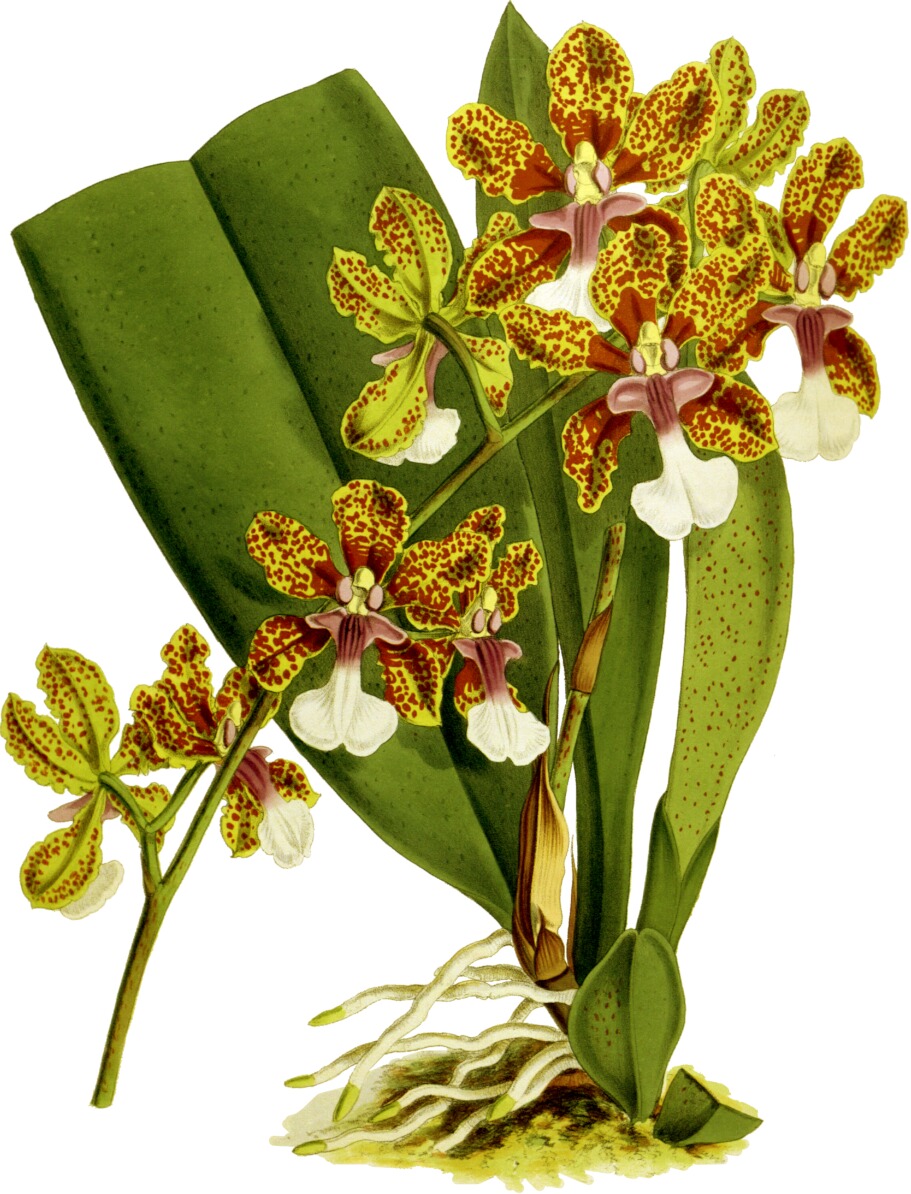
PL. 129. ONCIDIUM LANCEANUM LOUVREXIANUM.
65