MAXILLARIA LUTEO-ALBA. [Plate 106.] Native of Colombia.
Reading edition
MAXILLARIA LUTEO-ALBA. [Plate 106.] Native of Colombia.
Epiphytal. Pseudobulbs large, about two and a half inches high, ovate obtuse, compressed, clustered, bearing at the apex a solitary leaf. Leaves stalked by the folding of the basal portion, oblong obtuse, a foot long or more, of a dark green colour. Peduncles radical, about half the length of the leaves, invested throughout with green sheathing bracts. Flowers large and peculiar in form, triangular in outline, and measuring about six inches from the top of the dorsal to the top of the lateral sepal, brownish externally; dorsal sepal linear-oblong, acute, three inches long, of a tawny yellow in the upper two-thirds of its length, the basal third white, lateral sepals of the same form, size, and colours, but twisted; petals two, erect, or somewhat projecting like two horns, ovate oblong, about half as long as the sepals, white at the base, with a few splashes of purple, yellow at the tip, with a blotch of pale brown of about equal size between; lip concave at the base, hairy, the margins undulated, three-lobed, the lobes obtuse, the lateral ones short, erect, yellow, striped with purple, the front one oblong, emarginate, recurved, the central portion convex, yellow, the margins paler, whitish. Column short, curved, creamy-white.
Maxillaria luteo-alba, Lindley, Orchidaceæ Lindenianæ, 20; Reichenbach fil., in Walpers’ Annales Botanices Systematiceæ, vi., 516; Id. Bonplandia, ii., 15, 280.
The Maxillarias form a genus of Orchids not much appreciated by many growers, but of late there has been greater variety introduced among them, and they are becoming more popular in cultivation. Some of the better and more showy kinds are quite worth bringing before our readers, as they are free-growing plants, and most of them may be kept along with the cool Orchids.
Our figure of Maxillaria luteo-alba was taken from a plant we flowered at Holloway, and exhibited at one of the meetings of the Royal Horticultural Society, and for which we were awarded a First Class Certificate. We bloomed it many years ago, but we found that Orchid growers of the present day had many of them not seen it. We find it very useful for cutting purposes, as it flowers when the plants are small, which in our opinion is far better than making large specimens. When they get too large we cut them into several pieces, and grow them on again for blooming. The flowers having stalks about six inches long, may be cut without damaging the plants; they are extremely useful for button-hole bouquets, which are so much in request at the present day.
Maxillaria luteo-alba is an evergreen plant, with dark green foliage, and grows about eighteen inches high. The flowers proceed from the base of the pseudobulbs 20 at different times of the year. The sepals and petals are of a yellowish brown, and the lip yellow margined with white, the throat being striped with purple.
We find this species succeeds well in the cool house, with Odontoglossum Alexandræ; good fibrous peat suits it well, and it requires good drainage, with a liberal supply of water at the roots when it is in vigorous growth, as it is a free-rooting plant. After the growth is completed it should have only sufficient water to keep the pseudobulbs in a fresh plump state. A little shade is beneficial to the foliage of the plant in summer, but it should be grown as fully exposed to the light and as near to the glass as possible. Under this treatment it will be found to grow freely.
Renanthera Lowii.—This noble plant, also known as Vanda Lowii, has bloomed very finely in the collection of Baron Alphonse de Rothschild, at Ferrières, near Paris, this being the finest and best grown specimen we have seen. The main stem is about six feet high, with four growths from it, and every leaf is perfect, which is rarely the case. It bore eleven of its charming pendulous spikes or racemes of flowers, each spike extended to the length of nine feet; it had a noble appearance. with its reddish brown flowers, marked by irregular lines of greenish yellow; but the most curious part connected with the inflorescence of this plant is, that at the base it produces two blossoms of a tawny yellow, spotted with crimson, quite dissimilar from the others. The plant in question is a most remarkable one, and we may say that it is the finest specimen we have had the good fortune to behold. Great credit is due to Mr. Bergman for the production of such a specimen. The eleven spikes were, we understand, cut and sent to the Baroness in London. Gardening is well carried on at Ferrières; every department is well kept. There are many thousands of plants grown for purposes of decoration, which is kept up through the whole year. The mansion is a splendid structure, and the grounds are beautifully laid out, abounding with fine trees, and provided with lakes. In fact, it is one of the finest and best kept garden establishments we have seen, and great praise is due to those who have the management of it.—B. S. W.
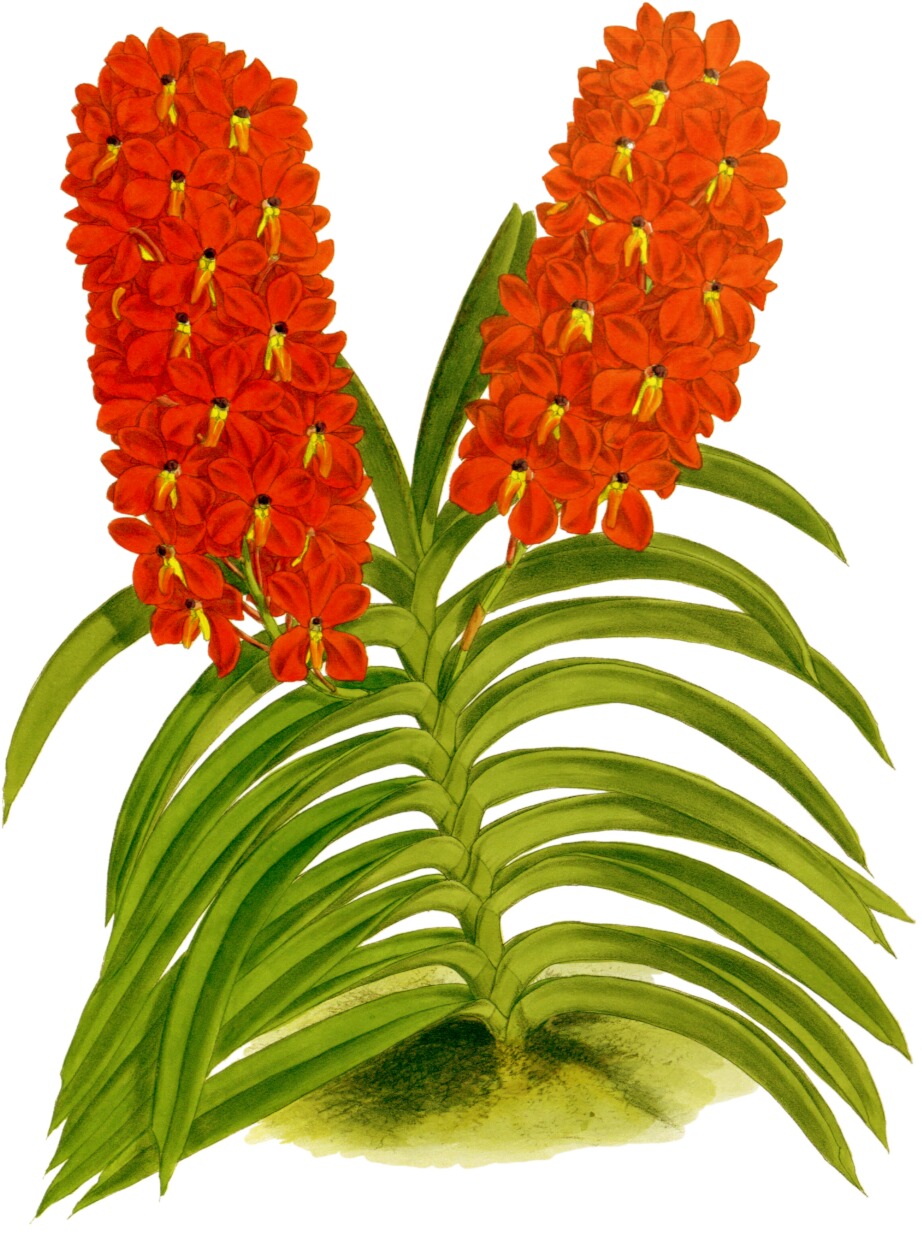
PL. 107. SACCOLABIUM CURVIFOLIUM.
21