CATTLEYA TRIANÆ FORMOSA. [Plate 108.] Native of Colombia.
Reading edition
CATTLEYA TRIANÆ FORMOSA. [Plate 108.] Native of Colombia.
Epiphytal. Stems oblong, club-shaped, furrowed, the lower parts enveloped in whitish membranaceous sheaths. Leaves solitary, coriaceous, ligulate-oblong, obtuse, emarginate, deep green. Scape two to three-flowered, proceeding from a terminal oblong compressed bract or sheath. Flowers large, six inches in depth and seven inches in breadth, richly coloured; sepals lanceolate, acute, about three-fourths of an inch broad, blush or very dilute rosy-purple; petals much broader—two and a half inches, having the margins much undulated, of the same blush or pallid purple hue as the sepals; lip well displayed, convolute at the base so as to enclose the column, and of a pallid purplish colour, the apical portion roundish, emarginate, and expanded, nearly two and a half inches across, the margin including the portion surrounding the throat, very much undulated so as to form a crenate-lobate frill, the surface for about two-thirds of the front of a deep rich magenta-purple, the disk and throat orange-yellow, the upper edge paler, and the magenta tint passing backwards in streaks over the disk.
Cattleya Trianæ formosa, Williams MS.
We now present to our readers a portrait of a most splendid variety of Cattleya Trianæ, of which them are numerous handsome forms, varying in colour from rose to crimson and magenta, and also to pure white, with intermediate tints. During the past five years there have been very large importations, but none that we have seen surpass the varieties we have already in cultivation, such as Dodgsoni, Osmanii, Russelliana, and Williamsii. These varieties are most difficult to improve upon, but probably we shall get other splendid forms among the large importations as they come to us from the different districts which the species inhabits. The Trianæ section has given us a grand lot of varieties for winter decoration especially; there are very many distinct types among them, and they come into blossom at a time, during the dull months of winter, when flowers are wanted to make our houses gay. Our drawing was taken from a very large specimen that has been grown and bloomed by us for several years, and which we consider one of the most beautiful varieties in cultivation—we believe our plate will show us to be fully justified in so doing.
Cattleya Trianæ formosa is a free and strong-growing evergreen kind, attaining fifteen inches high, with dark green foliage and strong sheaths. The flowers are of large size and substance, and are thrown well up so as to have a bold appearance, much more so than many others of its class. The sepals and petals are of a blush 24 pink, and the lip rich rose-magenta, being beautifully frilled and edged with a lighter tint of the same colour, two and a quarter inches in diameter, have the throat orange veined with a deeper orange. The flowers are produced in February and March, lasting for several weeks in beauty.
It thrives best in a pot with rough peat and good drainage, and requires the same treatment as C. Mossiæ and C. Trianæ, beginning to grow after it has finished blooming. These make their flower sheaths in summer, much earlier than most of the Cattleyas, which secures to this section more light and heat in which to finish off their growth before winter sets in. Their pseudobulbs must be kept dry during winter, as if allowed to get wet they will probably rot away; therefore, when their growth is finished, give only sufficient water to keep the pseudobulbs in a plump state.
Orchids at Gouville.—The Comte de Germiny, Chateau de Gouville, France, has a noted collection of Orchids, which we recently had the pleasure of visiting. We found many grand specimens that interested us exceedingly, including fine Cattleyas, Lælias, Saccolabiums, Aërides, Vandas, Angræcums, Cypripediums, Phalænopsis, &c. We gave a short notice of this splendid establishment in our second volume, and now confine our remarks to the specimens we saw in flower. Of Cattleya labiata pallida there were two wonderful specimens, with over one hundred pseudobulbs on each; the first had forty-eight expanded flowers on it, and the other twenty-eight, a most gorgeous sight. Contrasting well with these were several good plants, in full bloom, of Epidendrum nemorale majus, with their drooping spikes of showy delicate rose-coloured flowers. These were backed up with a fine specimen of Sobralia macrantha, bearing thirty spikes of its rich purple and crimson flowers, of a large size. Then came Epidendrum vitellinum majus, suspended on a block, with twelve spikes of its bright orange-scarlet flowers, which always form a fine contrast with the surrounding colours. Near this were fine specimens of Cattleya crispa superba, and a specimen of Cattleya Mendelii. There were also some fine Vandas in full beauty, as well as Oncidiums with bright yellow blossoms, and Dendrobium suavissimum, with orange yellow and brown spotted flowers. A fine specimen of Epidendrum prismatocarpum was showing fourteen spikes. M. Rondeau, the energetic gardener, informed us that they had at one time three hundred and ninety expanded flowers of Cattleya Mossiæ, Mendelii Warnerii, and others, which must have been a gorgeous sight; also Cattleya citrina, different plants, that produced fifty-two of their yellow fragrant flowers. It is always a delight to a lover of good plants to visit a place where gems like these are the pride of the owner; and in this case we found that the Comte de Germiny not only has a good knowledge of his plants, but took the greatest interest in showing them to us.—B. S. W.
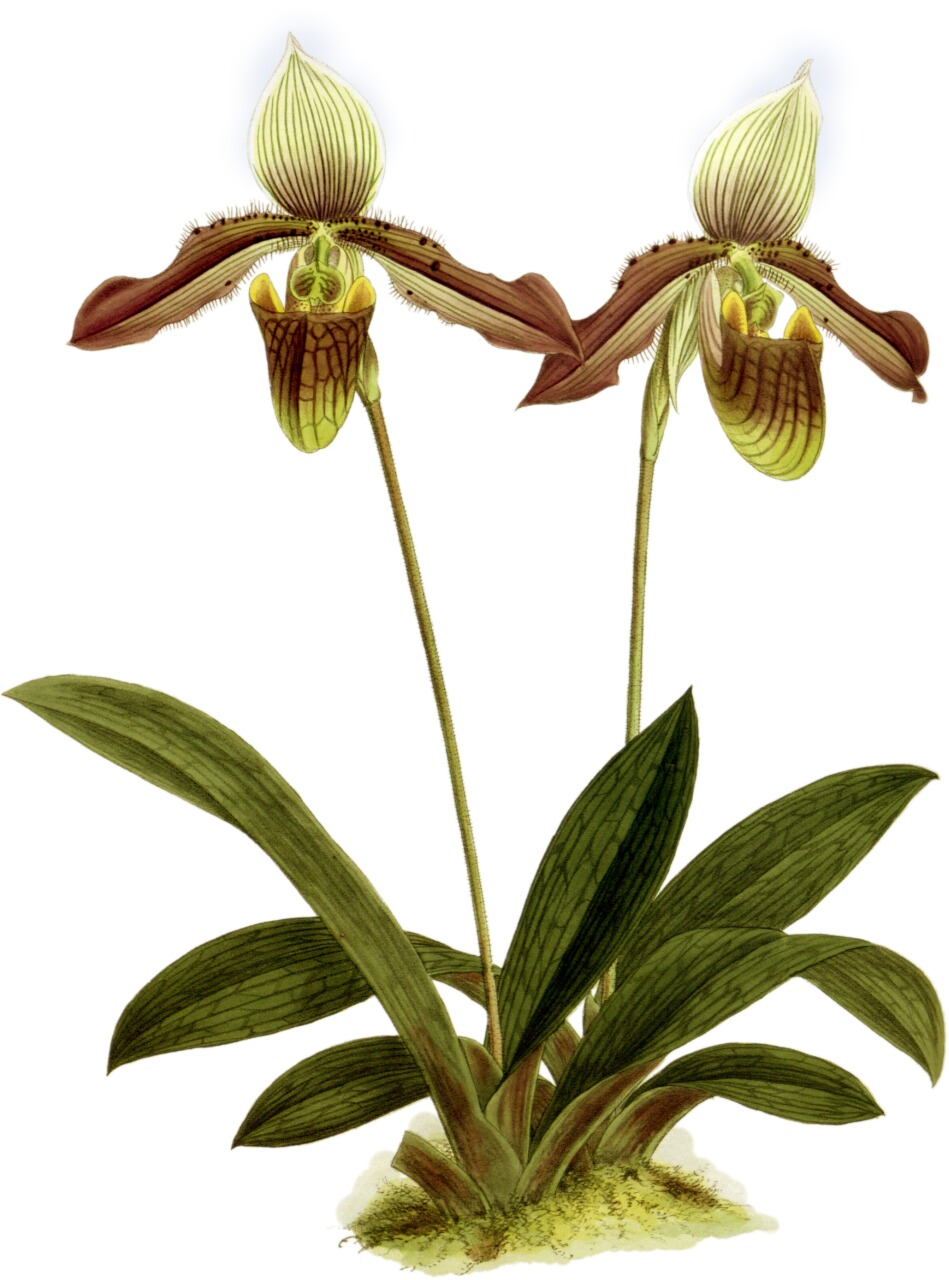
PL. 109. CYPRIPEDIUM MELANOPHTHALMUM.
25