CATTLEYA WHITEI. [Plate 115.] Native of Brazil.
Reading edition
CATTLEYA WHITEI. [Plate 115.] Native of Brazil.
Epiphytal. Stems clavate, furrowed, monophyllous. Leaves short, ovate-oblong, coriaceous. Racemes three-flowered, issuing from a pair of oblong-obtuse compressed sheathing bracts. Flowers medium-sized, very handsomely coloured; sepals ligulate-oblong, entire, recurved at the edge, of a deep rosy tint with a flush of olive green, which is more evident on the outer surface and at the tips, about as long as the lip, the dorsal one longer, the lateral ones falcately deflexed, all acute with the tips recurved; petals broader (an inch and one-eighth wide), ovate-oblong, acute, undulated towards the recurved apex, of a bright magenta-purple; lip two and a half inches long, stipitate, the lateral lobes truncate with the upper angle acute, pale blush towards the base, where they are rolled closely over the column, the tip which is recurved tinted with magenta, the lower side of the tube and throat bright yellow; front lobe of lip an inch long and an inch and a half broad, roundish reniform, with the edge neatly undulated, and distinctly fimbriate-denticulate, the ground colour magenta-rose, veined closely all over except the extreme edge, which is white, with deep crimson-magenta, the veins running back in a wedge-shaped figure to just within the tube, where they pass to crimson; a strong central line of magenta passes half way down at the back. Column clavate, semiterete, the edge thin, almost wing-like, whitish with a tint of blush at the apex.
Cattleya Whitei, Reichenbach fil., Gardeners’ Chronicle, N.S., xviii., 586.
This most beautiful Cattleya is of recent introduction, and is one of the most rare, chaste and distinct kinds that has been introduced of late. It is supposed to be a natural hybrid, the result of insect fertilisation in its native country. The specimen in the hands of Holbrook Gaskell, Esq., Woolton Wood, Liverpool, in whose fine collection it bloomed in July last, and through whose kindness we have been enabled to figure it, is believed to be the only plant ever imported; and we must congratulate the owner on his being the means of bringing such a magnificent species to the notice of Orchid growers. It is very gratifying to find that so many new forms of Cattleya, both species and varieties, have been brought home by our collectors within the last few years; they are grand acquisitions to our collections, as there are no other Orchids that make such an effective display. Now that there are so many and such varied kinds introduced, we shall be able to have Cattleyas in bloom all the year round, by procuring the different species and varieties which are of nearly all shades of colour, many of them being very brilliant and distinct. We are glad to know there are some kinds that will do in cooler houses and others of them are small-growing species, which will increase their value to those who have only small houses in which to grow them.
38
Cattleya Whitei is an evergreen plant with handsome, good-looking dark green foliage. In growth it is much like the dark variety of C. labiata, its foliage and pseudobulbs being similar; it produces three flowers on a spike, the sepals and petals being bright magenta-crimson, with a flush of brown on the front portion, the lip pale magenta distinctly veined with intense magenta-crimson, and the throat bright yellow. It blooms in July, and Mr. Davies, the gardener, tells us that it lasts two or three weeks in beauty.
This novelty requires treatment similar to that given to C. Mossiæ and C. labiata—namely, to be potted in good rough fibrous peat, with thorough drainage. It should have the heat of the Cattleya house, with all the light possible, during the whole year, which will enable the plant to properly mature its stems and foliage, after which we may expect good results. A slight shading must be given during hot sunny days.
Orchids at Melrose, the residence of A. Curle, Esq.—We paid a visit to this place a short time since and were well pleased with the collection. The mansion is prettily situated on rising ground, well backed up with trees, while the view of the ruins of the old abbey in front gives the place a quaint aspect which renders it specially interesting to visitors. There is a range of glass houses consisting of vineries, and greenhouses. Then we come to the Orchid houses, in which there is a well-grown collection of these plants, which are doing well and making fine growth. The centre table has a row of good plants, such as Vanda tricolor Dalkeith variety, also a beautiful Vanda suavis which was reported to be a fine variety, and some other good Vandas. We, moreover, noticed a telling plant of Cattleya Harrisoniana violacea finely in bloom, which, with its violet-coloured flowers, is very showy. There are some grand specimens of Cattleya gigas, C. Mendelii, and C. Mossiæ, showing excellent growth, and many other Cattleyas and Lælias making rapid progress. Suspended from the roof we noticed a plant called Lælia pumila spectabilis, but it was not in blossom; since our visit, however, we have received a fresh bloom of it from Mr. Sharp, the gardener, and a most beautiful flower it is, being of good shape, the sepals and petals dark rose, the lip rich purple and of stout substance. The foliage is very dark which is the case with some of the varieties of L. præstans, of which there are several in cultivation, this being one of the best we have seen. In the same house was a good Vanda cœrulea showing fine spikes, and associated with it were some handsome forms of Cypripedium Spicerianum in bloom. We noticed also some well-grown specimens of Dendrobium Wardianum giganteum making strong growth, several plants being five feet high.
In the next house were many fine examples of Odontoglossum Alexandræ, O. Pescatorei, and others making good pseudobulbs; also Masdevallias and many other good plants. We noticed a splendid Zygopetalum Mackayi, so called, but we think it was distinct from any we have seen, the colour being intense, and the lip of a very rich purple.—B. S. W.
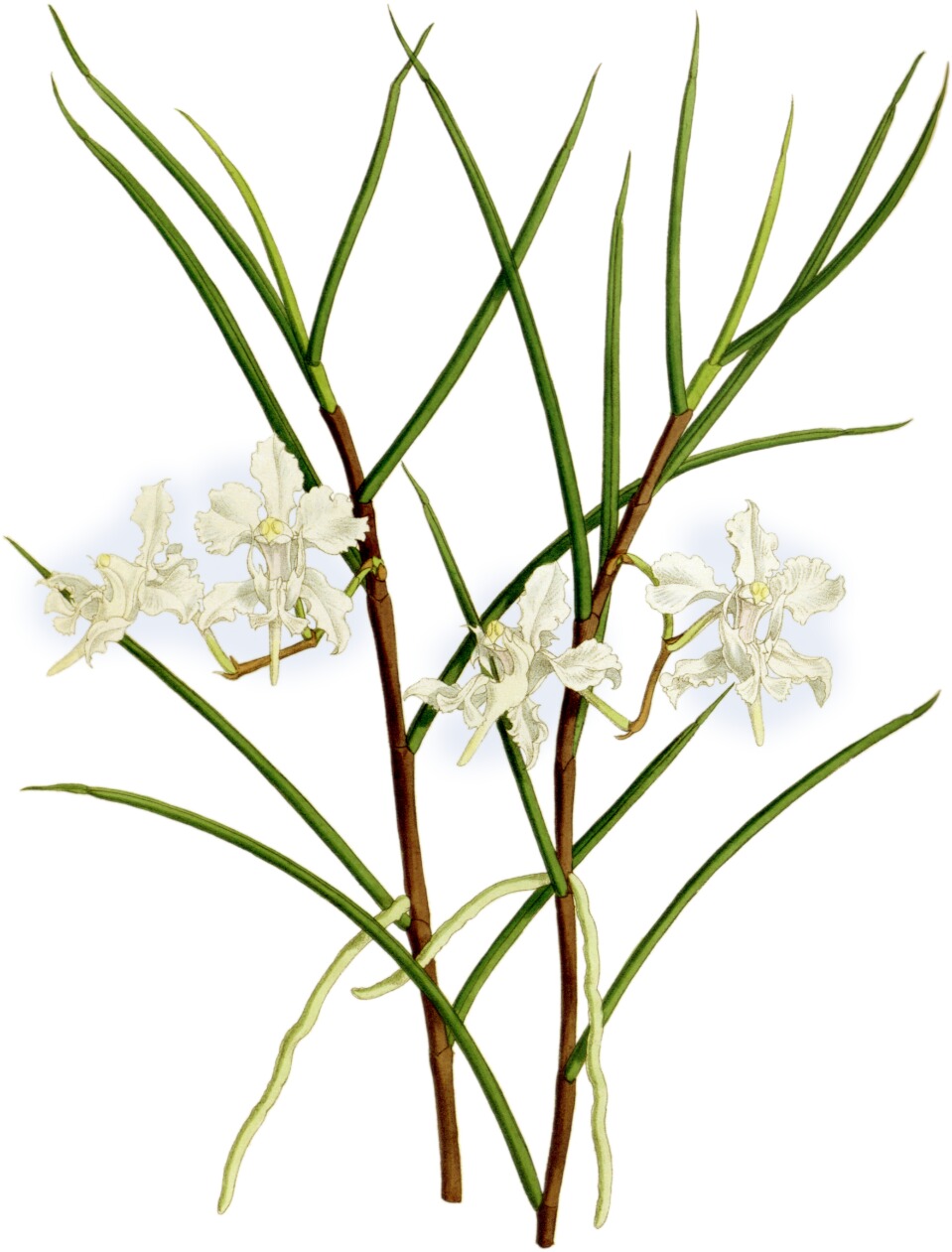
PL. 116. AËRIDES VANDARUM.
39