CYPRIPEDIUM CURTISII. [Plate 122.] Native of the Sunda Isles, Asiatic Archipelago.
Reading edition
CYPRIPEDIUM CURTISII. [Plate 122.] Native of the Sunda Isles, Asiatic Archipelago.
Epiphytal. Acaulescent. Leaves distichous, coriaceous, oblong acute, recurved, channelled and equitant at the base, of a dull green, the upper surface boldly chequered with oblong markings of darker green, the under side keeled with the surface paler and unspotted. Scape (peduncle) pubescent, dull wine-purple, with a short compressed ovate bract just below the ovary, which is green striped with brown. Flowers solitary, remarkable for the small dorsal sepal and large pouch; dorsal sepal short, ovate acuminate, curving from the base upwards, greenish with a white edge and about ten greenish-purple nerves; lateral sepals united, very small, ovate, greenish with green veins; petals measuring about four inches from tip to tip, linear-oblong, acute, wavy, recurved at the tips, greenish in the upper, white in the lower half, indistinctly veined with purple, and thickly spotted with small purple dots, the margin copiously fringed throughout with short purple hairs; lip with a large oblong bluntly-rounded pouch (one and a half inch long) of a dull wine-purple with a few prominent darker purple veins, the upper edge of the sac with narrow side angles greenish inside, the basal part with the edges rolled inwards and dotted with purple. Staminode transversely oblong, emarginate behind and having in front an inwardly curved tooth on each side with an apiculus between, pale yellowish green, with darker green reticulations in the centre.
Cypripedium Curtisii, Reichenbach fil., in Gardeners’ Chronicle, N.S., xx. 8.
This new species is both distinct and rare. It is, moreover, very beautiful and one that every lover of Cypripediums will be looking after. There are some cultivators who do not care for this class of Orchids, and there are some others who grow all the species and varieties they can procure, making the collecting of them a hobby. We can fully understand the pleasurable feelings of these latter, as the plants are ornamental in foliage as well as in flower, thus always keeping up a good appearance; they are also very easy of cultivation, and most of them take but little room to grow in. There are now so many species and varieties—blooming, too, at different periods of the year—that a good display of flowers may always be had from them; and there are some of the species that will do in the Odontoglossum and intermediate houses, added to which their long-enduring quality scores as a great point in their favour. We are never without Cypripediums in bloom.
The specimen we are now figuring was flowered by J. Day, Esq., of Tottenham, who, we are glad to say, after parting with one of the largest and most rare collections of Orchids at that time existing, is now fast forming another collection. We have 52 no hesitation in saying that Mr. Day has, to a greater extent perhaps than any other amateur Orchidophilist, a correct knowledge of the genera and species of Orchids. His first collection was of many years’ standing, and was the most complete as regards species and varieties that we ever saw; he not only had the plants under cultivation, but had besides many drawings taken by artists, and also took pleasure in sketching and painting them himself. We believe he still takes sketches of all the novelties which he himself blooms, as well as of some of those flowered by other growers, being a most proficient artist. All this shows what an intense love he has for this noble class of plants.
Cypripedium Curtisii, as will be seen by our drawing, is an evergreen plant with charmingly spotted foliage. The flowers are well thrown up above the foliage; the dorsal sepal is white veined with green, the petals crimson flushed with green and faintly veined and spotted with purple, and margined with a dense fringe of purple hairs, while the lip is large and of a reddish brown hue. This species blooms in July, and continues in beauty for several weeks. It requires the same treatment as C. barbatum and others of that class, and from its appearance we conclude that it will be found to be a free-growing as well as a free-blooming plant.
Zygopetalum Burkei.—This new species was exhibited by Messrs. Jas. Veitch & Sons at the meeting of the Royal Horticultural Society, on November 13th, and was greatly admired both on account of its distinct character and novel appearance. The pseudobulbs are about three inches long, carrying long narrow leaves; the sepals and petals are green transversely barred and spotted with brown; and the lip is white, and furnished with a crimson ruff or frill. It has been introduced from Guiana. Altogether this is a most distinct and desirable species, and we hope shortly to figure it.—H. W.
Cymbidium elegans.—W. McDonald, Esq., Woodlands, Perth, has kindly sent us a fine spike of this rare and distinct species. The spikes are very dense, and contain a large number of yellow flowers, which are very distinct. Mr. McDonald informs us that his plant bears seven spikes of flowers, a rather unusual number, and a fact which we think worth recording.—H. W.
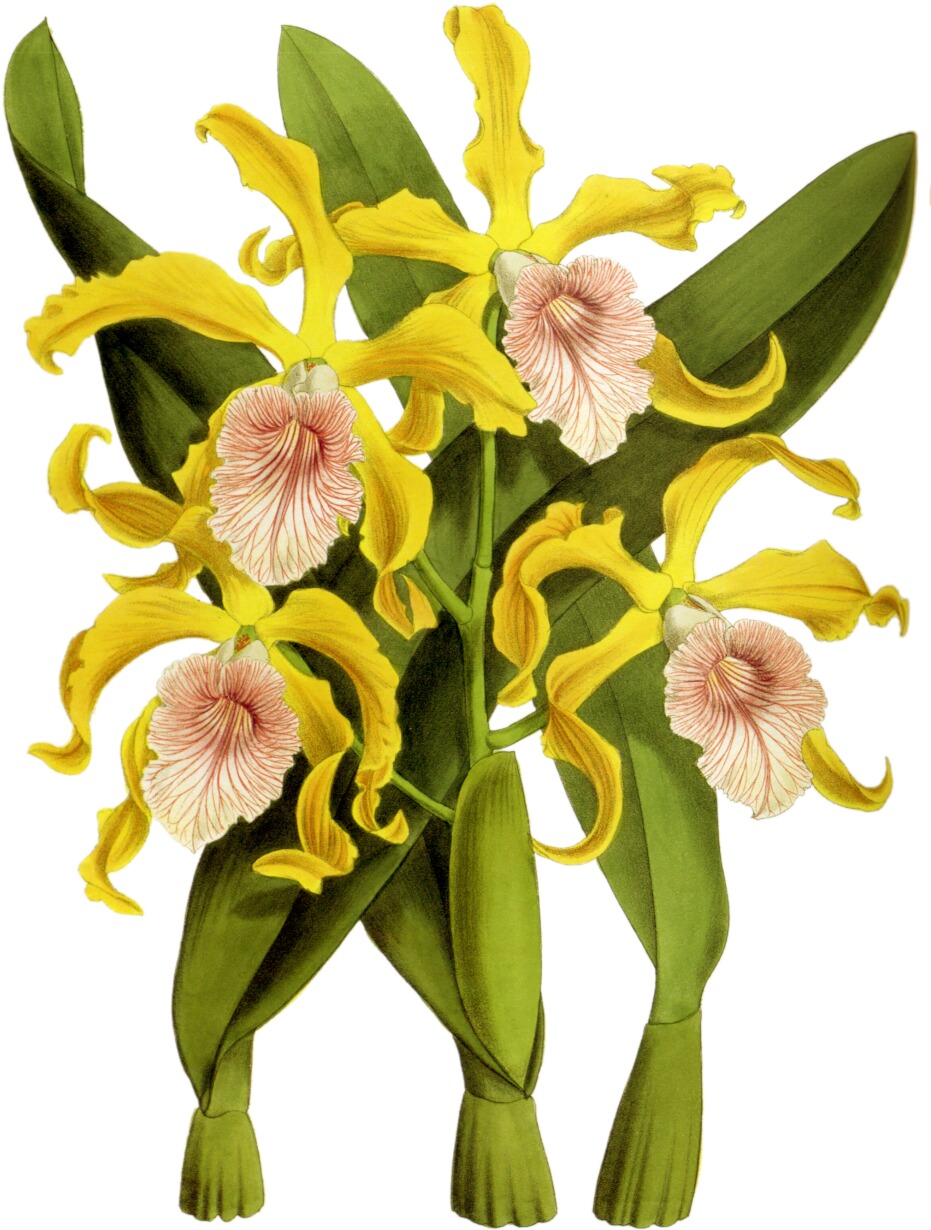
PL. 123. LÆLIA GRANDIS.
53