CYPRIPEDIUM SPICERIANUM. [Plate 119.] Native of Assam.
Reading edition
CYPRIPEDIUM SPICERIANUM. [Plate 119.] Native of Assam.
Epiphytal. Stemless, with spreading distichous evergreen foliage. Leaves few, oblong-ligulate, sub-acute, heeled beneath, and there purple-spotted towards the base, six to eight inches long or more, thick and leathery in texture, of a dull glossy green colour. Peduncles erect, issuing from an oblong compressed basal sheath, dark reddish-purple, puberulous, eight to ten inches high, the flower emerging from an ancipitous linear-oblong obtuse bract shorter than the purplish three-ribbed ovary. Flowers about three and a half inches across, with a large pouch or lip; dorsal sepal large, standard-like, the base green, hairy, cuneate, suddenly expanding into an ovate, bluntly apiculate, transversely oblong lamina, two inches broad, the sides of which are recurved, auriculæform, white, or in some forms tinted with pink, the keel or central line being marked with a well-defined purple stripe; lateral sepals short, connate, ovate, acute, whitish-green; petals ligulate or linear-oblong, laterally deflexed, the margins neatly wavy, but most so upon the upper side, pale yellowish-green, with a median purple line and numerous purple freckles over the surface; lip large, the pouch somewhat bell-shaped, with round everted auricles on each side, and a broad acute sinus in front, glossy, olive green, with the anterior part dark reddish-brown. Column short, hairy. Staminode subquadrate, obsoletely three-lobed in front, mauve-purple, with a white border, and yellow markings in the centre.
Cypripendium Spicerianum, Reichenbach fil., in litteris ad cl. Veitch, December, 1878; Id. Gardeners’ Chronicle, N.S. xiii., 363; Id. L’Illustration Horticole, t. 473; Id. Xenia Orchidacea, t. 231; Gardeners’ Chronicle, N.S. xiii, 40, fig. 7 (woodcut); Hooker fil., Botanical Magazine, t. 6490; Moore, Florin and Pomologist, 1882, 179 (woodcut); Garden, xvii., 169 (woodcut); xxiii., t. 378 (coloured figure of blush variety).
There is, no doubt, that this Lady’s Slipper, which was first received in England by Herbert Spicer, Esq., of Woodlands, Godalming, in whose honour it is named, is one of the most interesting and distinct species that has been introduced of late years. It was also at one time very rare, and realised high prices, being much sought after in consequence of its being so different from the other species known in cultivation; but now that it has been brought home in larger quantities it is more accessible. The plant may be cultivated in any warm moist house, and is of free-growing habit, as well as free in producing its blossoms. There are several slight variations differing in the size and colour or their flowers. That which we here figure has the dorsal sepal white, while some plants have a shade of rose colour towards the base. Our drawing was taken from a plant in the Nurseries of Messrs. Hugh Low & Co. of Clapton, who received a fine importation about two years ago. 46 Messrs. F. Sander & Co. have also added to our stock of this species; and we learn from them that “it grows on almost perpendicular rocks, from which the plants are loosened with sticks, and so let down, during the months of May and September. The water runs over these rocks—not in streams, of course, but sufficient water hangs round the plants to keep the soil and moss which is about them as wet as water itself. During the winter months this Cypripedium should not be grown hot.”
Cypripedium Spicerianum is a dwarf evergreen plant, with light glossy green foliage, six inches or upwards in length, and throws up its flowers on purplish downy stalks, some eight or ten inches above the foliage. The flowers are very peculiar, from the singular twisting of the dorsal sepal, which is white, or in some varieties suffused with rose, green at the very base, and having a broad purplish stripe along the centre; the petals, which are prettily waved especially along the upper edge, are green, with a central stripe and numerous dots of purple; and the lip is large, and of a brownish-green. The staminode in this species is very brilliant and conspicuous, being of a beautiful mauve-purple, with a white border. The plants bloom during September and October; and when a number of them can be obtained, and their growth regulated, they may be kept flowering for a much longer time, as each individual blossom lasts several weeks in beauty.
This interesting novelty requires the same treatment as C. Stonei, that is, to be potted in rough fibrous peat, intermixed with some charcoal and sphagnum moss; good drainage must also be afforded, as the roots must be kept moist during the growing season; in fact, they should never be allowed to get dry, as it has no thick fleshy bulbs or stems to support it. We find it do well in a warm house with other Cypripeds. Pot culture is the most suitable for it, but it will succeed in baskets suspended from the roof, if shaded from the sun.
Odontoglossum Alexandræ.—We have received a splendid variety of this popular Orchid from J. S. Bockett, Esq., of The Hall, Stamford Hill. The inflorescence was very distinct, and consisted of flowers of good form and substance, with the margins beautifully serrated. The sepals and petals were white flushed with rose, the sepals being in addition spotted with reddish brown, and the white lip was also spotted with brown. The flowers were, moreover, nicely regulated on the spike, so that the entire inflorescence had a particularly good appearance.—B. S. W.
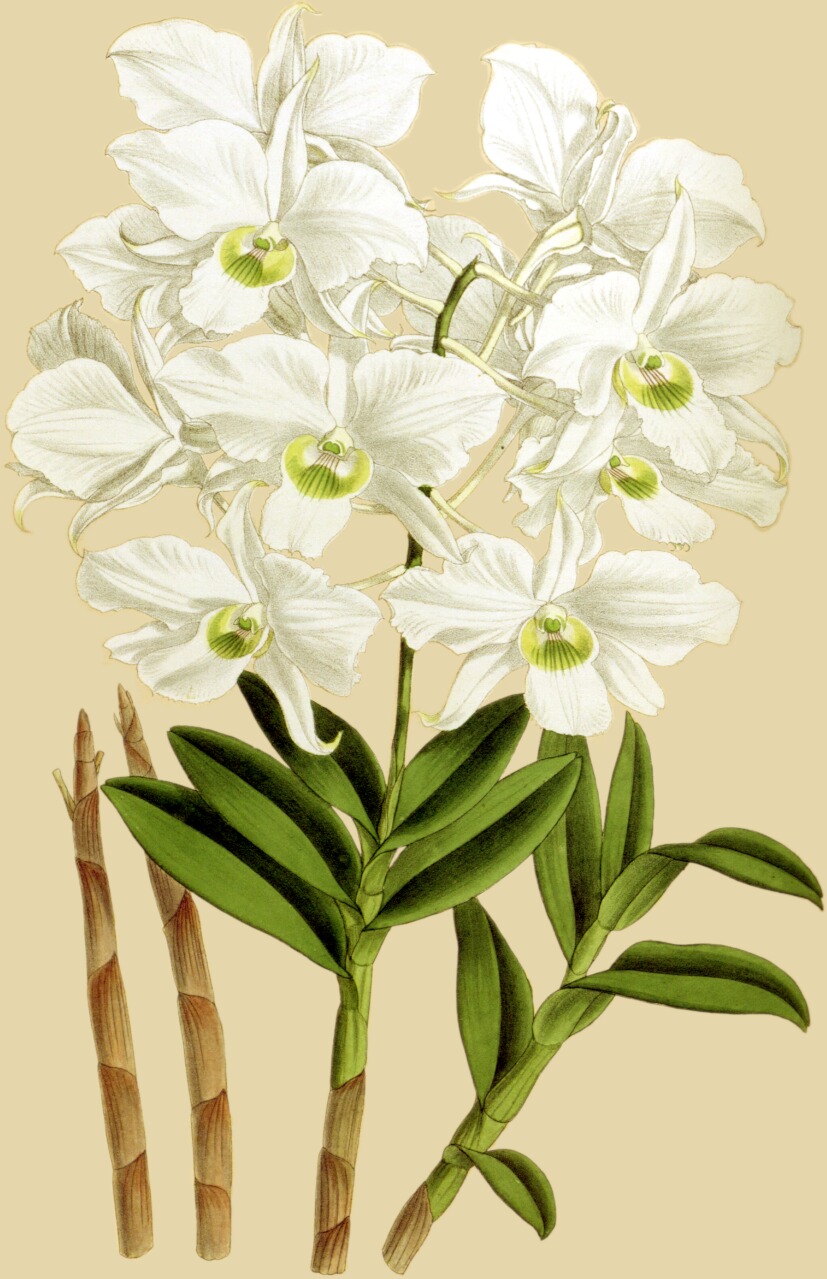
PL. 120. DENDROBIUM DEAREI.
47