SACCOLABIUM CURVIFOLIUM. [Plate 107.] Native of India (Nepal and Birmah) and Ceylon.
Reading edition
SACCOLABIUM CURVIFOLIUM. [Plate 107.] Native of India (Nepal and Birmah) and Ceylon.
Epiphytal. Stem dwarf, erect, densely leafy. Leaves crowded, distichous, linear, obliquely præmorse, with an acute apex, deflexed, channelled towards the base, pale green. Racemes erect from the upper axils, six inches long, densely flowered, the peduncles pale green, bracteate, the pedicels red, six-angled, with a small ovate bracteole at the base. Flowers bright cinnabar-red, about an inch across, somewhat concave; dorsal sepal obovate, with a claw-like base, entire; lateral sepals somewhat broader at the base, and unequal-sided, all spreading, and of a uniform dense cinnabar-red; petals of the same form as the dorsal sepal, and of a similar tint of colour; lip with a cylindraceous obtuse spur over a quarter of an inch long, to the front side of which is attached a tongue-like linear lamina, truncately-emarginate at the apex, and having a central paler orange rib with two knobs at the top of the spur-tube; at the back of the spur are two short erect lobes, which are convex outwardly, and with a boss or protuberance on the inner surface; lip more orange than the sepals, the processes at the end of the spur yellow; spur of the same colour as the lip. Column short, deep red, semi-terete, the angle winged upwards, the anther-case tinted with violet.
Saccolabium curvifolium, Lindley, Genera and Species of Orchidaceous Plants, 222; Bateman, Second Century of Orchidaceous Plants, t. 130; Lemaire, L’Illustration Horticole, xii, t. 493.
Saccolabium miniatum, Hooker, Botanical Magazine, t. 5326—fide Bateman and Lemaire.
The Saccolabium rank among the richest and most beautiful of the Orchid family; indeed, there are some magnificent species among those cultivated in our Orchid houses, which we hope to figure as time passes on. In the present illustration we introduce to our subscribers one of the small growing kinds, and one of the most distinct which we have seen as regards its habit and the colour of its flowers. Our figure was taken from a well-grown plant in the fine collection of W. Lee, Esq., Downside, Leatherhead, whom we are glad to observe is collecting and cultivating, along with the other East Indian kinds, the best species and varieties of this genus that can be obtained.
Saccolabium curvifolium is a dwarf and compact-growing evergreen plant, seldom seen more than a foot in height, with foliage of a light green colour, about four or five inches in length. It is a free-blooming kind, producing in May and June its bright orange-scarlet flowers, which continue in a fresh state for weeks. It is a very slow growing plant, and is seldom seen forming large specimens. Sometimes masses of it are imported, and these when set upon blocks of wood form charming 22 specimens. We saw one in the collection of the Comte de Germiny, in France, which was most beautiful—two feet in height, and well bloomed; this specimen, which was suspended from the roof of the house, had a remarkably fine effect.
This plant will do either on blocks of wood or in small suspended pans or baskets, so that, it gets all the light possible. We find the best material to cultivate it in is sphagnum moss and a few pieces of charcoal intermixed, and it must have good drainage; it requires very little moss, as the roots like to enjoy the moist atmosphere of the house. The species is found growing on trees where the roots get the full benefit of the light and air; and if we imitate this as nearly as possible as regards their roots, we shall not go far wrong. Of course in our Orchid houses the treatment varies, and consequently the plant will require a little shade. The temperature required is that of the East India house.
Stanhopea gibbosa.—We have received from Alfred G. Wallis, Esq., of Balham, a grand spike of this great beauty. The plant, Mr. Wallis informs us, is growing in a wire basket about fifteen inches in diameter, and has borne five spikes of flowers, four of them with two flowers on a spike and one with one flower. The flowers are large, about six inches across; the petals are yellow, barred and blotched with crimson, the sepals assuming a darker tint of the same colour. Mr. Peacock was also successful in flowering this plant in June of the present year. It is a great pity Stanhopeas are not more popular among Orchid cultivators, as they form a very showy group of plants, their only drawback being the short time they continue in flower, and their very powerful and unpleasant odour.—B. S. W.
Disa grandiflora.—We received a wonderfully fine spike of this superb Orchid from Mr. Thomas Speed, the Duke of Devonshire’s gardener, at Chatsworth. The spike was two feet six inches in length from the pot, and bore twelve flowers of large size and fine colour—a bright scarlet and crimson, the lip veined with pink, which gives a nice contrast. It is a most charming cool-house Orchid that every one may grow who has an ordinary greenhouse. Mr. Speed is a most successful cultivator of this fine plant. We saw the first small plant he had to begin with some years ago, and this plant has gone on improving, and many offshoots have been taken from it which have also made fine specimens. The Disa really seems to be no trouble to cultivate. The way in which Mr. Speed treats it is to grow it in a common greenhouse, where it gets plenty of fresh air and light, and here it requires nothing but plenty of water in the growing season. It is grown in sphagnum moss and rough fibrous peat and loam. There is no doubt that this plant does not get shifted from the place where it was found to do well. This is a great secret in plant culture. When a plant is found doing well, let it remain where it is, unless on trial another place is found to be equally suitable. Few people grow this Disa well. The reason is, that they keep it in too warm a house, and coddle it too much. If they would follow Mr. Speed’s plan, there is no doubt they would succeed, if the plants are kept free from insects, and provided with sweet material about their roots.—B. S. W.
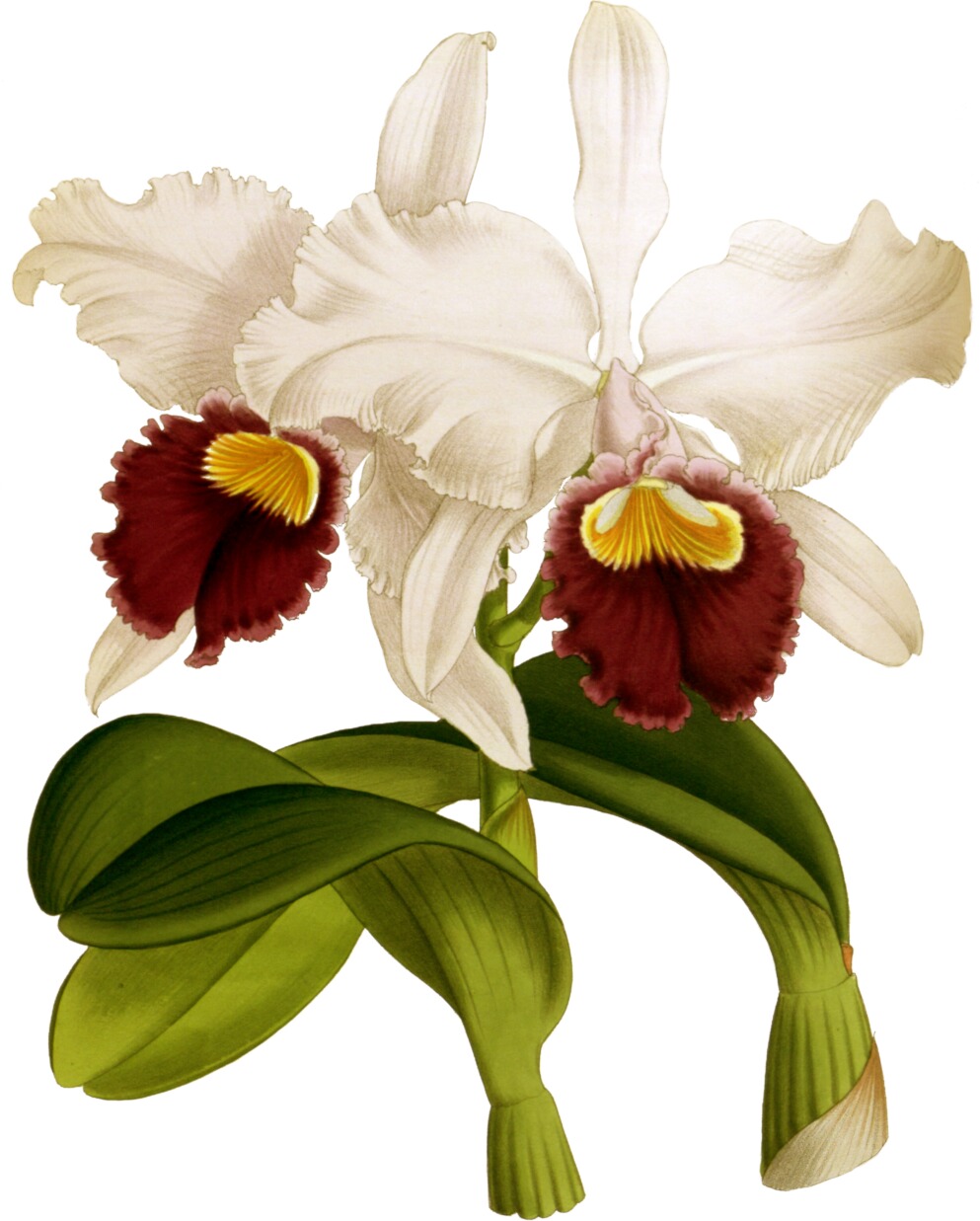
PL. 108. CATTLEYA TRIANÆ FORMOSA.
23