CYPRIPEDIUM MELANOPHTHALMUM. [Plate 109.] Garden Hybrid.
Reading edition
CYPRIPEDIUM MELANOPHTHALMUM. [Plate 109.] Garden Hybrid.
Epiphytal. Acaulescent. Leaves distichous, coriaceous, oblong-lanceolate, acute, of a pale dull green colour, chequered with coarse elongate reticulations of a darker green. Scape (peduncle) greenish, clothed with purple hairs, having near the apex a short acuminate hairy bract, which is strongly ciliated. Flowers medium-sized, of a rather showy character, solitary; dorsal sepal broad ovate-acuminate, an inch and a half long, white flushed with purple towards the base, distinctly marked with green veins, of which the two pairs on each side the central one are alternately long and short, while the rest become gradually shorter as they approach the edge; united lateral ones narrow ovate, whitish with green veins; petals glossy, linear oblong, dull purple on the upper side towards the base, and marked with a series of blue warty hairy dots on the upper edge, the apical portion bright reddish purple or wine-red, the lower half somewhat greener, both margins ciliate; lip bold, an inch and three-quarters long, with a somewhat compressed pouch an inch long, of a dull reddish purple suffused with green—the green colour most apparent towards the tip and back—and distinctly marked with darker purple reticulations, the sides veined, pale yellowish spotted with crimson warts within, their upper angles produced into auricles. Staminode very prominent, hexagonal, emarginate in front with a small tooth inside, veined with green in the centre, pale purplish green at the edge, the surface shortly downy.
Cypripedium melanophthalmum, Reichenbach fil., Gardeners’ Chronicle, N.S., xiv., 525.
This is one of the numerous hybrid Lady’s Slippers that have been raised by R. Warner, Esq., Broomfield, Chelmsford. All these are of free-blooming character, every small growth bringing its quota of flowers. The foliage of the several forms is differently variegated, while the flowers of all the kinds are of long duration, which is an excellent quality in any plant. It will be seen from our illustration that Cypripedium melanophthalmum is a pretty plant, and one well worthy of cultivation, since it produces flowers which are valuable for cutting purposes, the stems being firm and long, which makes it useful for vases and other decorations for the adornment of living rooms. The plants are grand for exhibition purposes, as they carry well without injury by tying each flower-stem to a small stick.
The Cypripedia are of easy cultivation. They may, moreover, be freely hybridized, and are more readily produced from seed than many other subjects, as may be seen from the number which have been brought before the public, by those who make it their study to raise them in this way. Some persons are more 26 successful in this branch of culture than others. There is no doubt that it requires a good deal of skill and tact to find out the best sorts for crossing, and also to effect the best crosses; moreover, it occupies a good deal of time, but we do not know of anything more delightful than this self-imposed task of improving the beauties of nature, and where one can devote attention to it, there must be a great deal of pleasure in watching the progress of one’s pets and noting the results of one’s labours when they put forth their blossoms.
Cypripedium melanophthalmum is an evergreen plant, having light yellowish green foliage with dark reticulations and blotches. The flower stems grow about six inches high, bearing the interesting flower at the top; the dorsal sepal is white flushed with purple at the base, and veined with green; the petals are bright reddish crimson, with darker veins and black hairy blotches or wart-like spots on the edge; the pouch is bright crimson with a green base, netted with green and reddish brown.
It requires the same treatment as C. barbatum—that is, it should be potted in rough fibrous peat, with good drainage, and the plant should be well elevated above the pot-rim, so that the roots can run over and also into the soil. These plants require a good deal of water, nearly all the year round, as they have no thick fleshy bulbs to support them. It must always be borne in mind that they must be kept free from insects to ensure successful and satisfactory progress.
Aërides Lawrenciæ.—At Stevens’ Auction Rooms, on the 19th day of September last, there was a magnificent new Aërides offered for sale, which realized the large sum of 235 guineas (£246 15s.), the purchaser being Sir Trevor Lawrence, Bart., M.P. It is encouraging to see that Orchids are more esteemed than ever they were, and that in spite of the enormous importations which are continually being received, good things are realising higher prices than ever. This new Aërides resembles in habit a large growing form of A. quinquevulnerum: the flower-spike measures two feet in length, and bears thirty-two of its lovely blossoms, which seem to be intermediate between those of A. odoratum and A. quinquevulnerum, possessing the strong aroma of the first-named plant. The flowers are very large, the sepals and petals white tipped with rosy-purple, the lip white marked with rich amethyst. It has just been named in compliment to Lady Lawrence.—H. W.
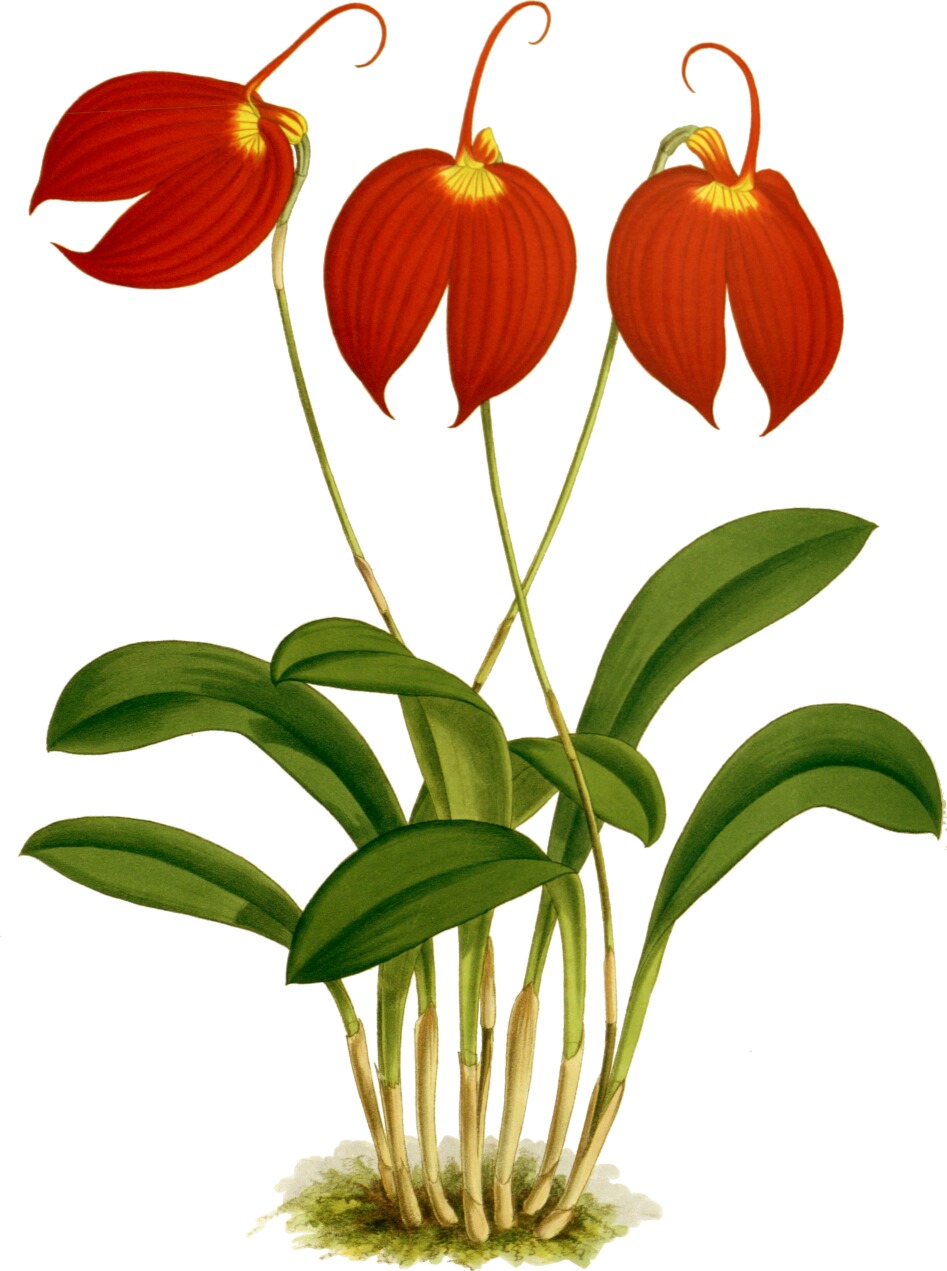
PL. 110. MASDEVALLIA HARRYANA MINIATA.
27