THUNIA MARSHALLIANA. [Plate 130.] Native of Moulmein.
Reading edition
THUNIA MARSHALLIANA. [Plate 130.] Native of Moulmein.
Terrestrial. Stems reed-like, erect, glabrous, cylindrical, about two and a half feet high, becoming smaller upwards, swelling into roundish tuberous knobs beneath the soil, clothed above with distichous leaves, and terminating in a dense raceme of flowers. Leaves oblong-lanceolate, acuminate, semi-amplectant, about six inches long, five to seven nerved, of a pale green colour, glaucous beneath. Racemes terminal, nodding, dense, and many-flowered, the bracts large ovate-lanceolate, acute, concave, shorter than the ovaries, pale yellowish green. Flowers large and delicately beautiful, white with orange-red veins; sepals and petals lanceolate-oblong acute, spreading, nearly equal, about two and a half inches long, pure white; lip white, with the lower part convolute around the column, produced behind into a retuse falcate spur and having in the centre five veins or ribs, fringed at the edge; the front part or limb flattened out, roundish, yellow with numerous forking veins of a deep orange-red colour, occupying the whole area, the disk traversed by five yellow raised veins, and about five shorter ones on each side, all pectinately fringed with crystalline hairs, the margin toothed and beautifully crisped, the extreme edge being white. Column enclosed by the lateral lobes of the lip (which are yellowish striated with red near the front) terete below, widened above, with two prominent toothed wings near the tip forming a kind of hood.
Thunia Marshalliana, Reichenbach fil., Linnæa xli., 65; Regel, Gartenflora, t. 1098.
The Thunias form a small genus of very beautiful Orchids, which have the further recommendation of being easy of cultivation. They are deciduous in habit, losing their stems and leaves after they have bloomed and completed their growth. That which we now figure, T. Marshalliana, is a most distinct and showy species. Our sketch of which was taken from a well grown plant belonging to W. Cobb, Esq., Silverdale Lodge, Sydenham, who has a well selected and finely grown collection of Orchids. This plant was indeed a marvel of cultivation, and did great credit to Mr. Catt, the gardener.
Thunia Marshalliana, like its congeners is a free-growing plant, furnished with tall red stems. These stems are of annual duration only, and grow from two to three feet in height, perishing as soon as the flowering and growth is completed; they are thickly clothed with distichous leaves, which are of a pale glaucous green colour, and three inches or more in length. The flowers are produced in large terminal spikes, 68 and have the sepals and petals white, and the lip white, beautifully veined and fringed with deep orange colour, margined with white. The plant generally blooms in June and July, and continues flowering on for several weeks; it makes a fine decorative subject, as well as a fine plant for the exhibition table. We have more than once seen some noble specimens shown at the Whitsuntide National Show of the Royal Botanic and Horticultural Society of Manchester.
We figured the charming Thunia Bensoniæ in our second volume at Plate 67, where will be found a full account of the treatment given to that beautiful species. T. Marshalliana requires a similar mode of cultivation, and is propagated in the same manner.
Oncidium Lanceanum, a very handsome variety of which is figured on the preceding Plate, was first discovered in Surinam by John H. Lance, Esq., by whom it was brought to England in the year 1834. In a letter quoted by Dr. Lindley in the Transactions of the Horticultural Society of London (2 ser. ii, 100, t. 5.), Mr. Lance states that he first found it growing on the trunk of a large Tamarind tree, near the Government House, and that he subsequently met with a number of the plants in different parts of the colony, generally attached to the stems or branches of Tamarind, Sapodilla or Calabash trees. With him it failed to grow in rotten wood and light earth, but grew well when fastened to the branches of the Orange, the Soursop, the Mammee, and even the Brugmansia arborea, producing vigorous stems with upwards of twenty blossoms on each.
The scent of the blossom Mr. Lance goes on to state “is extremely fragrant, and is retained after the flower is dried, only becoming fainter and more of a spicy flavour than when fresh. The plant remains in full beauty from ten or twelve days—a long period in that climate; and I found that it always required a shady situation, and a living stem to grow upon, without which it would not produce its flowers in the highest perfection.” Dr. Lindley, in one place, compares the fragrance to that of the Garden Pink, and in another to that of Vanilla.
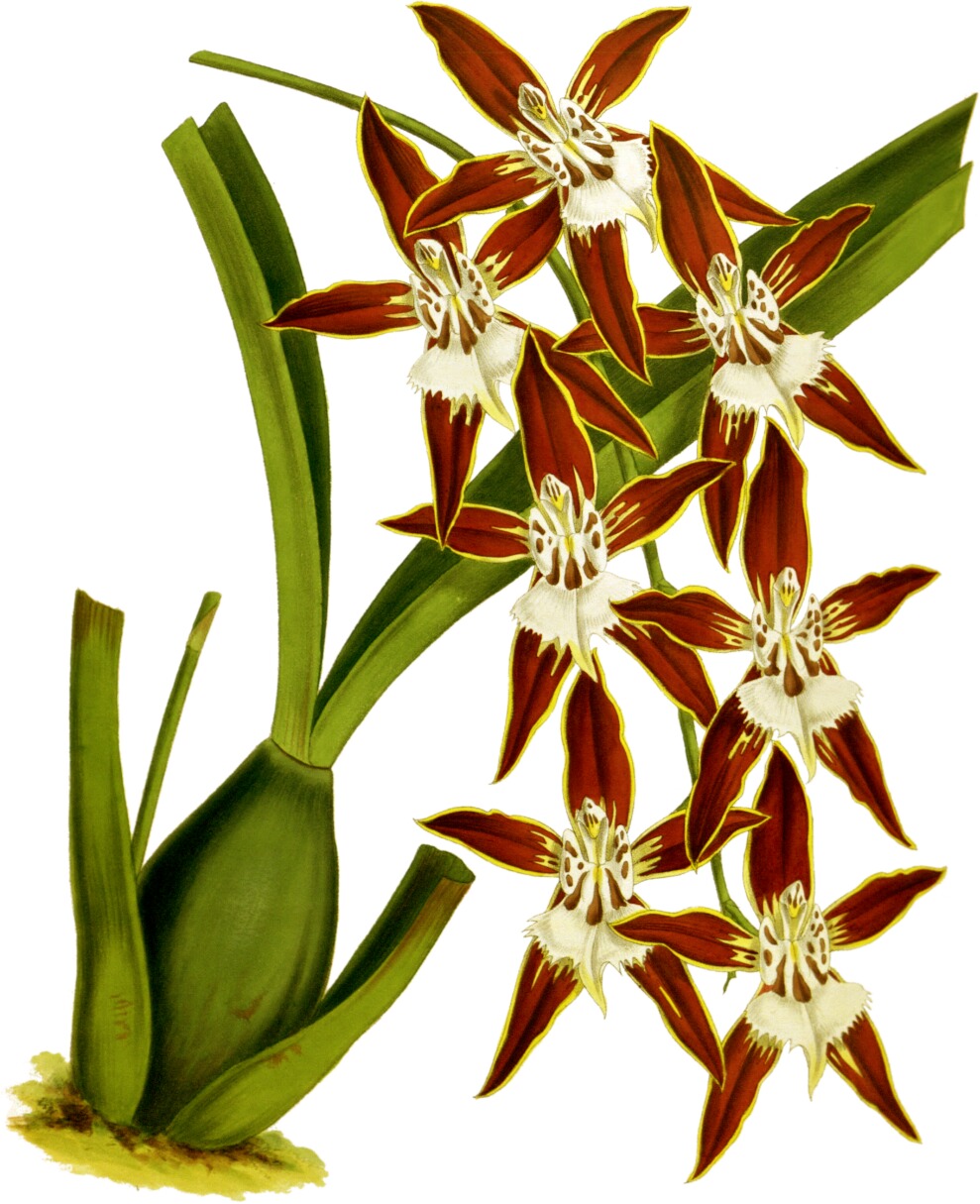
PL. 131. ODONTOGLOSSUM NEVADENSE.
69