ZYGOPETALUM GAUTIERI. [Plate 28.] Native of St. Catherine’s, Brazil.
Reading edition
ZYGOPETALUM GAUTIERI. [Plate 28.] Native of St. Catherine’s, Brazil.
Epiphytal. Pseudobulbs oblong, deeply furrowed, the younger ones ancipitous, attached to a branched creeping rhizome. Leaves fascicled, distichous, the outer ones shorter, the central ones narrowly elongate-oblong, plicate with a strongly developed costa, ten to twelve inches long, bright green. Scape issuing from the centre of the leaf-tufts, and terminating in a drooping raceme of three to six flowers, furnished with elongate-oblong amplexicaul bracts, those subtending the flowers being nearly as long as the pedicels. Flowers large, showy, green blotched with brown, the lip purple with darker purple ruff in front of the column; sepals and petals oblong, acute, nearly equal, the petals directed upwards, all pale green transversely barred and blotched with purplish brown; lip broad, three-lobed, furnished with an obtuse spur, the lateral lobes erect, rich deep purple, forming a crenated unguliform ruff or frill around the column, the middle lobe very large, two inches across, roundish, broader than long, apiculate, deep bluish purple, lighter at the edge. Column short, half surrounded by the purple ruff, arcuate, the anther case yellow, with a projecting point at the apex.
Zygopetalum Gautieri, Lemaire, Illustration Horticole, t. 535; Williams, Orchid Grower’s Manual, 5 ed., 311.
This genus of Orchids does not comprise so many species as many others, but among those which are known and introduced, are some which make very useful autumn and winter flowering subjects, and which are well adapted for decorating our stoves and Orchid houses. Amongst them occur some of the oldest of cultivated Orchids, such as are generally to be met with in good old-fashioned places. We remember to have seen plants of Zygopetalum Mackayi and Z. crinitum some thirty years ago, also of Z. maxillare—grand specimens with from seventy to a hundred flowers upon them, and a magnificent sight they were, with their numerous spikes hanging around the foliage, as represented in the plate, and being similar in colour.
The species which we now desire to bring to the notice of our readers, is a very lovely one, which has been sometimes considered as a variety of Zygopetalum maxillare, but the flowers are larger, and it not only blooms much earlier, but continues in blossom for several weeks. In addition to this, it is a much freer grower than Z. maxillare. We have had different plants in flower for several months, and then they seemed as though they would continue blooming much longer; in fact this species seems to flower whenever it makes its young growth—a peculiar feature which renders it the most useful of its class.
55
Our plate was prepared from a plant which bloomed in the fine collection of Mons. D. Massange, of Marche, in Belgium, under the care of Mr. Wilcke, who is one of the most successful continental growers of Orchids. We had the pleasure of seeing specimens from M. Massange’s grand collection, exhibited at the great show held at Brussels in July, 1880.
Zygopetalum Gautieri is a dwarf growing kind, attaining a height of about twelve inches, and is provided with distinct plaited green foliage. The flowers are large, and borne several together on the spikes; the sepals and petals are green, blotched with purplish brown, while the lip is of purplish blue, edged with a lighter tint of the same colour.
There are several varieties of this species, varying from very pale violet to a rich purplish blue, the variety here figured being one of the darkest-coloured forms we have yet met with. The flowers are particularly showy, and last a long time in perfection.
It is of easy cultivation, and not only free-growing but also free-blooming. It does well in the Cattleya house, planted in peat and moss, with good drainage, and it may be grown either in a pot or a basket, or on a block of wood, or on the stem of a tree fern, on which latter it is frequently imported from its native country. In its wild state, it appears naturally to creep up these fern stems, and it must look very beautiful growing in this way, since its drooping spikes cannot fail to have a good effect when thus seen hanging among the green foliage. It requires a good supply of water during the growing season, but, when at rest, less will suffice. The plant needs plenty of light, but it must be shaded from the fierce sun-rays during the summer months.
Lælia anceps Dawsoni.—One of the best specimens we have had the pleasure of seeing of L. anceps Dawsoni is in the collection of R. S. Dodgson, Esq., Blackburn; it had four spikes of buds when we saw it in November last; since then we have received a spike of three flowers, and a very fine variety it is. Mr. Osman informs us that the plant has ten expanded blossoms. It is one of the best plants and as good a variety as we have met with; the sepals and petals are large, pure white, and of great substance; the lip is bright rosy purple edged with white, the throat orange, veined with purple. No doubt there are different varieties in cultivation which were imported along with this some years ago. Mr. Dodgson’s plant is grown suspended from the roof, and from its appearance this seems to be the best method of growing it to perfection. It likes plenty of light all the year round, and should be just kept shaded from the burning sun.
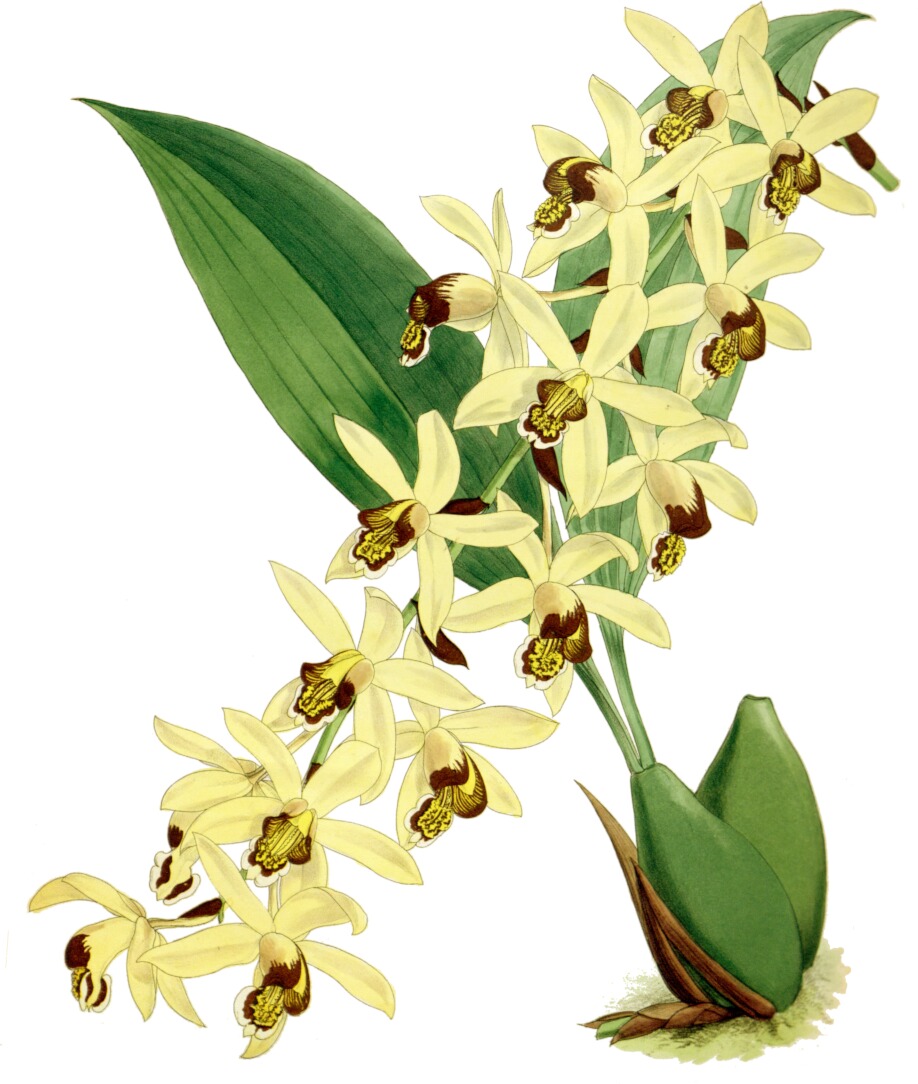
PL. 29. CŒLOGYNE MASSANGEANA.
56