ODONTOGLOSSUM KRAMERI. [Plate 40.] Native of Costa Rica.
Reading edition
ODONTOGLOSSUM KRAMERI. [Plate 40.] Native of Costa Rica.
Epiphytal. Pseudobulbs nearly orbicular, much compressed, ancipitous or sharply two-edged, one and a-half inch in diameter, pale green. Leaves solitary, oblong-lanceolate, acute, keeled, six to eight inches long, one and a-half to two inches broad, light green, with a smooth even surface. Scapes radical, four to six inches long, shorter than the leaves, three to five flowered, drooping or ascending, flexuous, pale green, with small appressed bracts and longish peduncles. Flowers one and a-half inch or more across, and delicately coloured; sepals oblong acute, rosy lilac with a white margin; petals about equalling the sepals in size, and similar to them in form and colour; lip with a short stout neck, deeply hollowed in front, with two erect calli, the lateral lobes semi-ovate, narrow, deflexed, the much larger middle lobe three-fourths of an inch broad, roundish reniform, emarginate, bearing at the base a pair of erect lamellæ, the unguis or neck yellow spotted with red, the front lobe deep rosy lilac, marked near its base with two semi-circular bands of white and purplish rose. Column short, thick, white in front.
Odontoglossum Krameri, Reichenbach fil., in Gardeners’ Chronicle, 1868, 98, with woodcut; Hooker fil., Botanical Magazine, t. 5778; Bateman, Monograph of Odontoglossum, t. 24; Williams, Orchid Growers’ Manual, 5 ed., 236; Floral Magazine, t. 406 (as O. Kremeri.)
This is a most charming small-growing Orchid, with remarkably pretty delicately coloured flowers. It is at the present time very rare in collections, and, in fact, had become almost lost to cultivation, but fortunately during the last year a small number of plants was imported into this country and distributed. Our drawing was made from a plant which formed part of this importation, and which produced its chastely coloured blossoms in the Victoria Nursery. Many years ago we remember to have seen a fine lot imported by the late George Ure Skinner, Esq., but since then it has until last year disappeared from our notice. We are, however, glad to see it again making its appearance in our Orchid-houses; for, as will be seen by reference to our illustration, it is a plant of a most distinct and pleasing character, and will be a real acquisition to the group of Odontoglots, of which numerous highly popular species are at present in cultivation.
Odontoglossum Krameri is a plant of compact-growing habit, with small flattened light green pseudobulbs, each producing from the top a solitary leaf of a pale green colour. The plant generally attains about ten inches in height. The flower spikes or peduncles are freely produced from the base of the pseudobulbs after they have completed their 79 growth, several flowers being produced on each peduncle. The sepals and petals are of a rosy lilac colour, margined with white; the lip is also rosy lilac, but of a darker shade, flushed with yellow and marked and spotted with purple at the neck, and having two semi-circular bands of dark purplish rose and white near the base. The plants continue in bloom for several weeks.
We have found this species to thrive well in the Cattleya house, planted in small pans or pots with good peat and sphagnum moss. It might possibly do in a cooler structure, but we have as yet only cultivated it in the Cattleya house, and this treatment has been found to suit it. It requires to be kept moist during the growing season, but when at rest should have only just sufficient water to keep it in a plump condition. The plant possesses one great advantage—that of blooming during the autumn months, when such flowers are so much in request. It has also another good quality—that of occupying but a small space, so that any cultivator who has a spare niche in his Orchid house can grow it without any inconvenience.
Cattleya Trianæ.—R. B. Dodgson, Esq., of Blackburn, has kindly sent us a wonderfully fine series of flowers of the different varieties of C. Trianæ, including some of the grandest that have yet come under our notice. Of two or three of these our Artist is preparing plates, which will be issued in due course in the Orchid Album. The variety named C. Trianæ Dodgsoni bears most beautiful flowers, which are quite distinct from all that we have previously seen, the sepals and petals being large, and of a pure white, while the lip is of a rich magenta colour, with the throat rich orange, white in the upper part. C. Trianæ Osmani is also a very fine variety, the flowers being rich in colour, the sepals and petals rosy pink, and the lip large, of a bright magenta colour; it is in fact altogether a wonderfully fine flower. There were several other varieties sent, including one which we have selected as the original C. Trianæ; this we shall first bring under the notice of our readers, and the other two will follow.—B. S. W.
Mr. Dorman’s Orchids.—When visiting this grand collection last month (March) we noticed the rare Epidendrum Wallisii in flower. Mr. Coningsby, the gardener, informed us that the flowers on this plant had been open since November, and they still looked fresh. Lælia flava was also good. Galeandra Devoniana, a plant one seldom sees in bloom, was quite at home here, flowering and growing luxuriantly. Lycaste Skinneri alba, with its pure white flowers looked very charming; this was an extra fine variety, with flowers as large as any we remember to have seen. In addition to these there were many fine things in flower, which space will not permit us to mention. Mr. Dorman’s Orchids are looking remarkably well, and are well cared for, both employer and gardener being enthusiastically fond of them.—H. W.
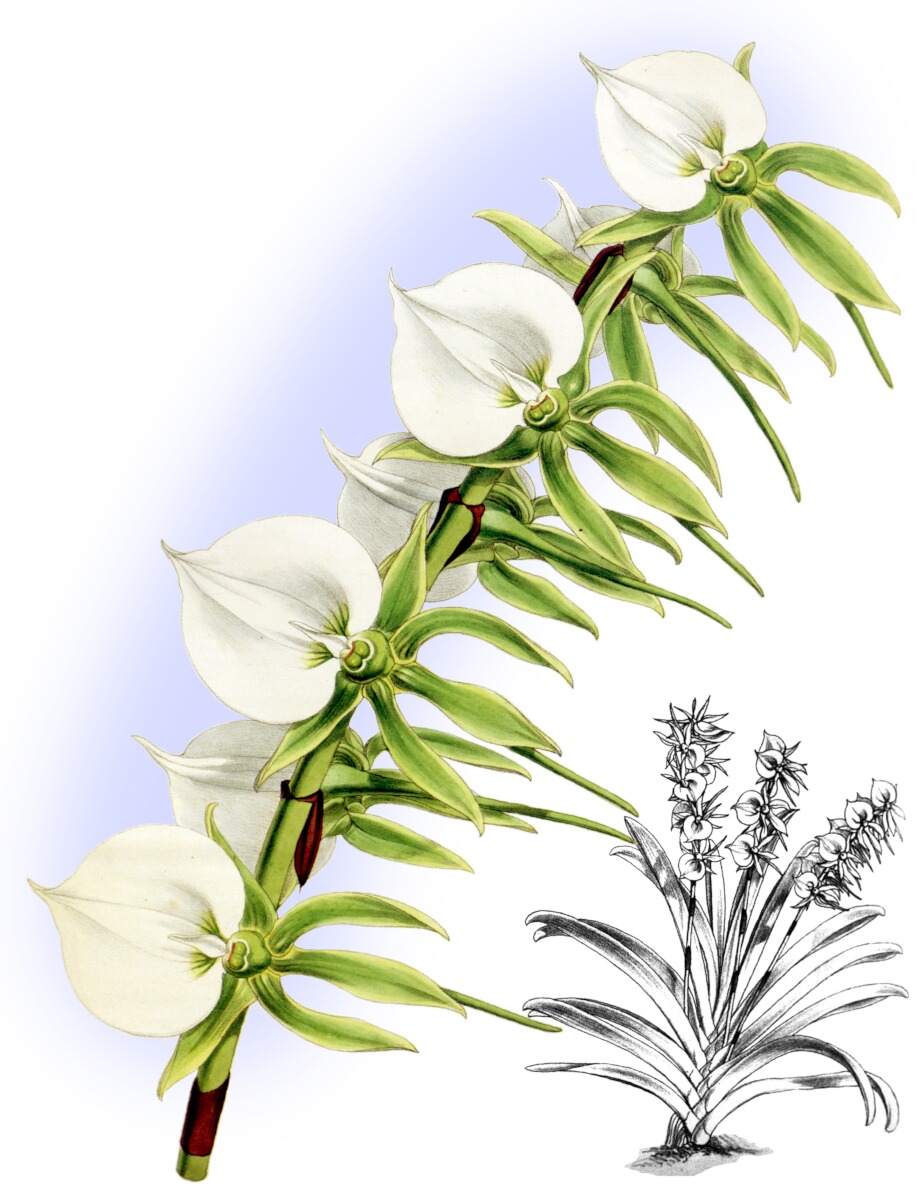
PL. 41. ANGRÆCUM EBURNEUM.
80