ANGRÆCUM EBURNEUM. [Plate 41.] Native of Madagascar and Bourbon.
Reading edition
ANGRÆCUM EBURNEUM. [Plate 41.] Native of Madagascar and Bourbon.
Epiphytal. Stem erect, leafy, producing roots from the lower part and from between the bases of the lower leaves. Leaves distichous, ligulate, very oblique at the apex, coriaceous, of a shining green colour, striated, about two inches broad, carinate below and overlapping each other at the base. Peduncles axillary, furnished with dark sheathing scales, and bearing an erect spike of numerous large flowers of peculiar form and appearance, all pointing in one direction and placed alternately back to back in a distichous or two-ranked manner. Flowers of a thick fleshy texture, green, with a broad conspicuous white lip; sepals and petals lanceolate, pale green, the dorsal sepal and the petals reflexed, the lateral sepals patent; lip large, broadly cordate, cuspidate, ivory white, the centre concave, and bearing a cleft acuminated ridge; spur tapering, considerably longer than and parallel with the dorsal sepal, dark green. Column short, thick, greenish white.
Angræcum eburneum, Du Petit-Thouars, Orchidées des Iles Australes d’Afrique, t. 65; Lindley, Botanical Register, t. 1522; Hooker, Botanical Magazine, t. 4761; Paxton’s Magazine of Botany, xvi., 90, with woodcut; Bateman, 2nd Century of Orchidaceous Plants, t. 111; Gardeners’ Chronicle, 1873, 216, fig. 46; Williams, Orchid Grower’s Manual, 5 ed., 88, with woodcut.
Angræcum superbum, Du Petit-Thouars, Orchidées, tt. 62-4.
Limodorum eburneum, Bory, Voyage, i., 359; t. 19.
A grand Orchid which was first introduced to this country from Madagascar by the Horticultural Society of London, through their collector, Mr. Forbes, in the third decade of the present century, that is, more than fifty years since. It is, without doubt, one of the finest of the species, and when well grown forms a noble plant, its long spikes of attractive flowers, in company with its bold and characteristic foliage and its majestic habit of growth, imparting to it an aspect of dignity which no one can fail to recognise. Indeed, the magnificent appearance it has when placed on the central stage of the East India house is quite sufficient to win for it the favour of Orchid fanciers.
Wherever space can be given to it, it should always be grown, as it blooms during the winter months and continues in perfection for many weeks longer than any other of its family that has come under our notice. Our drawing was taken from a very fine specimen, producing three well developed spikes, in the collection of D. B. Crawshay, Esq., Rosefield, Sevenoaks, Kent, who is a great lover of Orchids, and is forming a nice collection of them.
81
Angræcum eburneum is, as we have before noted, from Madagascar, and consequently requires the heat of the East India house. It is of comparatively easy cultivation. The strap-shaped leaves grow to about eighteen inches in length, and are of a pleasant glossy, light green colour; the flower spikes are produced from the leaf axils on each side of the stem, and extend to the length of eighteen inches, bearing many flowers of which the broad cordate lip is of a conspicuous ivory white. The plants will sometimes produce as many as four spikes at one time. The blooming period is in December, January, and February.
There is in cultivation another variety of Angræcum eburneum, called virens, but is not nearly so handsome and effective a plant as the type, its flowers being of a greenish white, but the spike has a somewhat more graceful contour, and the foliage is of a dark green colour, so that it also is worth cultivating where room can be found for its accommodation.
The Angræcums form a very interesting genus in the great Orchid family; and although amongst those that have bloomed in this country there are not many that we consider to be worth growing as ornamental plants, yet some, on the other hand, are very beautiful, and these we hope to be able to figure in due course. There have been several new introductions of late, and no doubt there are many yet to be acquired. We are glad to notice that Sir Trevor Lawrence is getting up a collection of all the best kinds, but it is found that some of them are difficult to obtain, and they are none of them so readily imported alive as many other Orchids are. They are mostly found growing on trees in their native country, different species being met with on the same trees. It was very interesting to hear the late Rev. W. Ellis talk of these plants, of which many years ago he brought home living specimens of some of the most beautiful of the species, such as Angræcum sesquipedale, A. Ellisii, and others.
Angræcum eburneum is best cultivated in a pot as it is a large growing plant, and produces thick fleshy roots. We find sphagnum moss to suit it well, but it must have good drainage as it requires a liberal supply of water during the summer months, for if it be allowed to shrivel the bottom leaves wither and decay; in the winter, on the other hand, it should have merely sufficient to keep the moss damp and the plant in a plump condition. It requires the same general treatment as the large growing Vandas, such as Vanda suavis, V. tricolor, and others. The plants are not subject to the attacks of insects, their thick fleshy leaves appearing to have no attraction for these pests.
Cattleya Trianæ.—We have received from E. Wright, Esq., Gravelly Hill, Birmingham, a very fine form of this splendid Cattleya; the flowers were six inches in diameter, the sepals and petals broad and of a rosy pink colour, the lip of a rich magenta and beautifully fringed, having the throat bright orange colour and the upper part rose-pink. It is altogether a desirable and charming flower. The varieties of this species are very useful, as they bloom in winter, when there are but few other Cattleyas in flower.—B. S. W.
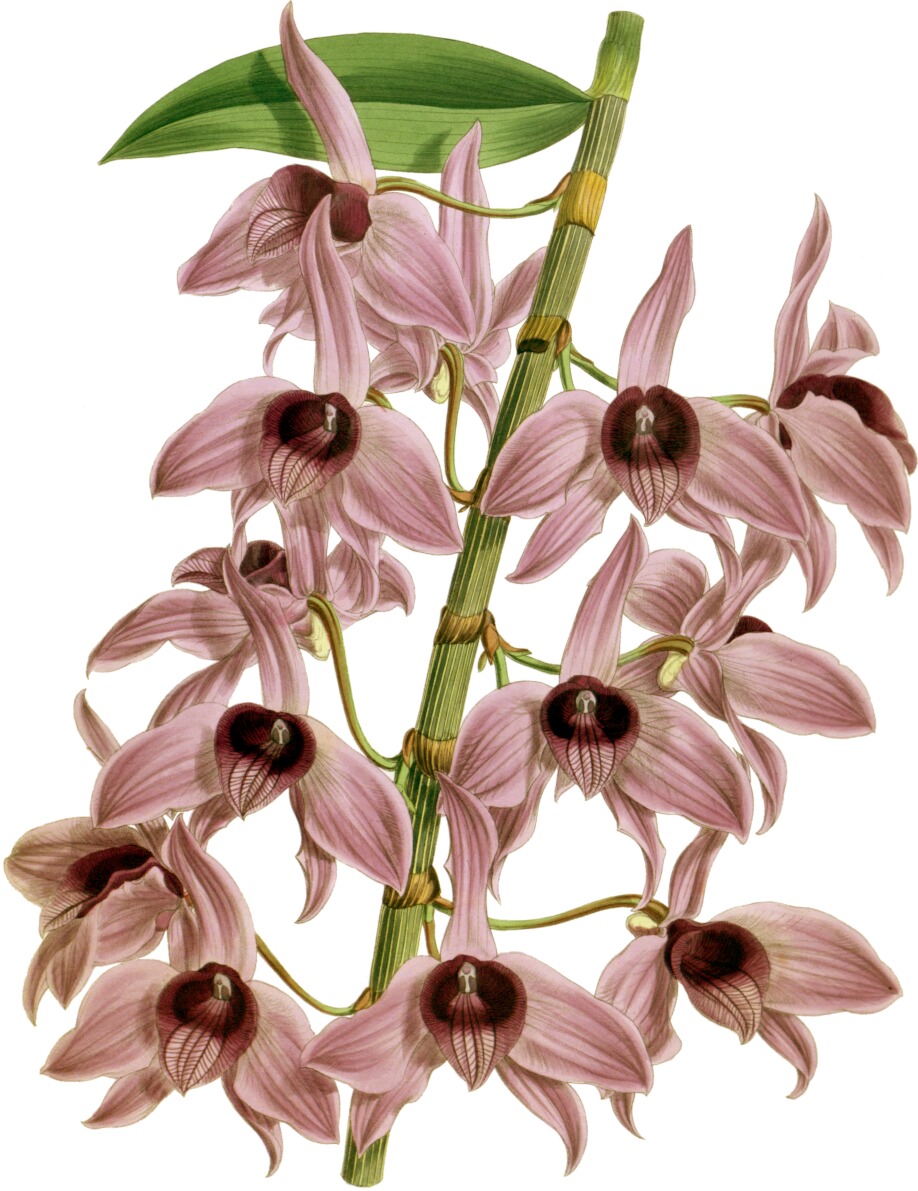
PL. 42. DENDROBIUM MACROPHYLLUM.
82