CŒLOGYNE MASSANGEANA. [Plate 29.] Native of Assam.
Reading edition
CŒLOGYNE MASSANGEANA. [Plate 29.] Native of Assam.
Epiphytal. Pseudobulbs pyriform, three to four inches in height, smooth, bearing two leaves at the apex. Leaves persistent, cuneate-oblong, acute, stalked, somewhat plicate, a foot and a half high including the stalk, and four inches broad. Peduncle pendulous, produced from the base of the pseudobulbs, one and a half to two feet long, nigro-asperate; bracts cuneate-oblong obtuse, much shorter than the pedicels. Flowers showy, in loose racemes of two dozen or more, yellow with a brown lip; sepals ligulate obtuse, somewhat keeled outside, light ochre-yellow; petals linear-ligulate, of the same colour as the sepals; lip three-lobed, concave, the side lobes semi-ovate, acute in front, of a beautiful maroon-brown with ochre-coloured veins, the middle lobe creamy white at the edge, with a large brown disk, short, transversely oval with an apiculus, and having three light yellow rather prominent toothletted keels extending from the base to the anterior lobe, and “six confluent rows of green retuse many-angled cells, reminding one of human molar teeth” in front of them. Column light ochre-yellow, streaked with brown, winged in front, the anther-bed with a retuse membranous border.
Cœlogyne Massangeana, Reichenbach fil., in Gardeners’ Chronicle, N.S., x., 684; Floral Magazine, 2 ser., t. 373.
The plant which we now bring under the notice of our readers belongs to a rather extensive genus of Orchids, some of the species of which are very beautiful, while others are not worth cultivating as decorative plants. That which is now before us, is, however, an exceedingly handsome and very remarkable species, which was imported from Assam, by MM. Jacob-Makoy & Cie., of Liège, Belgium. Our illustration was taken from a very fine plant, which produced no fewer than eight of its long pendulous racemes of flowers, some of these having as many as twenty-seven blossoms on them. This grand specimen was grown in the notable collection of Mons. D. Massange, at the Château de Baillonville, near Marche, in Belgium, in whose honour the species was named by Professor Reichenbach. We had the pleasure of seeing this extraordinarily fine plant, growing under pot-culture, in M. Massange’s Cattleya house, and since then we have received the materials from which our artist has made the capital representation which accompanies these remarks. In regard to its botanical affinities it stands near to the Bornean Cœlogyne asperata, which is sometimes called C. Lowii.
One remarkable feature of this Cœlogyne Massangeana is the extraordinary shortness of time which it takes to develope its rather ample spikes of flowers; these 57 are often pushed up from the pseudobulbs in their corkscrew-like fashion, and become extended to their full length in a very few days, the buds swelling off at once, and the flowers very soon appearing in full beauty, in which state they continue for four or five weeks.
We have seen a wonderfully fine example of this plant in the grand collection of R. Smith, Esq., Brentham Park, Stirling; this was suspended from the roof, and bore several fine flower-spikes. Mr. Smith regards this as one of the most beautiful Cœlogynes in cultivation. When we saw the plant, it was overhanging a wonderful specimen of Cattleya exoniensis, a grand variety, and there were also many other fine Cattleyas in the same house.
Cœlogyne Massangeana is a free-growing evergreen plant, with stout pseudobulbs from three to four inches in height, each supporting a pair of light green plicate leaves, which are about eighteen inches high, and about four inches broad. The flower-spikes are produced from the base of the pseudobulbs, and, when the plants are in vigorous health, they frequently attain the length of eighteen inches, or sometimes two feet. The sepals and petals are of a light yellow-ochre colour; the lip rich brown, its upper part or side lobes creamy yellow, lined with brown. The plant flowers at various times of the year. We have more than once had it in bloom twice in one year, and it continues for several weeks in a state of freshness and beauty.
In its native country, Assam, this species is found growing on the branches and stems of trees. Here, provided it receives proper treatment, it is a very free-growing Orchid, and is also easy of increase, as it often produces two growths from one bulb. It will thrive either in a basket or in a pot, but, when in bloom, it should be suspended from the roof in order that it may be seen to the best advantage, to accomplish which, if it be grown in a pot, some wire may be fixed around the rim by which to hook it up. When growing it may occupy any part of the Cattleya house, but it should be placed so that it can obtain plenty of light. When hung up near the glass it must be shaded from the burning sun. With us it thrives well in good fibrous peat, and we have found it to be a free-rooting plant, requiring to be kept moist during the growing season; indeed, we never allow the plants to become too dry, but just supply them with sufficient moisture to prevent them from shrivelling. Every effort must be made to keep the foliage clean, and free from insects, in respect to which the cultivator should adopt and act up to the golden maxim—“Prevention is better than cure.”
Cymbidium eburneum.—In our remarks on this plant, under Plate 25, we have inadvertently referred to it as producing but one flower on a scape. This, however, is not quite correct; as, although the scapes each usually bear but a solitary blossom, we have known them to produce two, or sometimes even three flowers.—B. S. W.
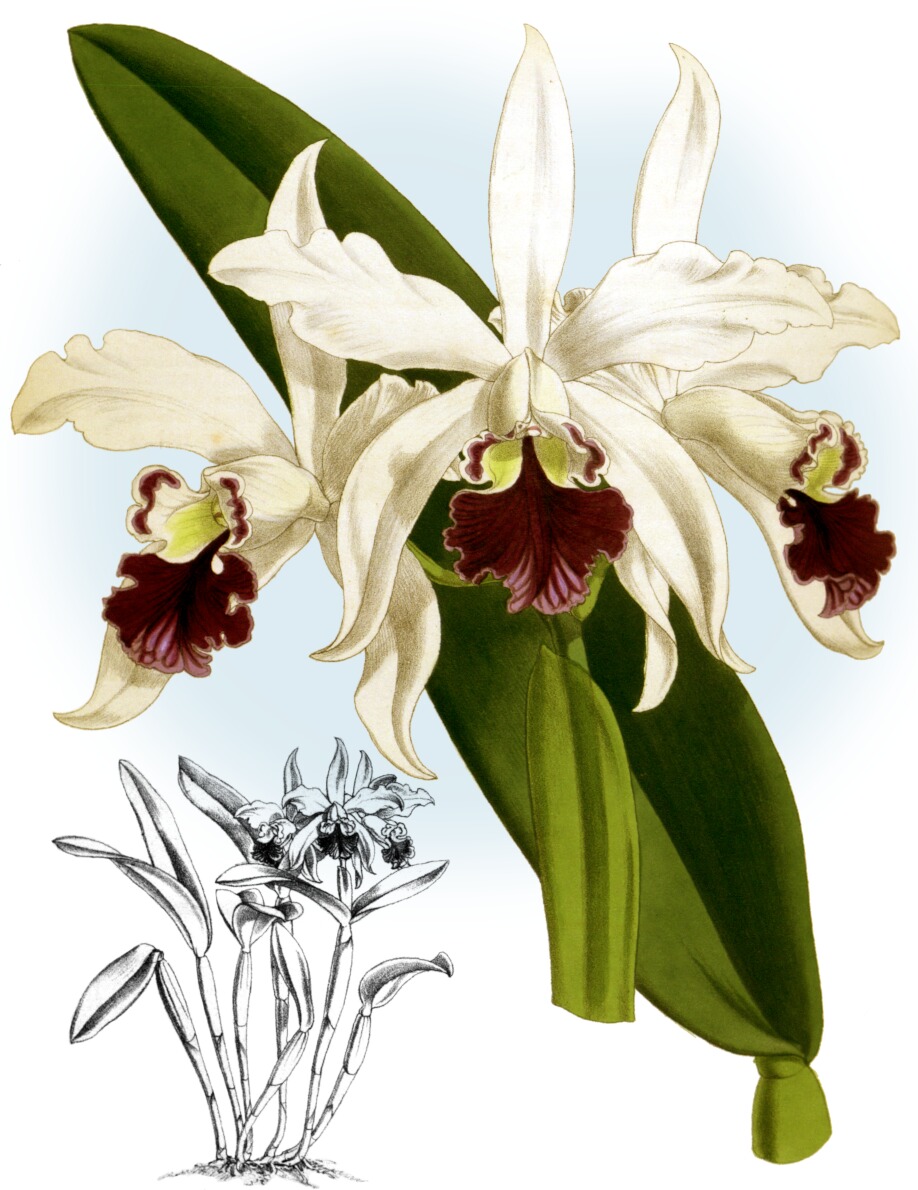
PL. 30. LÆLIA ELEGANS ALBA.
58