PESCATOREA KLABOCHORUM. [Plate 17.] Native of Ecuador.
Reading edition
PESCATOREA KLABOCHORUM. [Plate 17.] Native of Ecuador.
Epiphytal. Stems none or consisting of a short crown or growing point from which the leaves and stout fibrous roots proceed. Leaves tufted, numerous, imbricated at the base, erect or spreading, lanceolate, acute, twelve to fifteen inches long, and about two inches wide, deep green above, paler beneath, thin but firm in texture. Flowers large and showy, measuring about three inches in diameter, the peduncles springing from the axils of the lower leaves; dorsal sepal obovate-oblong, acute, about an inch and a half long, white in the lower half, and of a velvety chocolate purple in the upper portion; lateral sepals more distinctly oblong, being less narrowed at the base, acute, and attached obliquely to the chin of the flower; petals obovate-oblong, like the dorsal sepal, acute, white, deeply tipped with chocolate purple; lip distinctly stalked, with a sharply incurved claw, normally trowel-shaped when spread out, three-lobed, the lateral lobes prolonged, acute, and incurved so as to meet the base of the column, the middle lobe obtusely cordate, sulcate, with the edge recurved so as to bring it to a narrow triangular outline; it is white, with the whole surface, except the margin, covered with short purple-tipped papillæ, or ‘styliform processes,’ ranged in combined lines; on the disk is a large semicircular lamellate ruff or frill, extending to the base, and consisting of numerous (about 20) erect folds or lamellæ, which are white below and of a deep rich purple along the edge of the folds, forming a series of stripes extending inwards to the base of the lip. Column stoutish, angulate on both sides at the base, semiterete, dark purple, three-fourths of an inch long, projected over the basal ruff.
Pecatorea Klabochorum, Reichenbach fil., in Gardeners’ Chronicle, N.S. xi., 684; xii., 167; Paxton’s Flower Garden, re-issue, t. 21.
Zygopetalum Klabochorum, Reichenbach fil., in Gardeners’ Chronicle, N.S. xi., 684.
Until quite recently but few species of Pescatorea were known in cultivation. Latterly, however, several new ones have been introduced into this country, and Orchid cultivators have now more numerous opportunities of admiring the beautiful plants which are referred to this genus.
Pescatorea Klabochorum was introduced from Ecuador, by Franz Klaboch, a nephew of Herr Roezl, one of the most successful plant collectors of our time, and is named in commemoration of him and his surviving brother, also a traveller and collector, The first plants, brought home some four or five years since, were purchased by Messrs. James Veitch and Sons, of Chelsea, and were distributed by them; but since then it has been several times re-introduced, and is now to be found in numerous collections. Several varieties have been already noticed. It appears to have been first flowered in 1878 in England, by John Day, Esq., and in Scotland 33 by J. Gair, Esq., and again in 1879 in the noble collection of Sir Trevor Lawrence Bart., M.P. The drawing reproduced in our plate was prepared from a plant which flowered last August in our own collection, and represents a very fair variety. A fine variety, which bloomed with W. Cobb, Esq., of Silverdale Lodge, Sydenham, is figured in the revised edition of Paxton’s Flower Garden.
The treatment which we find to suit this plant the best is to place it in the Cattleya-house at the cool end. It should be potted in a compost of peat and sphagnum moss, with a few lumps of charcoal added; and a liberal supply of water should be given during the growing season, this being gradually decreased as the winter approaches. The plants should be well elevated above the rim of the pot, so as to allow any superfluous water to drain away from the crown.
We do not find that noxious insects attack the species of Pescatorea in any great degree. The scale will sometimes take up its abode on the young growths, but when found this can easily be removed by the use of a brush or sponge and water.
We saw a fine lot of Pescatoreas and Bolleas in splendid condition at Falkirk in September last, in the collection of J. Gair, Esq. These plants are not so easy of cultivation as many Orchids, their treatment not being generally so well understood; but this was not the case in this instance, for they were perfect plants, well cultivated, and blooming freely. We noticed more especially a fine species named in honour of Mr. Gair, which bears the richest coloured flowers we have ever seen; of this we hope to give our readers an illustration when it flowers next year. These plants were grown at the end of a house where a mixed collection of Orchids, such as Cattleyas, Dendrobiums, Aërides, and Saccolabiums, were doing well. Being a large house, the plants could be treated according to their several requirements, whereas in a small house the varied collection would not be found to do so well.
Vanda cœrulea.—This Vanda, whose flowers are of such a distinct and beautiful colour, is no doubt one of the finest Orchids in cultivation. We have had the pleasure of seeing the plant we are about to mention for two successive years blooming in great perfection in the collection of the Marquis of Lothian, at Newbattle, Dalkeith. The plant, which stands one foot in height, and is well furnished with good foliage, produced two spikes of its charming flowers, fourteen on each spike. The sepals and petals are of a delicate lavender blue colour, barred and veined with a deeper tint of the same; the lip is small, and of a dark violet colour. It was a most showy object, and the amount of bloom upon it was extraordinary, considering the small size of the plant. We have seen larger specimens, but never one that has pleased us so well. Great credit is due to Mr. Priest for producing such a plant, which is increasing in size, and in the number of its flowers every year. There Is a good collection of Orchids being formed at this place, where the houses are suitable for their cultivation, and the plants are well looked after and cared for.—B. S. W.
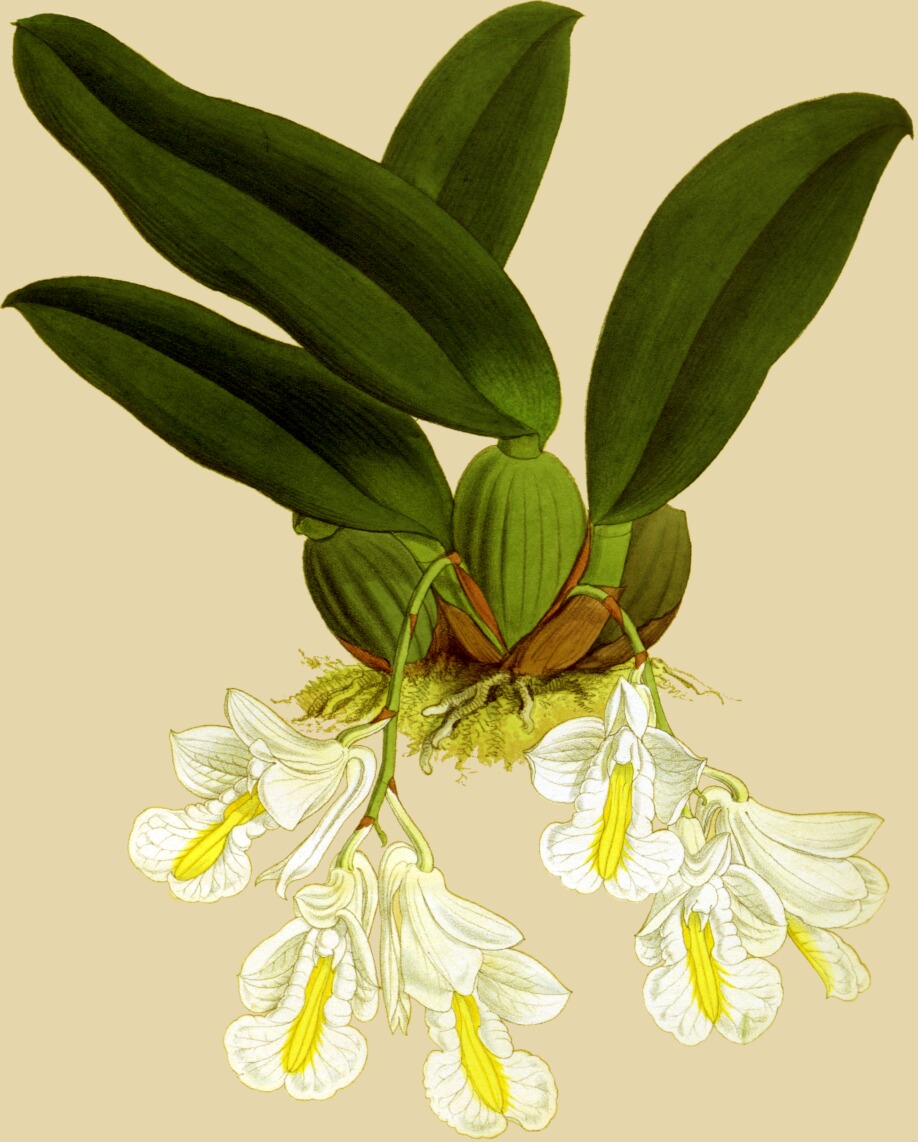
PL. 18. BURLINGTONIA CANDIDA.
34