CATTLEYA MENDELII GRANDIFLORA. [Plate 3.] Native of the United States of Columbia.
Reading edition
CATTLEYA MENDELII GRANDIFLORA. [Plate 3.] Native of the United States of Columbia.
Epiphytal. Stems oblong, club-shaped, furrowed when mature, twelve to eighteen inches high. Leaves solitary coriaceous, ligulate-oblong, acute, dark green above, paler beneath. Scape three to four-flowered, issuing from a terminal oblong compressed bract, which is three to four inches long, and an inch broad. Flowers very large and exceedingly handsome, measuring eight inches across; sepals an inch wide, lanceolate, recurved, white; petals spreading, clawed, broadly ovate, measuring nearly three inches across, plane towards the base prettily frilled in the anterior portion, the apex recurved, white, with a scarcely perceptible tint of blush near the edge; lip obovate emarginate, three and a quarter inches long, the basal half entire, rolled over the column, the anterior portion expanded and beautifully fringed, about two inches in breadth and rather more in depth, the apical half occupied with a solid blotch of rich magenta rose, passing to white at the frilled edge, the side portions white, the disk and throat of a delicate tint of nankeen yellow, the extreme base white, with numerous divergent lines of magenta rose, a few of which (about two) run out to join the blotch at the tip of the anterior lobe. Column about half as long as the convolute base of the lip, club-shaped, decurved, semiterete, with a rounded keel at the back.
Cattleya Mendelii grandiflora, supra.
When Cattleya Mendelii was first flowered by S. Mendel, Esq., some few years ago, many botanists were of opinion that it was not sufficiently dissimilar from, but only a variety of, C. Trianæ. Since that time it has been flowered in many different collections with but little variation of character, and, as we think, has fully vindicated its right, whether as a species or race, to be regarded as a distinct Orchid of first-rate merit.
The subject of our plate is a gigantic variety of the Cattleya Mendelii, which has just flowered in our own collection. It proves to be in every way larger, and altogether superior, to the old type, the flowers having much more substance, and being of better form, which results from the greater width of the lip and petals. The sepals and petals are white, the latter being very broad and of good substance, while the lip is broad and well fringed, pure white in its upper part, with a large bright magenta patch at the front part, and the throat is orange, with reddish crimson veins, which stand out in fine contrast against the pure white of the remaining portions of the flower. It produces as many as four flowers on a spike, each flower measuring over eight inches across, and the flowers are thrown 7 well up above the foliage, and thus produce the grandest appearance we have as yet seen in any Cattleya.
Cattleya Mendelii succeeds well in a compost of peat, with the addition of a little sphagnum moss, and requires good drainage. We have found it to do best in pots, with the plant well elevated above the rim, but it can be grown with success either on a block or in a basket suspended from the roof of the house. The temperature of the Cattleya-house suits it best.
This is a grand plant for exhibition or decorative purposes, as the pure white and magenta of its flowers are exceedingly effective amongst the other species of Cattleya which flower at the same time of year. The flowering season is May and June, after which time C. Mendelii begins to make its growth. It should then receive a moderate supply of water—not too much, as an over bountiful supply is apt to cause the young growths to rot. After the annual growths are completed the plants should be gradually dried off, only giving them sufficient water to keep them from shrivelling.
The species of Cattleya are all subject to white scale and thrips. These insect pests may, however, be easily removed by careful sponging, either with water or a little insecticide; they should be cleaned off as soon as discovered, as if allowed to establish themselves they disfigure the leaves and bulbs, and so spoil the appearance of the plants. Cleanliness and good cultivation are the chief points to be considered in the successful keeping of Cattleyas.
Vanda Lowii, &c.—One often hears that Vanda Lowii does not bloom until it attains a large size. This, however, is erroneous, for we have flowered it when not more than two feet high; and we have also seen a plant of about the same size in the collection of Sir Trevor Lawrence, Bart., with a flower spike some four or five feet long, in full beauty, with its two bright orange-yellow flowers at the base, the rest of the blossoms being of a bright brownish-crimson colour. This was a most extraordinary spike for so small a plant. When the specimens attain a larger size they often produce six of these long spikes, which extend to seven feet in length. We have one now showing this number of spikes, but the plant is fully five feet high. We were glad to see in this collection a grand mass of Epidendrum nemorale majus, which is figured in the first series of Warner’s Select Orchidaceous Plants, but we never expected to see such a specimen as that in the collection of Sir Trevor Lawrence, which must have been three or four feet across, and had eighteen spikes of its beautiful rosy and mauve-coloured flowers. This plant was well worth going to see, as were many others: indeed, the fame of this collection is so widely spread that it is almost needless to comment upon it; suffice it to say, that it is the finest and best kept collection we know of. At the time of our visit we were pleased to see some fine plants of Cattleya superba with their splendid deep rose and crimson flowers; this is one of the most distinct and beautiful of all Cattleyas, and had been grown in the East India House, suspended from the roof.—B. S. W.
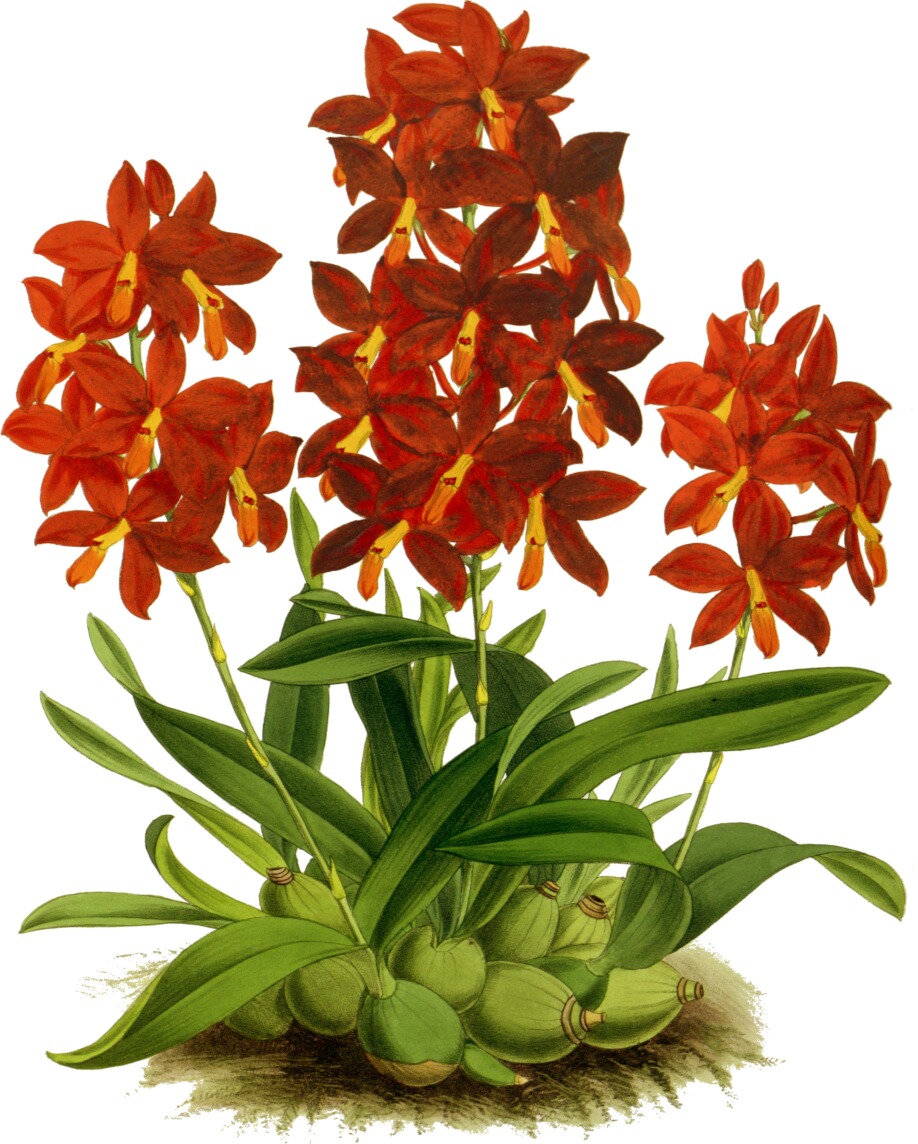
PL. 4. EPIDENDRUM VITELLINUM MAJUS.
8