EPIDENDRUM VITELLINUM MAJUS. [Plate 4.] Native of Mexico.
Reading edition
EPIDENDRUM VITELLINUM MAJUS. [Plate 4.] Native of Mexico.
Epiphytal. Pseudobulbs ovate, clustered, two-leaved. Leaves oblong-ligulate, acute, sheathing at the base. Scape erect, six to nine inches high, racemose, many-flowered, longer than the leaves. Flowers brilliant orange-scarlet, nearly two inches across, much larger than the typical form; sepals spreading; petals flat, elliptic, somewhat broader than the sepals, spreading, lanceolate, acute; lip clawed, linear, abruptly acute, with a bifoveate (two-holed) callosity below the middle, deep yellow passing to orange-scarlet at the tip. Column parallel with and nearly half the length of the lip, to which it is adnate towards the base, the anther-bed marginate in front.
Epidendrum vitellinum majus, of gardens.
The original form of Epidendrum vitellinum, of which a good though pale-coloured figure will be found in the Botanical Register for 1840 (t. 35), is one of the most brilliant of the Epidendreæ, on account of its remarkable fiery colour, which makes it invaluable for contrasting with other subjects, both in the Orchid-house, in the jardinière, or in the bouquet. The same colour, or something near it, occurs in a few other Orchids, which are equally valuable from a decorative point of view, as for example in Lælia cinnabarina, Lælia harpophylla, and Ada aurantiaca, all of them being plants, which, under favourable conditions, yield a brilliant effect. The subject of our plate has the advantage of producing larger and more showy flowers than its type, and to this extent is the more desirable of the two for the house-stage, or exhibition table.
Until within the last few years this plant was very rare, but having been imported in large quantities it is now to be found in every collection, however limited its pretensions. The bright colour of its orange-scarlet flowers, produced in considerable numbers on upright spikes, renders it a most striking and distinct species. We have known the flowers to last as long as twelve weeks in perfection; in fact, we have on several occasions exhibited a plant of it at as many as six different successive exhibitions. Mixed with other Orchids it has a most telling effect; and a well-flowered specimen once seen by a novice is likely to produce a lasting impression. In the Broomfield collection it is used very largely in association with Odontoglossums, and the effect of the orange-scarlet flowers amongst the numerous spikes of Odontoglossum Alexandræ, and other species, is charming.
9
We have found this Epidendrum to do well in the Odontoglossum-house in a compost of peat and sphagnum moss. It does equally well in a pot or in a basket, and should receive a fair supply of water while growing. The plant seems to revel in a good amount of sunlight, but it must be kept from the burning rays of the sun by a slight shading, too much sunshine being apt to make the foliage become blotched and sickly-looking.
The variety majus blooms at a different time of the year from the original species, which has the flowers much smaller, and which blooms in August and September from the young growths; whereas the variety majus flowers from the tips of the bulbs of the previous year’s growth. There are several forms of the plant, some with flowers much larger and brighter than others; indeed, the one here figured is not so large as some that were flowered years ago, which may be due to the fact that they were old-established plants. We remember the late Mrs. Lawrence, of Ealing Park, exhibiting a remarkably strong specimen at one of the Chiswick shows, thirty-five years since, a perfect blaze of flower. S. Brunton, Esq., also exhibited a grand plant of a good variety a few years back; and C. W. Lea, Esq., Parkfield, Worcester, had a wonderful example in bloom, last year. These several plants were all part of the early importations.
The Manchester Show of Orchids, June, 1881.—The display of Orchids at the Manchester Exhibition was a very fine one, and no Orchid grower should have missed the sight. The specimens were truly marvellous, especially the sixteen plants shown by R. Dodgson, Esq., of Blackburn, amongst which were a Vanda suavis with about a dozen flower-spikes; Lælia purpurata and Cattleya Warneri, both wonderful specimens, as also was Masdevallia Harryana; Cypripedium barbatum superbum which had a hundred blooms upon it, and was not made up for the occasion, but had been grown on from a single plant; and Dendrobium Wardianum which was a magnificent plant. Great credit is due to Mr. Osman for his talent, in successfully cultivating so fine a collection. G. Hardy, Esq., of Timperley, exhibited some wonderful plants, especially of Cattleyas, Lælias, Dendrobium thyrsiflorum, Oncidium Marshallianum, Odontoglossum vexillarium, &c. R. F. Ainsworth, Esq., M.D., also exhibited some fine specimens, especially Vanda suavis, Aërides Fieldingii, and A. Schröderii; these three are most extraordinary plants, and have been grown in the collection for eighteen years, which is a sufficient proof of what can be done by perseverance, and, moreover, gives one an idea how well Orchids can be grown and exhibited for many successive years. We have known these three specimens to be shown at the Manchester exhibitions and elsewhere for the past ten or fifteen years, and they are now in the finest possible condition, as they have always been, under the successful management of Mr. Mitchell. There were besides, other exhibitors whose specimens were well worthy of note.—B. S. W.
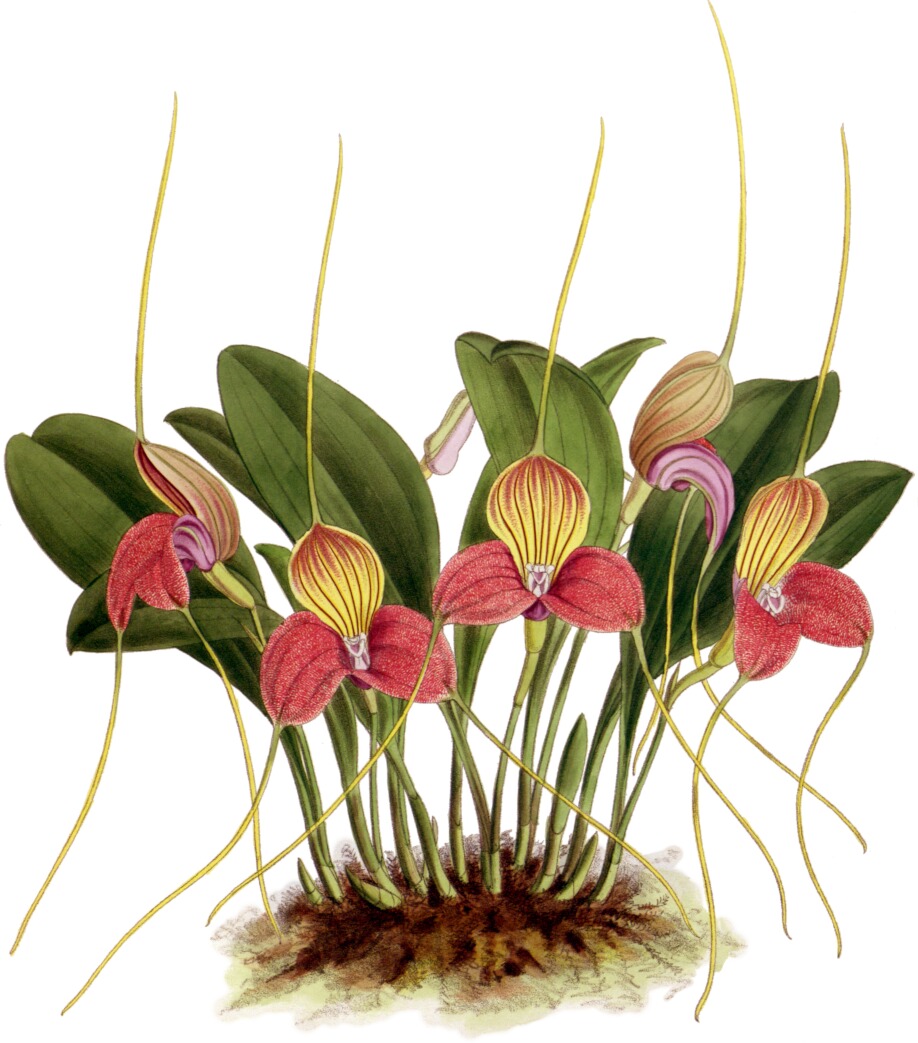
PL. 5. MASDEVALLIA SHUTTLEWORTHII.
10