CYPRIPEDIUM CHLORONEURUM. [Plate 37.] Garden Hybrid.
Reading edition
CYPRIPEDIUM CHLORONEURUM. [Plate 37.] Garden Hybrid.
Epiphytal. Acaulescent. Leaves radical, distichous, coriaceous, oblong acute, closely tessellated with dark hieroglyphic markings on a light green ground, the under surface reddish purple. Scapes solitary in the central leaf-axils, pubescent, reddish purple, one-flowered, with a very short ovate bract. Flowers large, with expanded petals, rather attractive in colour; dorsal sepal broadly ovate, bright yellow-green with white margin, and a narrow purple central stripe, on each side of which are about four strongly marked dark green longitudinal veins, connected by finer transverse veins; lateral (connate) sepals small; petals oblong, broader upwards, two and a half inches long, and three-fourths of an inch wide, with green longitudinal veins, and a dark purple central line, on one side of which (the upper half) they are washed with wine-purple, and have a yellowish buff margin, and a few black warts near the base, where they are ciliated; on the other (lower) half very slightly tinted with purple, the cross veins more apparent, and the margin green; lip rather large, shortly pouch-shaped, heavily stained with wine-purple, and freely marked with bold reticulations of a darker purple, the upper angles yellowish at the margins. Staminode transversely reniform, pale green, with dark green feathery markings in front.
Cypripedium chloroneurum, Reichenbach fil., in Gardeners’ Chronicle, N.S., xiv., 525.
This is one of the most distinct of the new hybrid Lady’s Slippers that have been recently introduced to the notice of Orchid-growers; it will also be appreciated as one of the most useful, being of a neat free-growing and abundant-blooming habit of growth. The Cypripediums are everybody’s plants, that is to say, any one who has a place adapted for their cultivation can manage them without difficulty. Many growers make them their especial care and study, procuring every species and variety that can be obtained, and thus forming a very interesting and diverse group.
Our present subject was raised by Robert Warner, Esq., in whose collection at Broomfield it has been blooming very abundantly, and it was from Mr. Warner’s plant that our drawing was taken. The variety resembles the one figured on plate 36 in being of free-blooming habit, and also in being very attractive in regard to its foliage as well as its flowers. Many hybrid Cypripediums have been raised in this country of late years by the Messrs. Veitch and Sons, and also by other growers. Some of these have proved to be very beautiful and effective subjects, and no doubt there are others coming forward that have not yet bloomed. Many splendid novelties may yet be gained by crossing those kinds that have flowers of distinct forms and colours, and, as many of the varieties bloom simultaneously, the hybridiser will find abundant opportunities for carrying out his plans.
73
These plants appear to be easily raised from seeds, and to reach the flowering stage sooner than most other seedling Orchids.
Some of the Cypripediums thrive well in a cool house, and by fertilising these with the best of the stove species, a new set of cool-house forms would probably be obtained. Such a result would be one of considerable importance to Orchidists, as no doubt, if varieties of a different character to those we already possess could be obtained, some of our enthusiastic growers would take up their cultivation in good earnest. At present the majority of the Lady’s Slippers require a warm house.
Cypripedium chloroneurum is a dwarf compact-habited plant, with evergreen foliage about six inches in length, beautifully variegated with closely chequered markings of dark and light green. The flowers are produced in January and February, and continue on for several weeks. The colours are distinct and attractive, the broad flat dorsal sepal being of a bright lively pale green striped with darker green nerves and bordered with white, the petals suffused with purple on the upper half and marked with black marginal warts, and the purplish lip freely ornamented with bold dark purple reticulations, altogether presenting a remarkably effective appearance.
This novel hybrid grows freely when potted in rough fibrous peat with good drainage. When in vigorous growth it requires a liberal supply of water at the roots. Propagation is accomplished by dividing the plants after they have finished blooming and are ready to start into fresh growth; they can then be divided with safety by cutting off a back growth with a leading shoot in front of it, but care must be taken in cutting that the remaining portion of the plant is provided with an eye so placed as to break and form a new growth. When this young growth has been made, the divided plant may be shaken out from the old soil and potted. The offshoots should be placed in small pots until the following year, when, if they have made good growth, they may require to be repotted. They must be kept moist and in a plump condition, as they have only slender resources of their own to rely upon, but they root freely. As the plants get established they will require larger supplies of water, for which reason good drainage must be secured.
Aërides Leeanum.—This novelty has bloomed in the collection of G. W. L. Schofield, Esq., of New Hall, Hey, Rawtenstall, near Manchester, producing four flower-spikes. It is a beautiful object, its spikes of richly-coloured rosy pink blossoms hanging gracefully from the plant. It is very distinct from any other species of Aërides, and will doubtless become a great favourite. One of its great recommendations is that it blooms in the winter, which is not the case with the generality of these plants, their usual flowering season being during the spring and summer months. A. Leeanum is a small growing plant, but produces its spikes of blossoms very freely; and requiring, as it does, but a limited space for its accommodation, it will be a most useful introduction for amateur cultivators.—B. S. W.
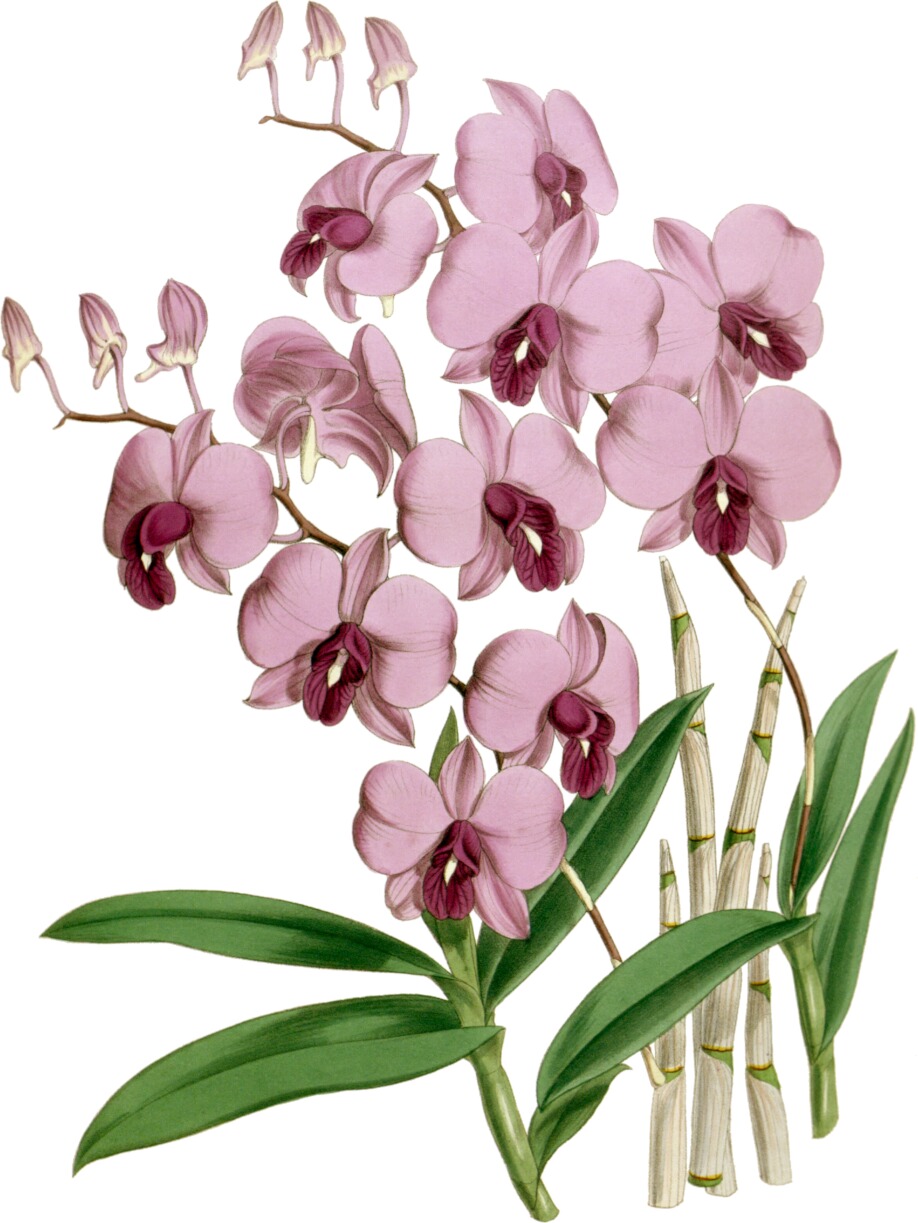
PL. 38. DENDROBIUM BIGIBBUM.
74