PHALÆNOPSIS AMABILIS DAYANA. [Plate 11.] Native of the Eastern Archipelago.
Reading edition
PHALÆNOPSIS AMABILIS DAYANA. [Plate 11.] Native of the Eastern Archipelago.
Epiphytal. Stem none, or consisting of a short crown furnished with rigid fleshy leaves, and emitting succulent roots, which latter are flattened, and cling to any congenial object with which they come in contact. Leaves large, thick and coriaceous, distichous, oblong, obliquely retuse, dark green above, purple beneath. Scape long, drooping, issuing from the base of the plant, or the leaf axils, and bearing the large moth-like flowers in a two-ranked raceme. Flowers large, pure opaque white, spreading, the lip beautifully coloured; sepals oblong-obtuse, white, the lower ones prettily dotted with carmine; petals larger and broader, sub-rhomboid, narrowed towards the base, pure white; lip furnished with a callus at the base, smaller than the petals, three-lobed, the lateral lobes ovate obtuse, ascending or incurved, yellowish along the antical margin and dotted with carmine-crimson near the base, the central lobe trowel-shaped, carmine-crimson across the base and at the edge, and marked with a central crimson stripe; the lip is concave, bearing at the narrowed apex two incurved twisted white cirrhi. Column semi-terete, recumbent on the ovary.
Phalænopsis amabilis Dayana, Hort.
The genus Phalænopsis belongs to the tribe Vandeæ, which is distinguished amongst those with waxy pollen-masses, by having these attached to a distinct caudicle, united to a deciduous stigmatic gland. It no doubt comprises several of our finest Orchids, which are prized no less on account of the graceful development of their inflorescence than for the attractive white blossoms of the more familiar species. Our drawing of the charming Phalænopsis amabilis Dayana here figured, was taken from a fine specimen in the collection of W. Lee, Esq., of Downside, Leatherhead, who was kind enough to allow us to publish an illustration of it. The variety is very rare; indeed, we believe this is the only specimen known to be in cultivation in this country. It was named in compliment to John Day, Esq., of Tottenham, from whose collection it was obtained by Mr. Lee. From the markings about the base of the lip it will be seen to be very distinct, though it is no doubt a form of P. amabilis, with which it agrees in foliage and in the general character of the flowers, but differs in the distinct markings just referred to. The plant grows to about the same size as P. amabilis.
There is at Downside a grand collection of Phalænopsids, which are especially well managed by Mr. Woolford, the gardener. They are great favourites with Mr. 21 Lee, and he has built a house to meet their special wants. This is undoubtedly a good plan to adopt where there is such a fine and comprehensive set of plants as are to be found in this establishment, since they require different treatment to most other Orchids. They have thick fleshy leaves, and the stems of the plant are also fleshy, while, unlike many Orchids, they have no thick pseudobulbs from which to derive support; hence it follows that they require more moisture than many others. We do not, however, agree with giving them so much as we often see supplied. One great advantage of having a separate house for them is that their individual treatment and wants can be more carefully studied and more exactly met.
We have seen Phalænopsids grown well amongst other East Indian Orchids. For instance, we exhibited a plant so grown of Phalænopsis grandiflora for ten successive years at the Chiswick and Regent’s Park Exhibitions, and at several shows during each year, and it generally bore from sixty to seventy blossoms. This was the variety imported from Java, which we consider the best, as it produces more flowers than the variety from Borneo. We see that growers now-a-days are obliged to put several plants together in order to make a specimen fit for exhibition. There were others who about that time also exhibited these large plants, and, amongst them Mr. Kinghorn showed at Chiswick a wonderful specimen, bearing the best flower-spike we have ever seen.
Phalænopsis amabilis Dayana requires the same treatment as P. grandiflora and P. amabilis, and will do either in a pot, basket, or pan, suspended from the roof. It will also thrive on the side stages, but in this case requires to be elevated so that the roots can hang free, for they are abundant rooting plants. If suspended from the roof the plants have more room to throw out their thick fleshy roots, and in this way they approach nearer to the manner in which they grow in their native habitats, for they are found on the branches and stems of trees, where they obtain a free circulation of air. When thus suspended they get without restraint the fresh air that circulates through the house. They can also be cultivated on blocks, but under these circumstances they will require to be more freely supplied with moisture. These are plants that like plenty of light, but they must be shielded from the sun by shading. The best material to grow them in is sphagnum moss, with good drainage, and they require to be kept moist all the year round. In warm weather they of course require more than in winter, when just a sufficient quantity to keep the moss in a moist condition will be all that they will need. It is imperative never to allow water to reach the heart of the plant, for that will sometimes induce it to rot, and will often cause the leaves to go spotted.
The plants must, of necessity, be kept free from insects. Sometimes the thrips will attack them, but this should be cleaned off. To be thoroughly successful with Orchids they require constant watching. Cockroaches are a great pest to all those that throw out thick fleshy roots, which they injure by gnawing them off, thereby weakening the constitution of the plant. J. S. Bockett, Esq., of Stamford Hill, has one of the finest grown collections of Phalænopsis we have ever seen, but this, of course, has been in process of formation for years, and the plants have become large established specimens.
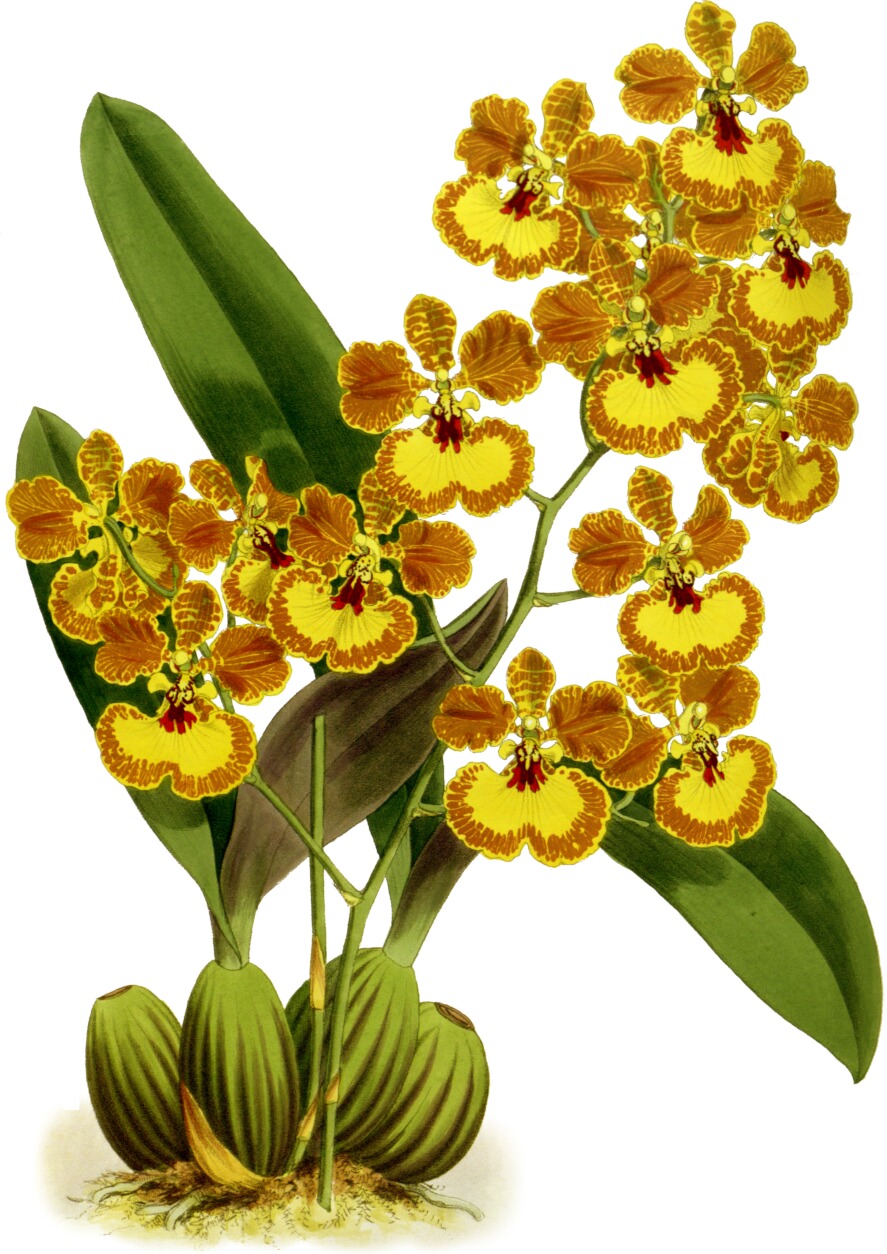
PL. 12. ONCIDIUM GARDNERI.
22