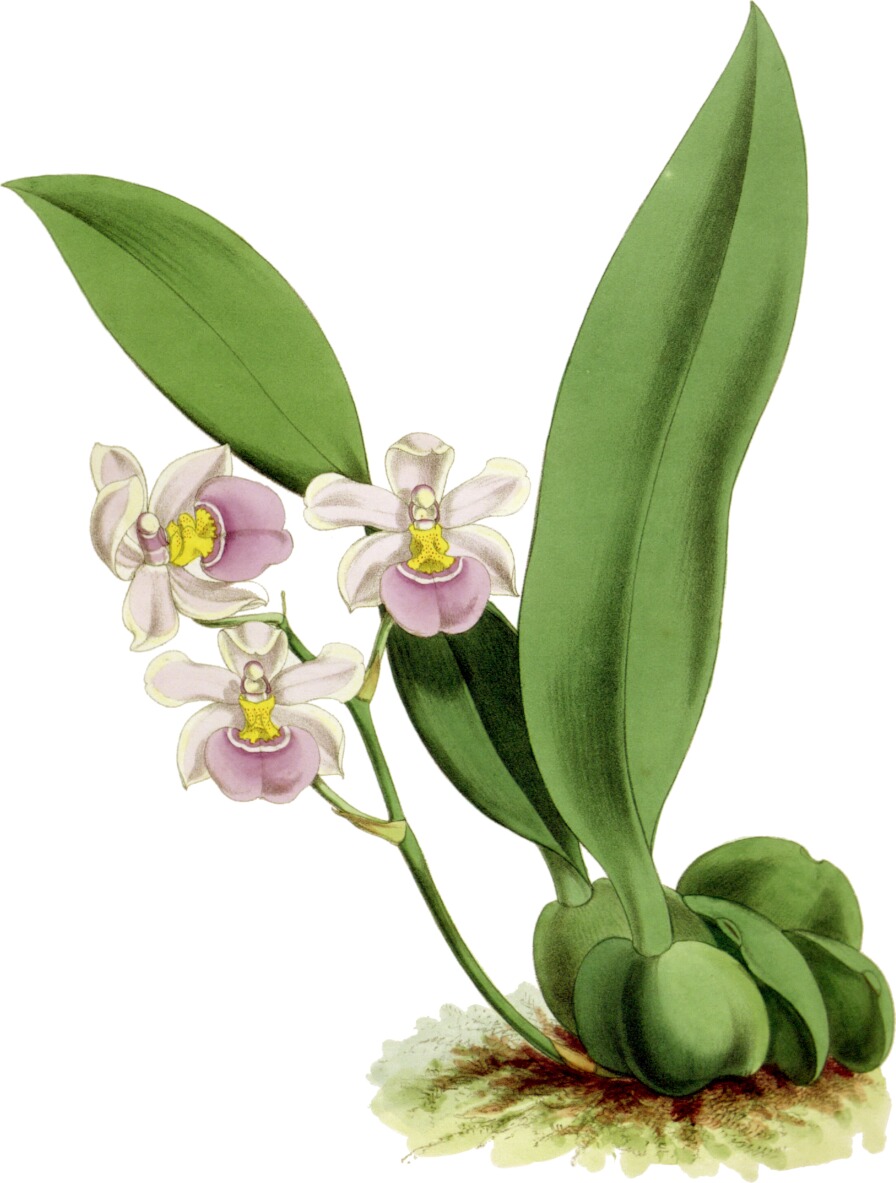
PHALÆNOPSIS STUARTIANA NOBILIS. [Plate 39.] Native of the East.
Reading edition
PHALÆNOPSIS STUARTIANA NOBILIS. [Plate 39.] Native of the East.
Epiphytal. Acaulescent, the plants clinging to their supports by stout flattened roots. Leaves coriaceous, distichous, ligulate-oblong, acute, channelled, equitant at the base, the upper surface marbled with transverse grey blotches which disappear with age, the under surface purplish red, similar in size to those of Phalænopsis Schilleriana. Scape radical, bearing a many-flowered (120 or more) branching panicle of very handsomely and peculiarly spotted blossoms. Flowers nearly three inches across, expanded, cream-coloured at first, becoming white; sepals oblong, or ovate-oblong, about an inch in length, the dorsal one white, the lateral ones white along the upper side, the lower side being yellow thickly spotted with cinnamon-red; petals much broader, narrowed near the base, white; lip three-lobed, with a four-horned yellow callosity at its base, the lateral lobes oblong, rounded, the middle lobe oval, with an anchor-like extremity, the apex terminating in a pair of narrow recurved laciniæ, all the lobes yellow at the base, white upwards and handsomely spotted with rich cinnamon-red. Column clavate, white.
Phalænopsis Stuartiana, Reichenbach fil., in Gardeners’ Chronicle, N.S. xvi., 748, 753, fig. 149; Moore, Florist and Pomologist, 1882, 49, t. 559.
Var. NOBILIS; flowers larger in all their parts, marked with fewer and larger spots; front lobe of the lip rhombic.
Phalænopsis Stuartiana var. NOBILIS, Reichenbach fil., in Gardeners’ Chronicle, N.S. xvi., 748.
There can be no doubt that the species of Phalænopsis rank amongst our finest Orchids, on account of the purity and soft tinting of their blossoms and the profusion in which they are produced. Unfortunately, at present, we only possess a limited number of them. During the last few years, indeed, many new kinds, which are giving a fresh interest to the genus, have been introduced by our collectors; and, although it is barely possible that any new introduction should surpass the old species, yet it is gratifying to know that there are yet to be found distinct and novel kinds of great beauty. P. Stuartiana, which we now bring under the notice of our readers, is a very fine and well-marked species, recently imported from the East by Messrs. Low & Co., of Upper Clapton, and named by Professor Reichenbach in honour of Mr. Stuart Low, who is one of the largest importers of this class of Orchids. Our plate, which represents the variety called P. Stuartiana nobilis, was sketched from a plant now in the fine collection of William Lee, Esq., of Downside, Leatherhead, who purchased it when in full beauty from the Messrs. Low, and we have to thank Mr. Lee for his kindness in allowing the drawing to be made. It is to be hoped 77 that collectors may find more of it in its native country, although we believe it to be very rare, and, like many other recent discoveries to be probably a natural hybrid produced by insect fertilisation. We have no doubt that there are yet many fine forms of Phalænopsis; and if we could but obtain the scarlet one, which some years ago was reported to have been seen by a collector who was not able to bring it home, what a grand acquisition that would be!
Phalænopsis Stuartiana nobilis resembles P. Schilleriana in the young growth, its newly developed leaves being of the same shape and colour and similarly spotted, but the older leaves assume more of the character of P. amabilis; while the flowers, instead of being mauve-coloured, are pure white, with the inferior halves of the lateral sepals yellow and boldly spotted with cinnamon-red, as also is a portion of the lip, the side lobes of which bear smaller and more closely set spots. We have little doubt that this plant is a wild hybrid between P. Schilleriana and P. amabilis, as though the young leaves come spotted, they afterwards change to the colour of those of P. amabilis, as already described.
This plant requires the same treatment as P. Schilleriana, and is best grown among sphagnum moss in baskets suspended from the roof, care being taken to give it a good supply of water during the growing season. It should have the heat of the East India house, and should at all times be kept moist at the roots, for if allowed to become dry, it will loose its lower leaves. If the plants are in a healthy and free-growing condition, flowering does not injure them; but, if at all sickly, they should not be allowed to blossom until they regain strength and vigour, as they are naturally free-flowering plants, and under such circumstances might bloom themselves to death. The moss about their roots must be sweet and in a living state; when it becomes decayed it should be removed, the roots washed, and the plant replaced in clean live moss with fresh free drainage, so that the water, of which a considerable quantity is required, may never become stagnant. Shading is an important element in the successful cultivation of these plants; therefore the sun, when at its full power in summer, must never be allowed to shine upon them, but in winter a little sun-heat is beneficial, and they then require all the light which it is possible to give them. Neither drip, nor water in any other form, must be suffered to reach the hearts of the plants, as it causes them to rot.
Insects are troublesome at times. The thrips, if allowed to multiply, will greatly disfigure the plants, causing damage by depriving them of the juices which should go to sustain their vigour. When free from such pests, and in a healthy condition, the leaves of the Phalænopsids have a pleasing appearance; and, if they are well looked after, it will not be difficult to keep them clean, the more especially as being of large size, they can be readily operated upon.
PL. 40. ODONTGLOSSUM KRAMERII.
78