TRICHOPILIA SUAVIS ALBA. [Plate 14.] Native of Central America.
Reading edition
TRICHOPILIA SUAVIS ALBA. [Plate 14.] Native of Central America.
Epiphytal, Pseudobulbs roundish-oblong or obcordate, thin, i.e., very much compressed, clustered, monophyllous. Leaves broadly oblong, acute, leathery in texture, almost sessile, of a pale green colour. Scapes radical, two to four-flowered, pendent. Flowers large, showy, and fragrant, each emerging from the axil of a thin ovate bract. Sepals linear-lanceolate, acute, somewhat undulated, spreading, and, as well as the similarly-formed petals, of a pure white colour; lip large, rolled up closely at the base, suddenly expanded upwards so as to become funnel-shaped, and then spread out into a large oblique limb, which is three-lobed, with the edges wavy and crisped, the middle lobe larger, slightly deflexed and emarginate or bilobed: Column elongate, terete, bearing at the back of the anther a hood of three fimbriated lobes.
Trichopilia suavis, Lindley, in Paxton’s Flower Garden, i. 44; 53, t. 11; Hooker, Botanical Magazine, t. 4654; Van Houtte, Flore des Serres, viii. 761; Lemaire, Jardin Fleuriste, iii. 277; Reichenbach fil., in Walpers’ Annales Botanices Systematicæ, iii. 553, et vi. 681.
Var. ALBA: flowers pure white, the lip with a yellow blotch in the throat.
Trichopilia suavis alba, Hort.
This plant belongs to a small genus of Vandeous Orchids, some of the species of which are exceedingly pretty, and well worthy of a place in every collection. Dr. Lindley calls Trichopilia suavis “a delicious Orchid,” and says that “the flowers emit the most delicate odour of hawthorn.” The fragrant and richly spotted flowers make it a great favourite amongst growers, and no doubt it is one of the best and most showy of the species yet known. The variety alba, of which we have now the pleasure of publishing an authentic figure, the first which has appeared, is new to cultivation, and is also extremely rare. Our plate was prepared from a specimen which flowered in the fine collection of Dr. G. Boddaert, of Ghent, Belgium, who kindly allowed us to have a drawing made from it.
Trichopilia suavis alba was imported, with the typical T. suavis, and is a compact evergreen plant, with foliage attaining from six to ten inches in height, and three inches in width, and of a light green colour. The pendent flower-scapes are produced from the base of the bulbs, and bear two or three, or sometimes four, flowers, which thus hang over the sides of the pan or basket in which the plant is cultivated. When suspended from the roof of the house they thus have a very 27 charming appearance. The sepals and petals are pure white; the lip is white, with a pale yellow stain in the throat. The plant blossoms during May and June, and lasts about two weeks in perfection. We have flowered this variety during the present year, and it was very much admired by every one who saw it.
Trichopilia suavis alba was exhibited by J. S. Bockett, Esq., of Stamford Hill, at one of the meetings of the Royal Horticultural Society, and was awarded a First Class Certificate of Merit.
The Cattleya house is the best position for the plant, but it should be placed at the coolest end. It will flourish either in a basket or pot, in a compost of fibrous peat, with good drainage, but it must be well elevated above the rim, so that the flowers may hang down according to their natural habit. Propagation is effected by division of the plant after blooming; two or three bulbs should be severed from the original plant, or more if a larger specimen is desired.
Aërides odoratum majus.—This fine old Orchid was shown by Mrs. Arbuthnot at the Chislehurst Exhibition, on the 16th of July, and in this case it was a most wonderful example of good cultivation. The plant was one mass of its beautiful racemes of flowers, about fifty in number, many of them measuring fifteen inches in length. The flowers are white, tipped with pink, and are produced in long graceful spikes which overhang the foliage and produce a most charming effect. The perfume given off by this variety is very delightful, and was in this case most refreshing to those who passed by, many of whom wondered where the pleasant odour came from, as it was shown among the stove and greenhouse plants. This plant was two and a half feet in diameter, and three feet in height. Great credit is due to Mr. Mitchell, the gardener, for his skill in cultivating so fine a specimen. We often wonder why this plant is not more popular at our exhibitions, especially as it is easy to grow, taking very few years to make a good specimen, and being purchasable in small sizes for a few shillings. When not in bloom, it is, moreover, an attractive plant.—B. S. W.
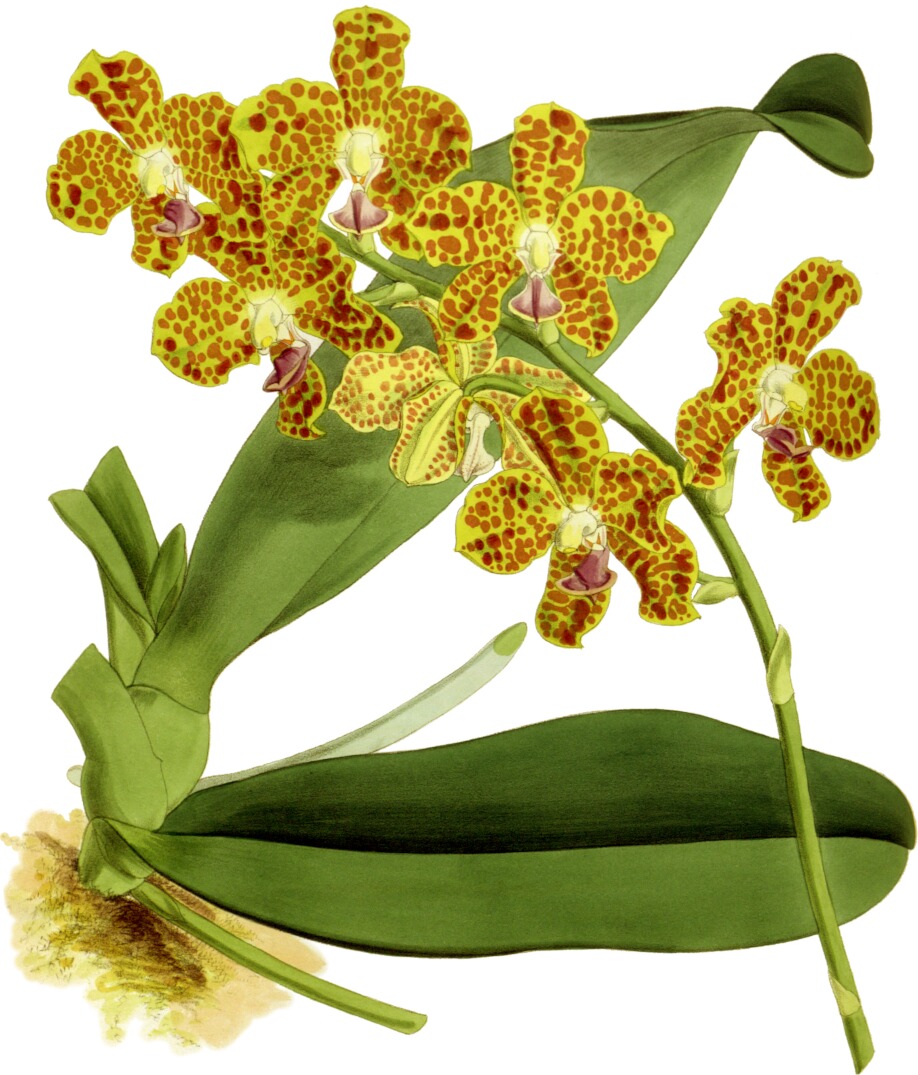
PL. 15. VANDA PARISHII.
28