CYPRIPEDIUM LAWRENCEANUM. [Plate 22.] Native of Borneo.
Reading edition
CYPRIPEDIUM LAWRENCEANUM. [Plate 22.] Native of Borneo.
Epiphytal. Stem almost none, the leaves springing from the crown of stout roots. Leaves radical, distichous, coriaceous, broadly oblong, acute, channelled, a foot long, the upper surface marbled with a dark green mosaic pattern on a whitish-green ground colour. Scapes solitary in the leaf-axils, stout, pubescent, with an oblong-ovate acute sheathing bract near the top, from which the flower or flowers emerge. Flowers very large, in the way of those of C. barbatum majus; dorsal sepal sub-rotund or very broadly-ovate, acute, white, with numerous (about thirteen) shining curved purplish veins which run out nearly or quite to the edge, and usually alternate with others which are short and less boldly marked; lateral sepals connate, small, oblong, greenish white, with five dark purplish veins; petals fully half an inch wide, divaricate, linear-oblong ciliate, green in the upper half, with purple margin, stained with dull purple towards the tip, and with several dark fleshy warts along each margin, the lower half flushed with pale wine red; lip very large, pouch-shaped, the lateral horns much developed, purplish brown above, yellowish green below, with numerous warts on the inside. Staminode of a wax-like yellowish white, the posterior exterior border split in the centre, and having five anterior teeth, the middle one much larger than the rest.
Cypripedium Lawrenceanum, Reichenbach fil., in Gardeners’ Chronicle, N.S., x., 748; Veitch and Sons, Catalogue of New Plants, 1879, p. 9, 23, with figure; Florist and Pomologist, 1880, 112, with figure.
The introduction of this splendid species of Lady’s Slipper is one of the results of Mr. F. W. Burbidge’s visit to Borneo, in the service of Messrs. Veitch & Sons, of Chelsea. It is a very robust grower, and flowered for the first time in the autumn of 1878, when it was named by Professor Reichenbach, in the place above quoted, in honour of Sir Trevor Lawrence, Bart., M.P., an ardent orchidophilist, and the possessor of a collection of Orchids of unequalled richness and beauty.
The Cypripediums now form a large family group, and rank amongst the most useful of Orchids that can be cultivated, since the lasting quality of their flowers, especially for exhibition and decorative purposes, is something extraordinary. Many of them in addition possess beautifully variegated foliage, as in the species we now figure, which has the leaves most distinctly marked with light and dark green. Our drawing was taken from a very fine plant in the select collection of H. M. Pollett, Esq., Fernside, Bickley, a gentleman who is a great lover of Orchids, and who has the wisdom to secure healthy young plants at the outset, in order that he may see them grow on into good specimens, such as the one now before us has done. It gives one great pleasure to see plants so well cultivated.
43
Cypripedium Lawrenceanum has, as we have already said, beautifully marked foliage, so that even when not in blossom, it is found to be an object of attraction. The upper or dorsal sepals of the flowers were in this case three inches across, white, striped with plum-purple, which runs in curved lines from the base nearly to the margin. The petals are green along the upper edge, suffused with purple towards the end, and having black wart-like spots, and a fringe of purple hairs along the margin. The pouch or lip is large, of a reddish brown colour in front, the under and hinder part yellowish green.
These plants are best grown in pots with peat, and a little charcoal, or sometimes a little good fibrous loam mixed with the peat. It is a free-rooting species, and likes to be well elevated above the pot rim, so that its roots can penetrate readily and work freely in the rough material. The pot should be half filled with drainage, so that a good supply of moisture may be given to the roots during the growing season. The Cattleya or the East India-house seems to suit the plants well, as in these structures they grow and flower freely.
The flowers are very useful for cutting, as they will keep a long time in vases if the water is kept sweet and pure.
Baron Schröder’s Orchids.—On the occasion of a recent visit to The Dell, Staines, the seat of Baron Schröder, we had the good fortune to inspect the fine collection of Orchids which has been got together. The houses are well built, after the plans of Mr. Ballantyne, the gardener, and are placed in good positions; not only have the ventilation and heating power been well considered, but cleanliness also; indeed the arrangement of the houses leaves nothing to be desired. The Orchids were, at the time, looking remarkably well. Entering the Phalænopsis house we noticed a fine plant in flower of the rare and beautiful Phalænopsis intermedia Portei, a treat which seldom falls to one’s lot, for it is a matter of regret that this splendid Phalænopsis is so rare in collections: it must be very scarce in its native habitat or collectors would surely find it oftener. Cypripedium Spicerianum was also flowering here. Several different species of Nepenthes were in fine character, growing above a tank, with their pitchers gracefully drooping over the water, in which position they seemed to be quite at home. In this house were also some grand plants of different species of Saccolabium, Cypripedium, &c., all doing well. Leaving the Phalænopsis house the Cattleya house, which runs at right angles to it, is next entered. Here we noticed a gigantic specimen of Cattleya exoniensis, carrying several spikes of flower; Lælia autumnalis atrorubens, with grand spikes, and flowers of unusual size and fine colour; and Dendrobium Wardianum in full beauty, suspended from the roof. The Cattleyas, &c., in this house were in grand condition, and bid fair to produce some fine spikes next season. In the Odontoglossum house Zygopetalum Gautieri was flowering well, also Miltonia candida and Sophronitis grandiflora. The East Indian Orchids were in an especially healthy condition, the collection containing some grand specimens of Vanda, Aërides, and Saccolabium.
This collection, which has been lately formed, bids fair to become one of the finest in the country, Baron Schröder being an enthusiastic lover of this handsome class of plants, and being also careful to obtain only the best varieties.—H. W.
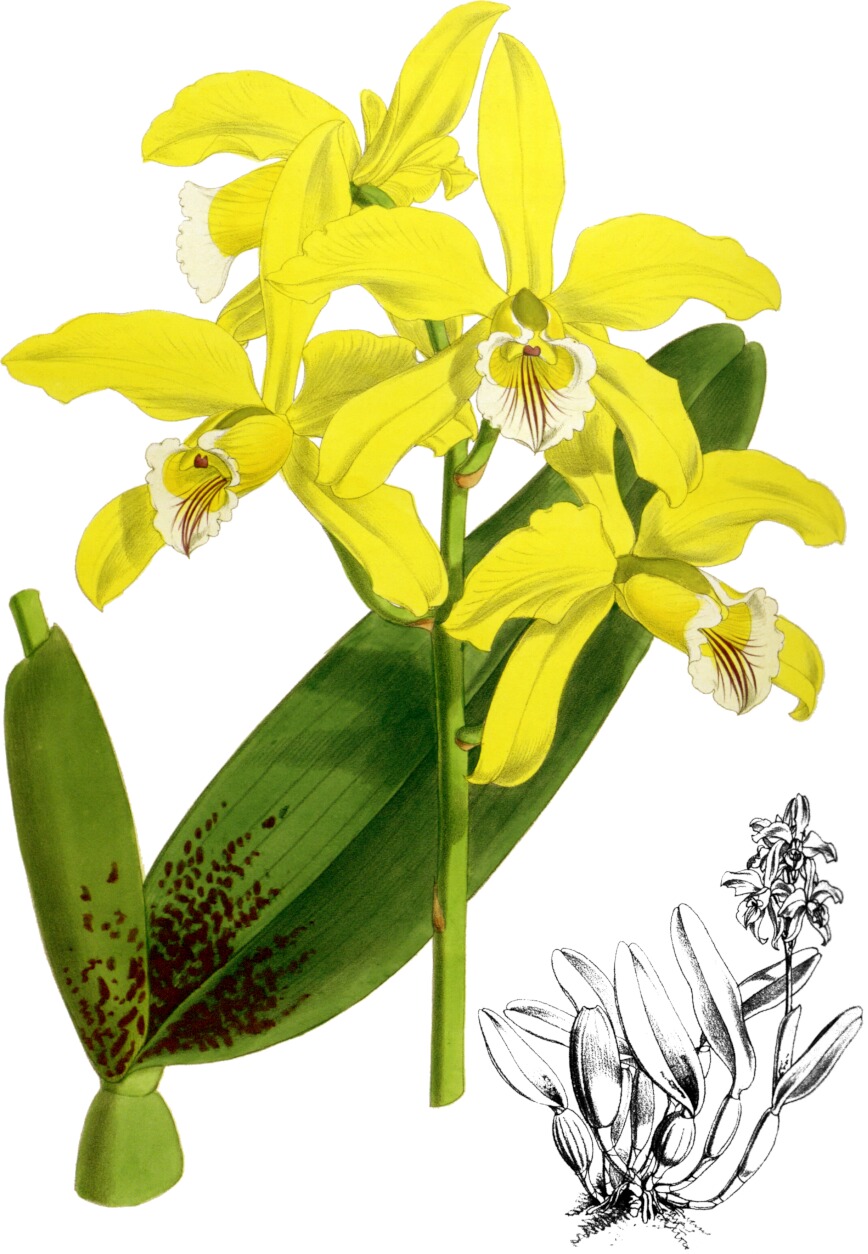
PL. 23. LÆLIA XANTHINA.
44