ODONTOGLOSSUM ALEXANDRÆ. [Plate 47.] Native of Bogota, New Grenada.
Reading edition
ODONTOGLOSSUM ALEXANDRÆ. [Plate 47.] Native of Bogota, New Grenada.
Epiphytal. Pseudobulbs oblong-ovate, compressed, often stained brownish purple, two-leaved. Leaves ligulate-oblong, acute, channelled toward the base, of a pleasing light green colour. Scape radical, supporting a many-flowered raceme, or in the more vigorous plants a panicle equalling or exceeding the leaves, and having small acute bracts at the base of the pedicels. Flowers exquisitely chaste and beautiful, white, tinted with rose, and variously spotted, fully three inches across; sepals ovate-lanceolate, acuminate, entire or toothed, white, suffused more or less with a delicate tint of rose-pink; petals in the best forms, broadly ovate and much undulated, entire or toothed, white, rather less deeply tinted with pink; lip shorter than the petals, oblong-ovate, the margin much crisped and the shortly acuminate apex recurved, white, with a rich yellow stain down the centre, and marked with reddish brown radiating lines on the disk, and with one or two (or in some forms many) rich red-brown spots or blotches half-way down, the disk also bearing a bilamellate crest. Column arcuate, club-shaped, chestnut-red.
Odontoglossum Alexandræ, Bateman, in Gardeners’ Chronicle, 1864, 1083; Id., Proceedings of the Royal Horticultural Society, iv., 186; Id., Monograph of Odontoglossum, t.t. 14, 19; Hooker, Botanical Magazine, t. 5691 (var. Trianæ), t. 5697 (var. guttatum); Jennings, Orchids, t. 26; Warner, Select Orchidaceous Plants, 2 ser., t. 23 (var. Warneri); Floral Magazine, t. 343; Williams, Orchid Grower’s Manual, 5 ed., 228.
Odontoglossum Bluntii, Reichenbach, fil., in Mohl and Schlechtendal’s Botanische Zeitung, “n. 53, Dec. 64;” Van Houtte, Flore des Serres, t. 1652.
Odontoglossum crispum, Lindley, in Annals of Natural History, xv., 256; Id., Folia Orchidacea, art. Odontoglossum, No. 57; Reichenbach fil., in Walpers’ Annales Botanices Systematicæ, vi., 845.
The Princess of Wales’ Odontoglossum, one of the most beautiful and one of the most useful of Orchids, was found in the province of Bogota, in New Grenada, at an altitude of from 7,000 to 8,000 feet, growing in great profusion on the branches of trees in the forests of that elevated region. It was introduced to this country in 1864 by Mr. Weir, when collecting for the Royal Horticultural Society, and was described in that year by Mr. Bateman as above quoted. There cannot be two opinions respecting its beauty, as it is one of the best Orchids in cultivation; and though there are amongst the imported plants great diversities in the form and colour of the flowers, yet all are beautiful. Some have the flowers of a pure white, in others they are variously suffused with a delicate rosy hue; some are spotted with crimson, and there are those with yellow flowers, but the 93 most chaste and beautiful of them all are the pure white varieties, tinted with rose colour, which are mostly sought after by cultivators, though the many beautifully spotted forms produce a fine contrast when intermixed with the others.
The figure we now publish was taken from a well-grown specimen in the collection of H.R.H. the Prince of Wales, at Sandringham, and, as this species is named in honour of the Princess of Wales, who is a great lover of flowers, and especially of the Orchidaceæ, we are proud to be able to announce that our artist has been permitted to prepare an illustration of this charming plant from such a source. There is a very fine collection of these plants at Sandringham, and among them are some very fine specimens, the accomplished gardener, Mr. C. Penny, being most successful in flowering them with grand spikes of bloom. There are also numerous varieties in the collection, but the one we have figured is a good example of the typical form.
Odontoglossum Alexandræ is a compact-growing plant, attaining about a foot in height; it is furnished with lively green foliage, and produces its blossoms after the growth is completed on a drooping spike which, as it overhangs the green foliage, has a most graceful appearance. The sepals are white, slightly tinged with pale rose colour, the petals are pure white, and the lip is white, with reddish-brown spots upon it, and a patch of bright orange-yellow at the base. The plants bloom at different times of the year, according to the period of the completion of their growth, and, therefore, by having a good quantity of plants, a succession may be kept flowering all the year round. We are never without a good show of these plants in bloom, and it is the same in all collections where they are grown in considerable numbers. The individual flowers will last many weeks in beauty. They are extremely useful for cutting, as they keep for a long time in water.
As this species requires what is called cool treatment very little expense need be incurred in its cultivation. Indeed, any one having a small house where a temperature can be kept up in winter of from 45° to 50°, with as little fire-heat as possible, can grow a great quantity of them, since they occupy but little space. In summer no fire-heat is required, unless the nights are cold, which is seldom the case at that season, but no draughts should be allowed to reach them, as draughts are as deleterious to them as to all other plants grown in glass houses. They require shading from the scorching rays of the sun, but like to have all the light that can be given them. Under this treatment they will grow stronger and stronger, and flower more and more freely.
The potting material which we find most suitable for them is good fibrous peat, with the finer earthy particles shaken out; they must have good drainage, in fact the pots must be three-parts filled with drainage material, and the plants well elevated above the pot rim. They are naturally free-rooting plants, but we find a little live sphagnum moss on the top of the peat causes them to root more freely, and as they require a good deal of moisture at the roots during their period of growth, the moss, if kept in a growing condition, will help to supply their wants.
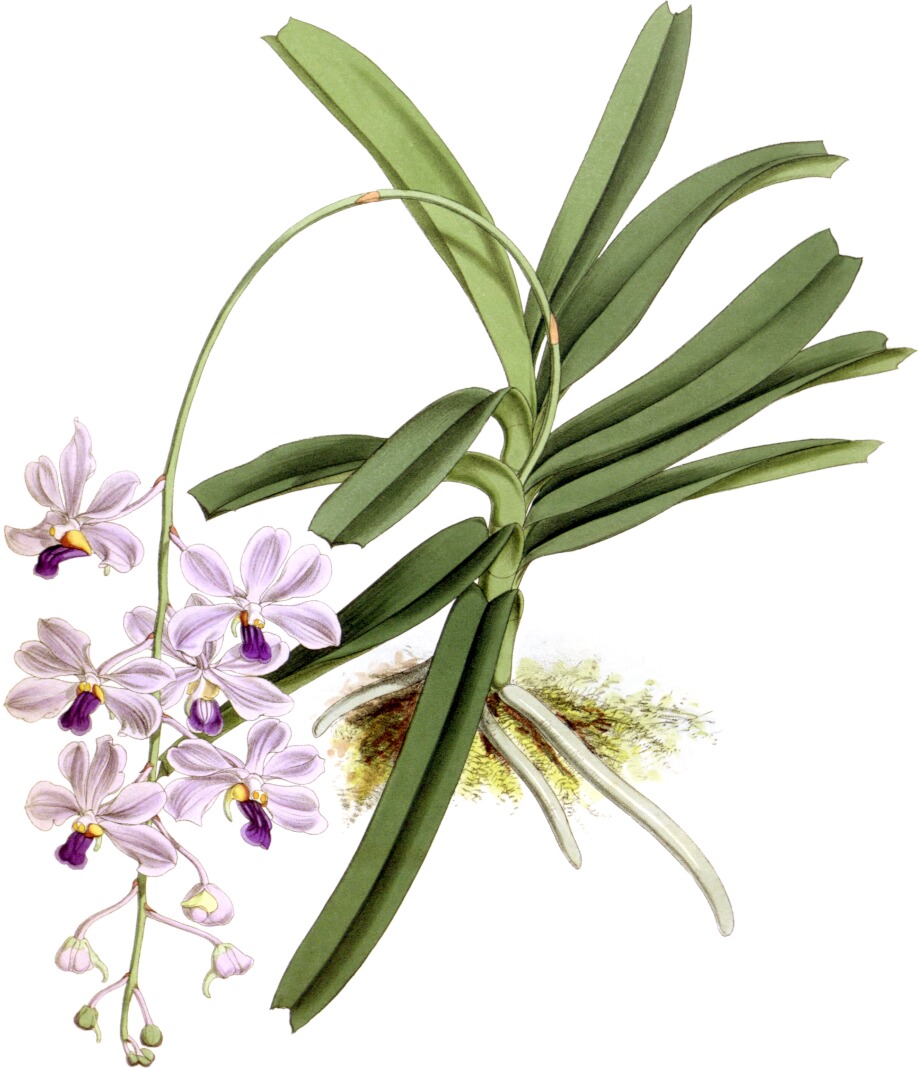
PL. 48. VANDA CŒRULESCENS.
94