DENDROBIUM BIGIBBUM. [Plate 38.] Native of Tropical North-east Australia.
Reading edition
DENDROBIUM BIGIBBUM. [Plate 38.] Native of Tropical North-east Australia.
Epiphytal. Pseudobulbs long, slender, erect, fusiform, one to two feet in length, closely invested between the nodes with dry light brown sheaths, the older ones swollen at the very base. Leaves oblong-lanceolate, sub-acuminate, five ribbed, of a deep green colour, and a somewhat coriaceous texture, a few only (five or six) being developed towards the extremities of the stems. Racemes erect or curving, six to twelve flowered, nearly a foot in length, usually produced from the upper nodes of the old leafless stems, but sometimes from the apex of the younger leafy stems. Flowers large, showy, rich rosy purple; sepals oblong acute, flat, of a rich purplish magenta, the lateral ones united at the base into a short blunt spur below the setting on of the lip, above which spur is a gibbosity, occasioned by a similar swelling at the base of the lip (whence comes the specific name bigibbum); petals large, roundish, spreading, recurved, of the same colour as the sepals; lip three-lobed, the lateral lobes incurved, the retuse middle lobe somewhat reflexed, rich crimson-purple veined with darker purple, the base decurrent and gibbose, and the disk with three white papillose crests. Columns compressed, grooved, the back united with the sepal.
Dendrobium bigibbum, Lindley, in Paxton’s Flower Garden, iii, 25, fig. 245; Hooker, Botanical Magazine, t. 4898; Walpers’ Annales Botanices Systematicæ, vi., 302; Warner, Select Orchidaceous Plants, 2 ser. t. 8; Van Houtte, Flore des Serres, xi., t. 1143; Bateman, Second Century of Orchidaceous Plants, t. 169; Williams, Orchid Growers’ Manual, 5 ed., 165.
This plant belongs to one of the most noble and popular, one of the most showy and beautiful genera of the whole family of Orchids, and one among the flowers of which nearly every colour occurs—bright yellow, pure white, rich crimson, bright purple, soft mauve, rich orange, nankeen, and many others being found among the many and various habited species of Dendrobes.
Dendrobium bigibbum, the subject of our plate, is a species of a remarkably beautiful and showy character, which, until within the last few years, has been somewhat rare. In 1876, however, we received a large consignment from our collector, Mr. Goldie, who was then on his way to New Guinea, and who met with it growing on an island in Torres Straits, it having hitherto, we believe, been found only on the mainland of Australia. These plants were very fine, some of the specimens being of enormous dimensions, with stems quite two feet long, and from one and a-half to two inches in circumference. The specimens from which our figure of one of the most charming forms of this species which we have yet seen, was prepared, were kindly sent to us from the fine collection of the Marquess of Lothian, at Newbattle Abbey. 75 Dalkeith, where it bloomed in September last in full beauty, amongst many other notable Orchids which are well cultivated by the intelligent gardener, Mr. Priest, who takes great delight in the careful management of his plants.
This species of Dendrobium is partially deciduous, the fully ripened stems sometimes losing the whole of their foliage, while the young growths retain their leaves until the following year. It grows from one to two feet in height, and produces its racemes of flowers sometimes from the top of the young growths, and sometimes from the old stems, in the latter case often bearing many spikes on the same stem. The flowers are of a rich rosy purple, and last in perfection for a considerable period. It is a most useful subject for associating with a button-hole bouquet, single flowers being shown off to great advantage by placing a light-looking fern frond behind them. The racemes of flowers last a long time after being cut if placed in water, and are most useful in all floral decorations. By growing several plants, successional blooms may be had at different periods.
This Tropical Australian species is best grown in a warm house, as the plants require a good amount of heat—70° to 80° while growing—and plenty of light, but the burning rays of the sun must be kept from them. They thrive best when planted in pans or baskets amongst rough fibrous peat and sphagnum moss, and suspended from the roof of the Orchid house. During the summer season they require a liberal supply of water, but in winter should have only sufficient to keep the stems plump. The plant will also succeed on blocks of wood, but, if grown in this way, it will in hot weather need watering twice a day, and once a day at other times. Some cultivators have been unsuccessful with this species, but we have found it to thrive well in a house where Crotons, Dipladenias, Stephanotis, etc., are grown; the Dendrobes seem to enjoy the moisture transmitted to them by the stove plants which are generally syringed in warm weather, and the dew arising from this operation appears to suit the Orchid. The syringe is also useful in subduing the red spider, which will sometimes attack the young growth. Insects often infest those kinds of Dendrobium that are grown in strong heat, but they must by this and other means be kept under.
Such treatment suits almost all the popular Dendrobes, namely, D. Devonianum, D. Wardianum superbum, D. chrysanthum, D. superbum (macrophyllum), D. crassinode, etc.; and the plants are found to be much stronger by reason of hanging near the glass well exposed to light, in which position they can be syringed on warm days—this moistening not only invigorating their growth, but being also a means of keeping insects under control.
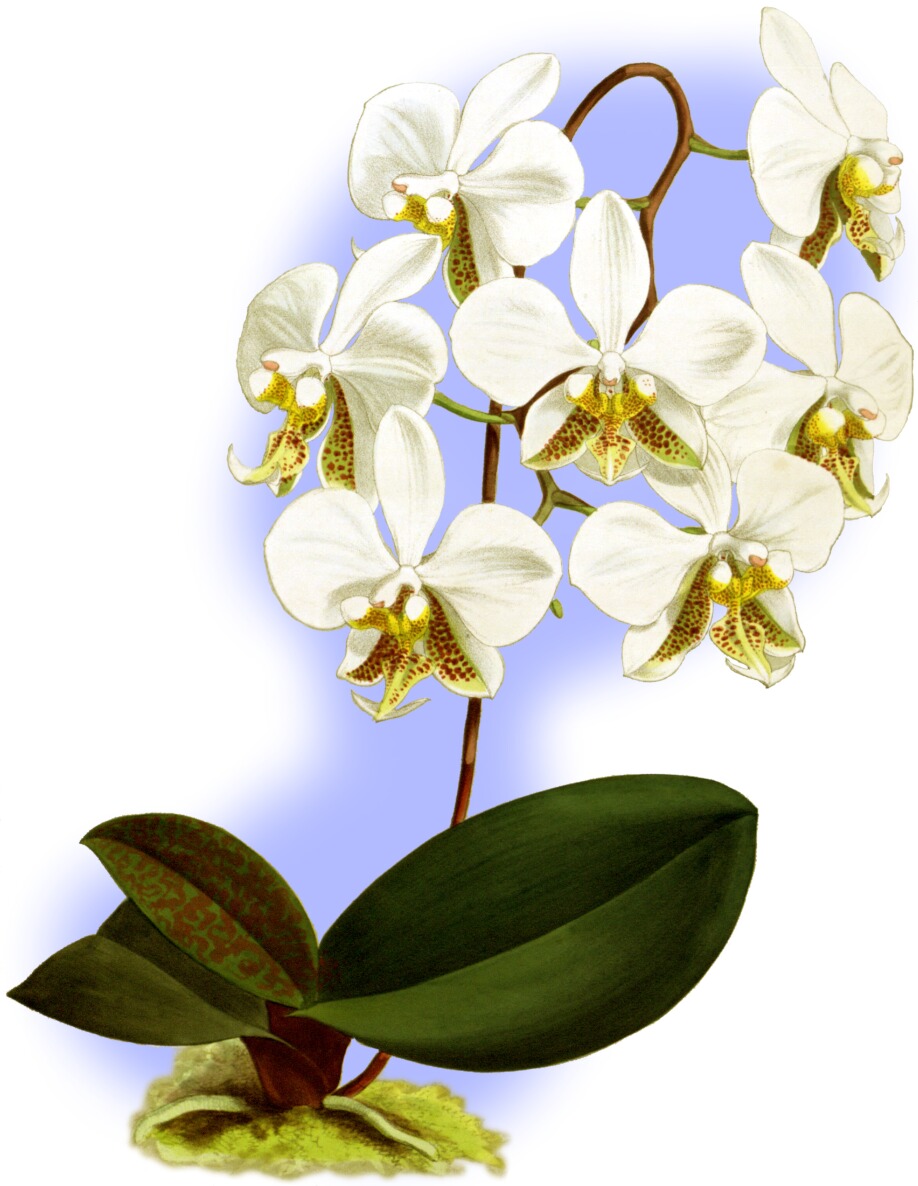
PL. 39. PHALÆNOPSIS STUARTIANA NOBILIS.
76