CYPRIPEDIUM STONEI. [Plate 8.] Native of Borneo.
Reading edition
CYPRIPEDIUM STONEI. [Plate 8.] Native of Borneo.
Terrestrial. Stem wanting, the short erect crowns each furnished with numerous radical evergreen leaves, and emitting stout fleshy roots. Leaves distichous (two-ranked), a foot or more in length, leathery or somewhat fleshy, oblong, obtuse, with a short recurved mucro, dark green above, of a paler green beneath. Scape dark purple, issuing from the centre of the leaves and furnished with a sheathing bract at its base, about two feet in height, three to four-flowered, the pedicels subtended by green lanceolate acuminate bracts. Flowers large, richly-coloured, measuring when spread out four inches in the direction of the sepals, and nine to ten inches in that of the petals; dorsal sepal broadly cordate, acuminate, nearly two inches broad, white, marked in front with a bold central, and on each side with two or three curved lateral stripes of deep purple-brown, keeled behind, and there stained with purple-brown; lateral sepals (united) ovate-acuminate, with a central and on each side three lateral stripes extending nearly to the base, greenish-white, edged with purple-brown; petals set at a right angle to the sepals, one-fourth of an inch broad, five inches long, tapering gradually to the apex, decurved, greenish-white with dark purple-brown veins and spots, becoming wholly purple at the tip, and having near the base a purple margin, and a few scattered marginal purple hairs; lip large, prominent, calceoliform, the basal portion unguiculate from the introflexion of the margin, greenish, the apex large, pouch-shaped, like the front of a shoe or slipper, dull purplish-red reticulately veined with darker purple. Column white, with a ring of yellow hairs at the base, two-branched, the lower branch three-lobed, the later lobes bearing each a small orbicular sessile yellow anther, the terminal lobe forming a large white ovate fleshy disk (abortive third stamen) the upper or stigmatic branch cordate-obovate, convex, whitish, tinged with purple, and fringed at the back and sides with yellow hairs.
Cypripedium Stonei, Low; Hooker, Botanical Magazine, t. 5349; Van Houtte, Flore des Serres, xvii., t. 1792-3; Lemaire, Illustration Horticole, ix., p. 107; x. t. 355; Bateman, 2nd Century of Orchidaceous Plants, t. 141; Jennings, Orchids, t. 12.
This magnificent plant is one of the most beautiful species of the genus Cypripedium. Several varieties of it are known, and though they are all good and well worth growing, that which we have selected for illustration is the best and darkest that has come under our notice. The plant from which our figure was taken, bloomed in the Victoria Nursery, and had five flower-spikes, two of which have been in bloom for the past six weeks, and are now as fresh as ever.
Cypripedium Stonei was first flowered by Mr. Stone, gardener to John Day, Esq., of High Cross, Tottenham, after whom it has been named. It was for a long period a very rare species, and, indeed now, though small plants may be purchased for a moderate sum, yet large specimens are scarce and valuable. It makes a fine 17 show plant, its lasting qualities being a great recommendation to it, both from an exhibition and decorative point of view.
The plant is a native of Borneo, and was introduced to this country by the Messrs. Low, of Clapton. It produces dark green foliage of about twelve or in some of the varieties we have seen as much as fifteen inches in length. From the centre of this tuft of leaves the flower-spikes are produced and rise to a height of about two feet, each bearing three or four of its large slipper-shaped blossoms, which are the most exact representations of a shoe or slipper of those of any of the species, and most completely justify the trivial name of the genus, Lady’s Slipper. The sepals are large, white, striped on the veins or nerves, with dark purple, and tinged with yellow; the petals are five inches in length, and are yellowish, streaked and blotched with purple; and the lip is large and of a dull reddish-purple, veined with deeper purple-red. It is of free-blooming habit, and when the growths are strong it produces a flower-spike from each crown, but it takes some considerable time to complete its growth before it sends forth its spikes; indeed, it begins to grow soon after its blossoms have faded. The plant having no thick fleshy bulbs from which to derive support, requires a more continuous supply of moisture than many other Orchids. The roots are coarse and fleshy, and should in consequence be supplied with a stronger soil than is required by some of the other kinds. We find it to thrive best in good fibrous loam, with a small quantity of charcoal, and a little leaf-mould or peat, all being well mixed together, giving the pots good drainage, but not so much as is required in the case of Cattleyas, for example. As it is a strong rooting plant, it is best grown in a pot, and should be a little elevated above the rim. We have found the East India house to supply the most suitable atmospheric conditions in which to cultivate it; here it should be placed on the side-tables near the light, but out of the sun. The finest specimen we have seen exhibited was staged by Mr. Child, gardener to Mrs. Torr, Garbrand Hall, Ewell, Surrey, at the South Kensington Show, in 1878.
There is a very distinct variety of this plant called Cypripedium Stonei platytænium, of which a figure has been lately published in Mr. Warner’s Select Orchidaceous Plants, 3 ser., t. 16. Of this form, living plants were till recently only to be found in the collection of John Day, Esq., but they were distributed when that collection was recently dispersed by auction sales, and were purchased at high prices by Baron Schröder and Sir Trevor Lawrence, Bart., M.P., in whose collections they may now be seen. This variety is just like C. Stonei in its growth, and the flowers are closely similar, the chief difference being, that the petals are shorter and broader, and resemble those of C. superbiens.
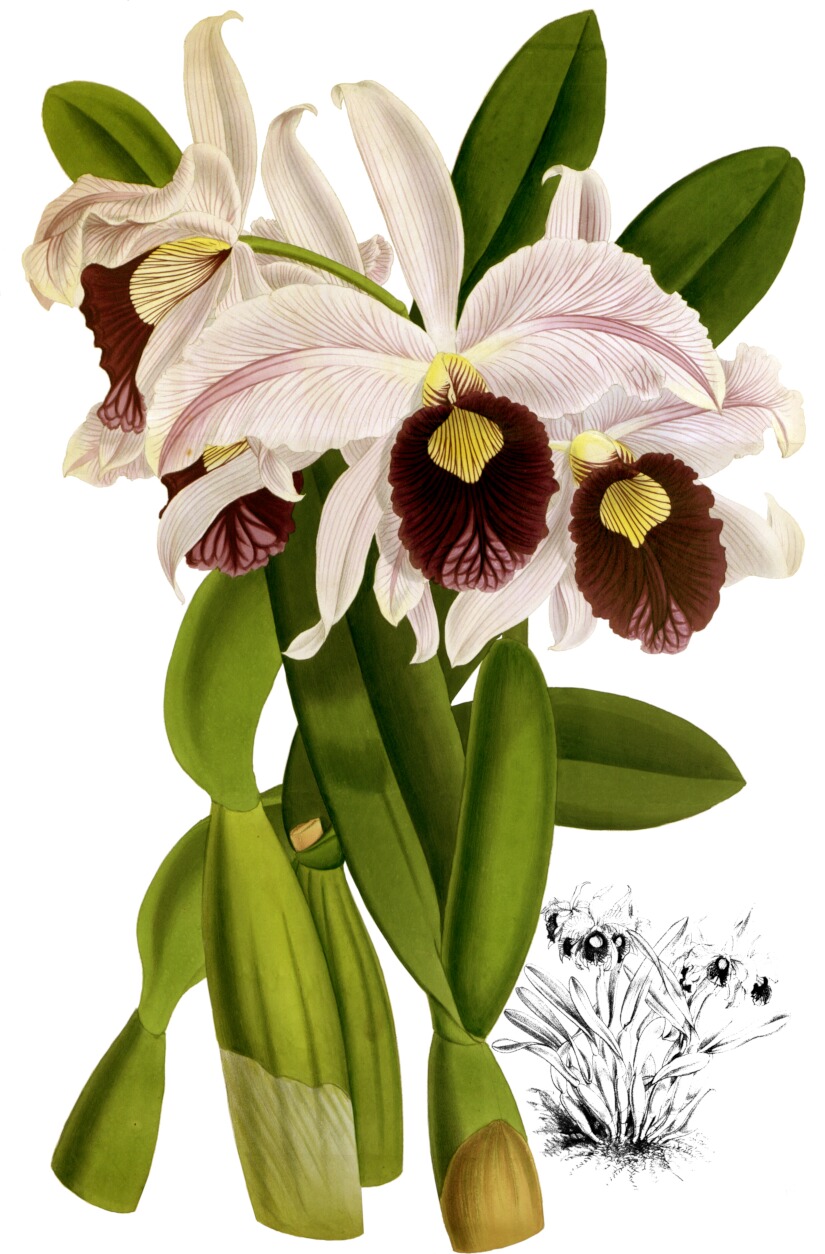
PL. 9-10. LÆLIA PURPURATA WILLIAMSII.
18