ONCIDIUM GARDNERI. [Plate 12.] Native of the Organ Mountains of Brazil.
Reading edition
ONCIDIUM GARDNERI. [Plate 12.] Native of the Organ Mountains of Brazil.
Epiphytal. Pseudobulbs oblong-ovate, furrowed, about two inches in height, dark green, purplish beneath. Leaves oblong-lanceolate, acute, coriaceous, about six inches long, growing two together from the apex of the pseudobulbs. Scape one and a half foot high, including the panicle of handsome flowers, lateral, that is, springing from the base of the pseudobulbs. Flowers showy, of medium size, deliciously fragrant; sepals oblong, acute, the lateral ones semi-connate; petals twice as large as the sepals, roundish in outline, clawed at the base, the edges undulated, and as well as the bars across the sepals of a light chestnut or bronzy brown colour with a narrow margin of pale yellow; lip large, three-lobed, the middle lobe large, transversely emarginate, bright yellow, with a belt of confluent parallel oblong chestnut brown blotches just within the margin, the lateral lobes auriculæform, obsolete, yellow; the crests of the lip consist of two pairs of tubercles with the intermediate space warted. Column furnished with dwarf roundish wings.
Oncidium Gardneri, Lindley, London Journal of Botany, ii., 662; Id. Folia Orchidacea, art. Oncidium, 19; Reichenbach fil., in Walpers’ Annales Botanices Systematicæ, vi. 728.
This charming Orchid is very nearly related to Oncidium curtum, O. prætextum, and O. amictum. It belongs to an extensive genus of Vandeous Orchids, many of the species of which are exceedingly beautiful on account of the brilliancy of their flowers, which are mostly of a bright yellow colour, often prettily spotted, and generally produced in graceful spikes or panicles. No collection should be without some of the best and most ornamental of them. The figure which we now publish represents a very charming Brazilian species, one of the best forms of the plant we have seen. Our drawing was made from a specimen in the select and varied collection of W. Vanner, Esq., of Chislehurst, who was kind enough to permit our artist to avail himself of it. This collection occupies several houses which are respectively filled with species belonging to the different groups or classes, and among which are some very rare specimens, all well cultivated by Mr. Milford, the gardener, who, for many years has been a successful grower of Orchids.
Oncidium Gardneri is a compact growing plant, furnished with dark green pseudobulbs, which are from two to three inches in height. The foliage is also dark green in colour, and about six inches in length. The flowers are very freely produced in branching spikes or panicles, and are generally developed in June and July, lasting for several weeks in perfection. The sepals and petals are brown, narrowly 23 margined with pale yellow. The lip is large, of a bright golden-yellow colour, margined with bright brown oblong parallel blotches. The flowers, moreover, are deliciously scented. There are many varieties of this plant, all of which are worth growing, since they take up but little space, and when grown in quantity, produce a good effect. We saw about fifty spikes of the different varieties, some in bloom, and others showing, in the collection of C. G. Hill, Esq., of Arnot Hill, near Nottingham, and we shall not soon forget the effect produced, as the group of plants appeared to be one mass of bloom. By cultivating plants of this character space may be economised, since they grow as freely on blocks as in baskets. We also find them to thrive well in small pans suspended from the roof of the Cattleya-house or in any situation affording them the same temperature, with very slight shading from the sun. They are best grown near the glass, so that they may get all the light possible. As a root medium, a mixture of good sphagnum moss and fibrous peat suits them best, but the plants must have good drainage, since they must be kept moist during the growing season, though when at rest a more limited supply will suffice—just sufficient being given to keep the bulbs plump, for on the other hand, it is not a plant that likes to be dried up. The bulbs sometimes shrivel when they flower too freely; if this is observed do not allow the blossoms to remain too long on the plants, as they will keep a good time in water when cut from the plant. Being of a graceful character they are well adapted for the decoration of drawing-room stands, in which, if intermixed with foliage and other flowers, they help to produce a very charming effect. Indeed no flowers are so useful as Orchids for decorative purposes, as they last so long when cut.
Lælia Dominiana rosea.—This is the finest hybrid Lælia that has come under our notice. It is the result of a cross between Cattleya Dowiana, and C. exoniensis, and the parentage is very evident in the novel form thus obtained. The lip is like that of C. Dowiana, of a rich purple-crimson, crisped at the margin; the sepals and petals are of a pale lilac colour. It is a most beautiful Lælia, and is named in honour of Mr. Dominy, who has been most successful in raising seedling Orchids. There have been many wonderful hybrids brought out by the Messrs. Veitch and Sons, through the indefatigable exertions of Mr. Dominy, who has long been known as one of the oldest and most successful of Orchid growers, and whose name will be kept in remembrance as long as Orchids are cultivated.—B. S. W.
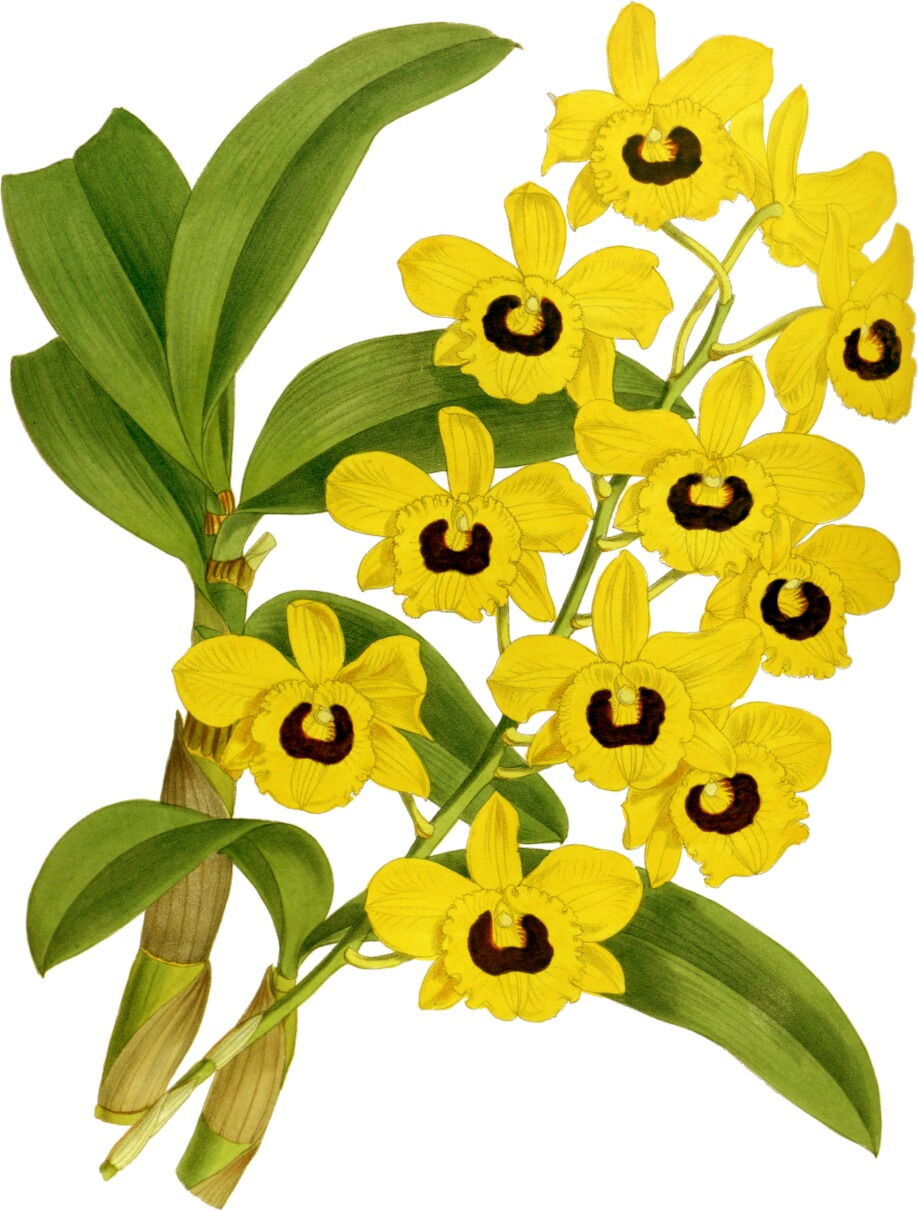
PL. 13. DENDROBIUM SUAVISSIMUM.
24