ANGULOA RUCKERII SANGUINEA. [Plate 19.] Native of Colombia.
Reading edition
ANGULOA RUCKERII SANGUINEA. [Plate 19.] Native of Colombia.
Epiphytal. Pseudobulbs large, ovate-oblong, four to six inches high, furrowed when mature. Leaves several, growing from the apex of the younger pseudobulbs, broadly lanceolate, acute, two to two and a half feet long and four to six inches broad, strongly ribbed and plaited. Flower-scapes radical, one-flowered, shorter than the leaves, clothed below with imbricated sheathing bracts. Flowers large, fleshy, nearly erect; sepals roundish with an apiculus, strongly convex, conniving into a semi-globular shape, which with their nearly erect position gives them a somewhat tulip-like appearance, creamy yellow outside, and of a deep sanguineous red on the inner surface; petals similar in form and colour to the sepals; lip clawed, subconvolute, three-lobed, the lateral lobes broadish and obtuse, the middle portion hairy, funnel-shaped and two-lipped, the front lobe tridentate, and with the middle part crimson blotched and barred with white. Column entire, creamy white, spotted with crimson.
Anguloa Ruckerii sanguinea, Lindley in Gardeners’ Chronicle, 1852, 271; Hooker, Botanical Magazine, t. 5384; Williams’ Orchid Growers’ Manual, ed. iv., 90; ed. v., 92.
The subject of our present illustration is an exceedingly rare plant, and is met with in only a few collections. In its habit of growth and general appearance it resembles the type Anguloa Ruckerii, but it is very distinct in colour, and is altogether a more desirable plant, the flowers being of a much richer colour—a deep rich blood-red spotted with a darker tint of the same—whereas in the original A. Ruckerii they are of a fine orange colour spotted with dark brown.
The growth of this plant is very majestic, producing as it does bulbs four to six inches high, and leaves from eighteen to thirty inches long, by four to six inches broad. The flowers, which proceed from the base of the pseudobulb, are erect, tulip-shaped, and of great substance and size, lasting as long as four weeks in perfection. A. Ruckerii sanguinea is a very suitable plant for exhibition purposes on account of the distinct appearance produced by its massive flowers when intermixed with other Orchids.
The temperature best suited for this plant is that of the cool Orchid-house. We have found it succeed well in pots in a compost of good fibrous peat, with plenty of drainage. It requires a good season of rest, during which period the plant should be kept rather dry until it begins to show renewed signs of growth, when the supply of water may be increased. It is propagated by division of the pseudobulbs just before they start into growth. We are indebted for the opportunity of 37 figuring this plant to Dr. Boddaert, of Ghent, Belgium, in whose collection it flowered last July.
A fine figure of the original Anguloa Ruckerii will be found in Warner’s Select Orchidaceous Plants, 2nd series, t. 10; and it is also figured in the Botanical Register, 1846, t. 41; and in Moore’s Illustrations of Orchidaceous Plants, art. Auguloa, plate 3.
Cattleya Dowiana.—We have received a very beautiful flower of this grand Cattleya, by post, from R. Dodgson, Esq., of Blackburn, in whose fine collection the plant has been grown. Mr. Osman, the gardener, says, “we had three imported plants last year, and two of them are now in bloom.” We were pleased to hear this, as Cattleya Dowiana is considered a difficult plant to flower, though we have seen many plants blooming this season. There is no doubt that its cultivation is becoming better understood. The variety above referred to has a large lip of a most intense dark purple, striped and reticulated with golden yellow, in a very prominent manner. The sepals and petals are large, of good substance, of a bright nankeen colour, and produce a very pleasing and altogether distinct appearance. This is, undoubtedly, one of the most distinct and beautiful of all Cattleyas. There is a grand figure of this species in the 2nd series of Warner’s Select Orchidaceous Plants, t. 27.—B. S. W.
Cypripedium Spicerianum.—We were pleased to receive last month a splendid bloom of this fine variety from J. S. Bockett, Esq., of Stamford Hill. There is no doubt that it is one of the most distinct species of the whole genus. The dorsal sepal is erect, curiously curved, pure white, of a wax-like texture, having a purple streak extending from the base to the apex; the linear-oblong petals are much crisped on the edge, and, like the other parts of the flower, are of a bronzy-green colour, the lip being darker, of a reddish-brown and glossy. It has been named in honour of H. Spicer, Esq., and was introduced from India some few years ago. We also received at the same time a fine form of Odontoglossum Chestertoni, and a most distinctly spotted variety of O. Alexandræ, the sepals and petals of which are white, spotted with reddish-crimson, and the lip white, with a large reddish-brown blotch on the lower portion.—B. S. W.
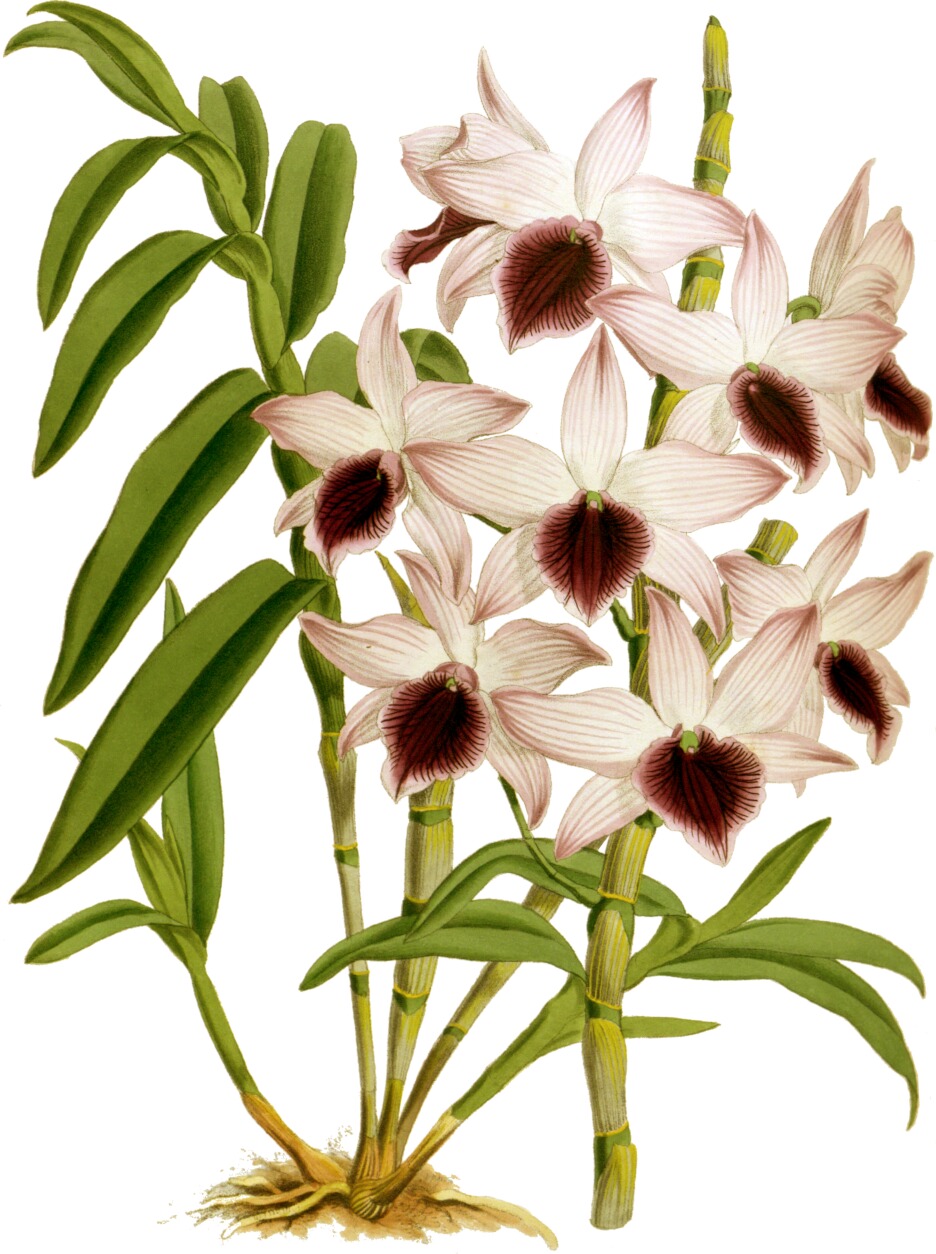
PL. 20. DENDROBIUM AINSWORTHII ROSEUM.[
38