ODONTOGLOSSUM BREVIFOLIUM. [Plate 27.] Native of the Cordillera of Peru.
Reading edition
ODONTOGLOSSUM BREVIFOLIUM. [Plate 27.] Native of the Cordillera of Peru.
Epiphytal. Pseudobulbs ovate-oblong, compressed, monophyllous. Leaves short, oblong, two inches broad, and sometimes not much exceeding that in length, spreading. Scape simple, radical, bearing at the apex a many-flowered erect raceme, the membranaceous bracts of which are oblong acute, and as long as the pedicels. Flowers nearly or quite two inches in diameter, of a rich chestnut brown on the inner, and olive-green on the outer surface; sepals roundish-ovate, somewhat undulated, narrowed at the base, of a bright chestnut-brown, narrowly bordered with yellow; petals similar in size and colour, oblong-ovate; lip clawed, auriculate, wedge-shaped, emarginate, shorter than the sepals, bright yellow, bearing at the base five warty tubercles, with a three-toothed appendage in front of them. Column small, the edges of the anther-bed serrated, and decurrent in the form of membranous wings.
Odontoglossum brevifolium, Lindley in Bentham’s Plantæ Hartwegianæ, 152; Id. Folia Orchidacea, art. Odontoglossum no. 61; André in Illustration Horticole, 3 ser. t. 170; Reichenbach, fil., in Walpers’ Annales Botanices Systematicæ. vi. 846.
This very distinct species was first found by Hartweg, on the Peruvian Andes, near Loxa, and was described by Lindley, in Mr. Bentham’s account of the plants collected by that traveller. It appears to have been introduced by M. Linden, and to have been first flowered in his establishment, the figure published in L’Illustration Horticole having been derived from this source. The small compressed pseudobulbs are formed at the end of a sucker or offshoot, which is invested by large membranous bracts or scales, the upper of which covering the base of the flower-scape is somewhat broader and leaf-like.
This Odontoglot ranks among the most distinct species of its genus, as may indeed be seen by a glance at our illustration. It produces dense spikes of its beautiful flowers, which are more in the way of those of Odontoglossum coronarium than of any other cultivated species; it, however, blooms more freely. The spike of flowers we have here represented was sent to us by Mons. F. Massange, of Liége, in whose collection the gardener—Mr. Kramer—induces it to flower freely every year. M. Massange is a great connoisseur of Orchids, and in his collection are to be found many rare and valuable specimens, which have been frequently exhibited during the past few years, including the Liége Exhibition of 1881.
53
Odontoglossum brevifolium is a dwarf growing plant, and produces its erect spikes of flowers from the side of the pseudobulbs. There were seventeen blossoms on that which is here represented. The sepals and petals are of a bright chestnut-brown, margined and slightly marked near the base with yellow, the lip is rich yellow with two light brown patches at its base. It is altogether a strikingly showy plant, and one that should be always cultivated amongst Odontoglots for its distinctness of colouring.
The treatment which we find to suit the plant, is to grow it in a basket suspended from the roof, as it requires and enjoys all the light that can be given to it; but, of course, it needs to be shaded from the burning sun. The most suitable material in which to grow the plant is sphagnum moss and fibrous peat. It requires also a good supply of water in the growing season, so that it must be thoroughly drained. It thrives best in a cool house in which the same temperature is maintained as is found congenial to Odontoglossum Alexandræ, and others of that class.
Odontoglossum Londesboroughianum.—We have been under the impression that this species was not so good as it was first reported to be, but we are now of a different opinion. There are no doubt many varieties of the plant, as is the case with nearly all Orchids. In their native countries they are produced freely from seeds, all of the variations not being equally good. If our collectors could only pick out the best, when in bloom, we should be saved many disappointments, but of course they cannot spend their time in doing this. We were agreeably surprised when we paid a visit to the collection of G. W. Law-Scholefield, Esq., New-Hall-Hey, Rawtenstall, near Manchester, to see a fine spike of the O. Londesboroughianum with twenty-five of its large blossoms, much finer than any we had ever seen before. The sepals and petals are yellow, barred with brown; the lip is large, of a bright golden yellow, and very showy, and, as the long spikes hung drooping among the white and coloured flowers of the other Orchids the effect was very good. No one could complain of having such a species as this, for it is a most showy flower.
Cypripedium insigne.—When calling at Mrs. Haywood’s, Norris Green, Liverpool, a few weeks ago, we were pleased to see a fine specimen of this old Orchid, which was two feet in diameter; on nearly all the numerous scapes there were two flowers, and very fine ones they were. Mr. Bardney, the gardener, informed us that they come so every year, which makes this plant the more interesting, as the character of the species is merely to produce one flower on a stalk. This plant was grown in the grand conservatory, in which there was a most wonderful display of blossom, in fact, the grandest lot of greenhouse flowers we ever remember to have seen in winter, consisting of Pelargoniumns, Primulas, Camellias, Cyclamens, and the Luculia gratissima, with 40 or 50 heads of bloom. There are not many Orchids at this place, but, what there are, are doing well, and are well looked after.
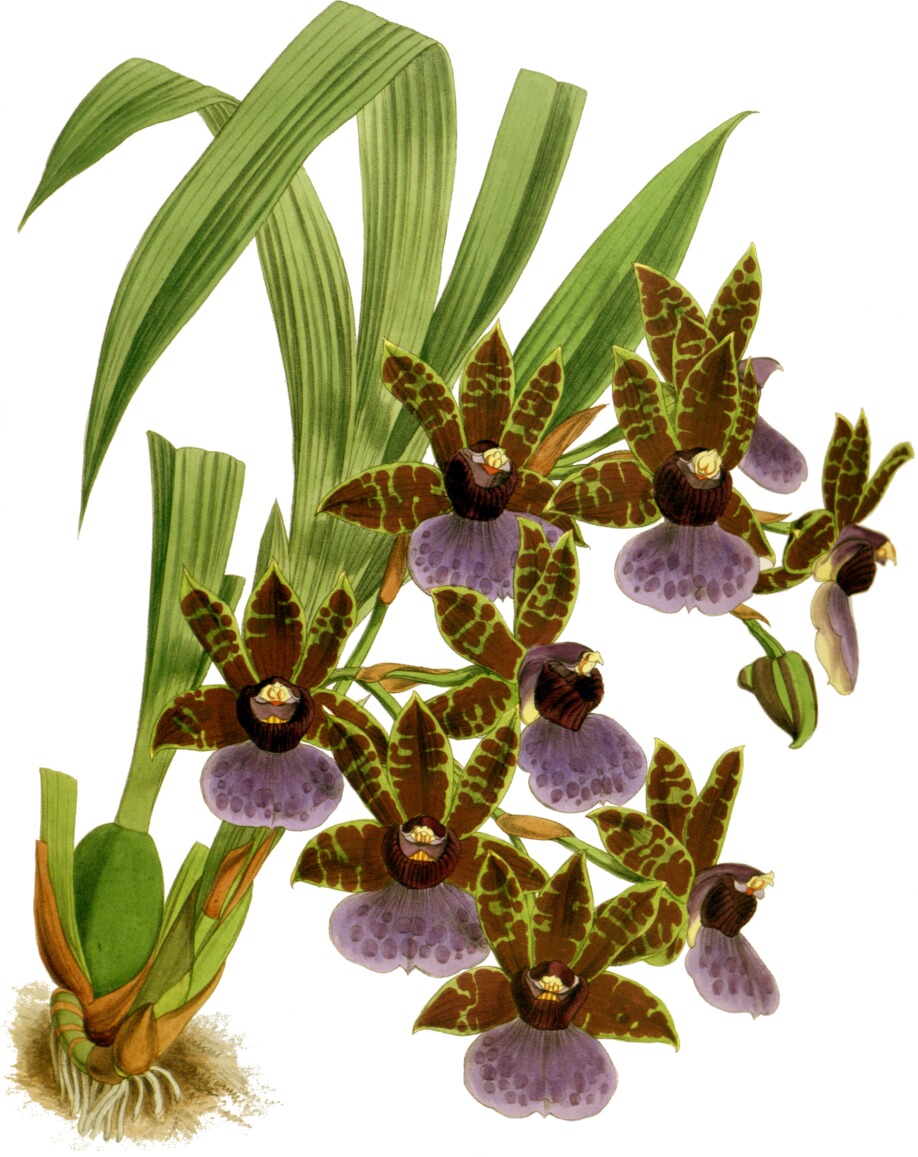
PL. 28. ZYGOPETALUM GAUTIERI.
54