LÆLIA PURPURATA WILLIAMSII. [Plates 9-10.] Native of St. Catherine’s, Brazil.
Reading edition
LÆLIA PURPURATA WILLIAMSII. [Plates 9-10.] Native of St. Catherine’s, Brazil.
Epiphytal. Stems (or pseudobulbs) clavate-oblong, monophyllous, two feet or more in height, somewhat furrowed when mature. Leaves coriaceous, evergreen, narrowly oblong, emarginate, dark green. Scape three to four-flowered, issuing from a stout sheathing oblong bract or spathe, four to five inches long. Flowers large, and very handsome; measuring eight inches across, of a delicate rose colour, with a purple-crimson lip; sepals linear-lanceolate, acute, of a pale rosy tint, pencilled with simple rosy-purple longitudinal lines; petals oblong-lanceolate, obtuse, of a beautiful delicate rose colour, pencilled with divergent forked lines of deeper purple; lip (labellum) three-lobed, the lateral lobes obsolete, convolute around the column, the front lobe large, broad, and roundish, of a rich dark crimson-magenta, the tip paler and reticulately veined, and the throat yellow, beautifully veined with crimson-magenta. Column scarcely reaching to the middle of the convolute base of the lip.
Lælia purpurata Williamsii, Hort.; Williams’ Orchid Grower’s Manual, ed. 4, 196; ed. 5, 208.
The species, of which this is one of the finest known varieties, and the genus Lælia to which it belongs, together with the neighbouring genus Cattleya, are placed by the great Orchidist, Reichenbach, in his amplified genus Bletia, so that the Lælia purpurata of Lindley, in Paxton’s Flower Garden, becomes the Bletia purpurata of Reichenbach in Walpers’ Annales, vi. 423. The name of Lælia is, however, that which is adopted amongst cultivators of Orchids.
The Lælia which we have now to describe, was named many years ago in the Orchid Grower’s Manual, when it was exhibited at the Crystal Palace and received its present appellation. The plant now represented was flowered at the Victoria and Paradise Nurseries, but has now passed into the select collection of Baron Schröder, of The Dell, near Staines. It was a wonderfully strong plant, and produced two spikes of its highly coloured blossoms, which led all those who saw it in its beauty, to pronounce it to be the finest Lælia they had ever witnessed. Our artist has given a good representation of the plant and its blossoms. The club-shaped stems and foliage stood thirty inches in height, and were provided with very strong sheathing bracts whence the flower-spikes issued, each bearing four flowers, which were individually eight inches in diameter. It has bloomed with us in the same style for two successive years. The plant that we flowered some years ago was not so large as that now figured, the reason being that it was not so strong a specimen, and, therefore, not able to produce such fine flowers. This is sufficient 19 evidence of the advance the plants make before they get to their full strength and vigour. In the variety before us the sepals and petals are of a delicate rose, veined with a beautiful dark tint of the same colour, while the lip is very broad, large, and splendidly coloured, the prominent parts of a rich dark crimson-magenta, paler and veiny at the tip, and beautifully veined with crimson on the yellow ground-colour of the throat. The blooming season is in May and June, the flowers continuing in perfection for three or four weeks, if kept free from damp and in a dry place. We have a house set aside specially for Orchids when in flower, and in it very little moisture is used, by which means we seldom get the flowers spotted or prematurely decayed.
There is another fine form of Lælia purpurata with white sepals and petals that are quite flat, not at all recurved; this variety has a rich dark crimson-magenta lip. We exhibited this form with nine flower spikes at the Regent’s Park Exhibition, and it produced a grand effect. There are many other fine varieties.
Lælia purpurata when well cultivated is a good looking plant, and even when not in bloom it is an object of attraction, on account of its stately evergreen foliage. It is a native of Brazil, and is found growing on the branches of trees on the outskirts of the forests where the plants get light, and are yet shaded from the burning sun. They are best grown in the Cattleya-house, and will thrive either in pots or baskets, but we find the pot system the best, as they are strong growing plants, and require ample space to bring them to perfection. They are the better for being moved about, especially if they are required for exhibition. There are no more showy Orchids for exhibition purposes, and this is especially true of such varieties as that now before us.
We find that they thrive best in good fibrous peat, and some live sphagnum moss on a part of the surface; when in a growing state the moss keeps them moist without too much water being given whilst they are making their growth. In watering them be careful not to wet the young shoots. The pots should be three parts filled with drainage, which must be formed of broken pots and lumps of charcoal intermixed. The plants must be elevated about two inches above the rim of the pot. The best time to pot them is after they have done blooming just as they begin to make new growths, and before the roots start, when they will soon commence to work into the clean sweet peat. If the plant is in a sufficiently large pot, and the soil about it is sweet and clean, it will not require re-potting, but it will benefit the plants greatly to give them some fresh fibrous peat just before they begin to root, as the old soil is apt to become hard and inert through constant watering. They require to be kept moist during the growing season, but must not even then be soddened with water. In winter only just sufficient must be given them to keep them moist, and to prevent their stems and leaves from shriveling.
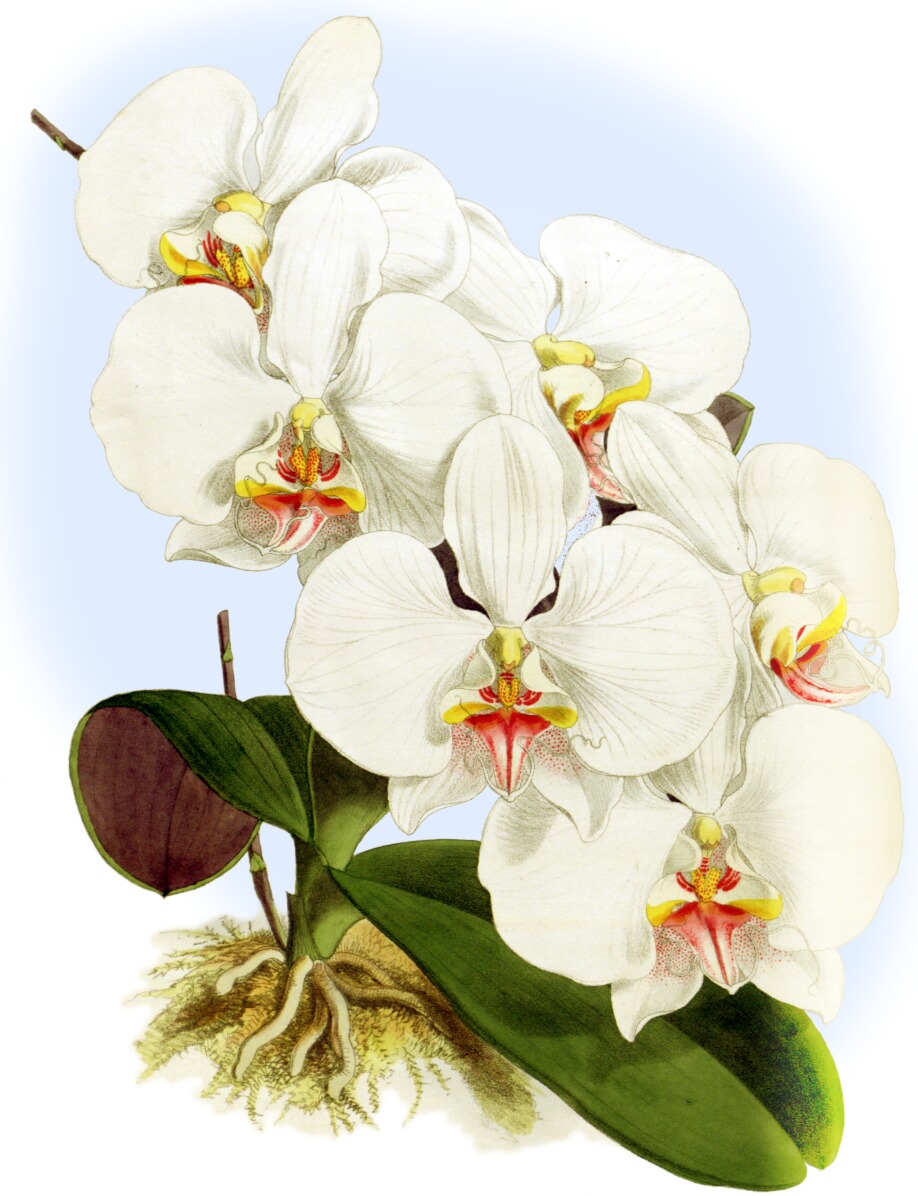
PL. 11. PHALÆNOPSIS AMABILIS DAYANA.
20