MASDEVALLIA SHUTTLEWORTHII. [Plate 5.] Native of the United States of Colombia.
Reading edition
MASDEVALLIA SHUTTLEWORTHII. [Plate 5.] Native of the United States of Colombia.
Epiphytal. Rhizome slender, slowly creeping. Leaves crowded, petiolate, the petiole with a sheathing scale at the base, the blade about equalling the petiole, two to three inches long, elliptic-oblong, acute, pale green, obscurely three to five-nerved. Scapes numerous, slender, as long as or longer than the petioles, green, with an ovate acuminate appressed bract at the top. Flowers yellowish, tinted with rose, rather large for the size of the plant; the perianth tube very short and swollen at the base; dorsal sepal of a pale yellowish red, indistinctly dotted with pale rosy red spots, and marked with from five to seven (or nine according to Reichenbach) longitudinal wine-coloured nerves, fully an inch long, sub-erect, concave or somewhat hooded, obovate, suddenly contracted into a tail two or three times its own length, the tail green below and becoming orange-yellow towards the tip; lateral sepals obliquely ovate, spreading, and decurved, thickly studded with deep red spots, and tapering off into a tail similar to that of the dorsal sepal; petals small, linear-oblong or ligulate, bilobed at the apex; lip very small, broadly oblong, recurved at the tip, with two keels or ridges running down the centre. Column short, three-toothed at the apex.
Masdevallia Shuttleworthii, Reichenbach fil. in Gardeners’ Chronicle, N.S. iii., 170; Hooker fil., Botanical Magazine, t. 6372.
Of this interesting plant, one of a popular genus inhabiting the cool temperate humid regions of Northern and Western South America, Professor Reichenbach, by whom it was dedicated to Mr. Shuttleworth, one of Mr. W. Bull’s collectors, remarks that it is “rather a nice thing amongst Masdevallias of the second order of beauty.” It was first flowered in 1878 by W. H. Punchard, Esq., of Poulett Lodge, Twickenham. Our figure was prepared from a plant which has bloomed in our own collection recently. We find it to be a very free-blooming species.
The Masdevallias comprise many interesting species and varieties, some of very remarkable structure, and others with colours of extraordinary richness and brilliancy. Our present subject is not one of the most showy, but it may be ranked with the more curious of the species, and is certainly of a distinct and pleasing character, as is well represented in our Plate. The plant was discovered by Mr. Shuttleworth, when travelling for Mr. Bull, and by him it was first transmitted to Europe. Since then we have received it from the same country through our own collector, Mr. Carder. The Masdevallias are plentiful in their native habitats, but the difficulty of obtaining them in this country lies in the risks attending importation, which are mainly attributable to the fact that they have no thick fleshy bulbs to support them 11 during their journey. We have heard of thousands of plants of this particular species having been sent off, but of these comparatively few have been received alive, so that unless some more successful means of introducing them into England can be found, it will always remain a rare plant.
Masdevallia Shuttleworthii is of free-blooming habit, and the flowers last a long time in perfection. It generally blossoms during the spring and summer months. The plants require but little room, as the foliage is of neat growth, and the whole height of the plant does not exceed from six to eight inches. The leaves are of a dark green colour and firm texture. The flower-scapes proceed from the young growth, and attain the height of about eight inches, the more conspicuous spreading long-tailed sepals being of a pleasing yellowish rose colour thickly marked with wine-red spots, while the petals and lip are small and inconspicuous.
We find the plants grow well when potted in small pots or pans suspended from the roof, and filled with peat and sphagnum moss; but they require thorough drainage, since they need a liberal supply of water during summer. In the autumn and winter months they do not require so full a supply, but they must have sufficient to keep them moist. They thrive best in the same house with the Odontoglots, where they obtain shade, and are kept cool. None of the Masdevallias like heat, and most of them require the same kind of treatment. The house in which they are grown should have a north aspect, so that they may not get too much sun-heat, as this causes the leaves to become spotted, to the great disfigurement of the plant.
Insects become a nuisance if allowed to accumulate on the plants. The thrips, which is one of their greatest insect enemies, constantly attacks them, and must be subdued by cleansing them frequently and thoroughly with a sponge and warm soft water.
The propagation of Masdevallias is effected by dividing the plants, leaving a few old bulbs with a leading one in front. They are the easiest of all Orchids to increase, and are best divided up occasionally, as when the plants get too large they do not flower so freely. The most suitable time to perform this operation is just as they commence to make their growth. They should at first be put into small pots, and shifted into larger ones as they increase in size, and develope abundance of roots.
Lælia Philbrickiana.—This new Hybrid was exhibited at the Royal Horticultural Society, South Kensington, by the Messrs. Veitch and Sons. It was raised between Cattleya Aclandiæ and Lælia elegans, partaking of the dwarf habit of C. Aclandiæ. The plant grows about eight inches high, and produces its leaves in pairs, of a dark green colour, about four inches in length; from between these the flower-sheaths proceed. The sepals and petals are of a glossy purplish crimson-brown, spotted with darker spots; the lip is of a bright crimson, the basal part purple and white. It blooms in June and July, and will be a very useful addition to our collections.—B. S. W.
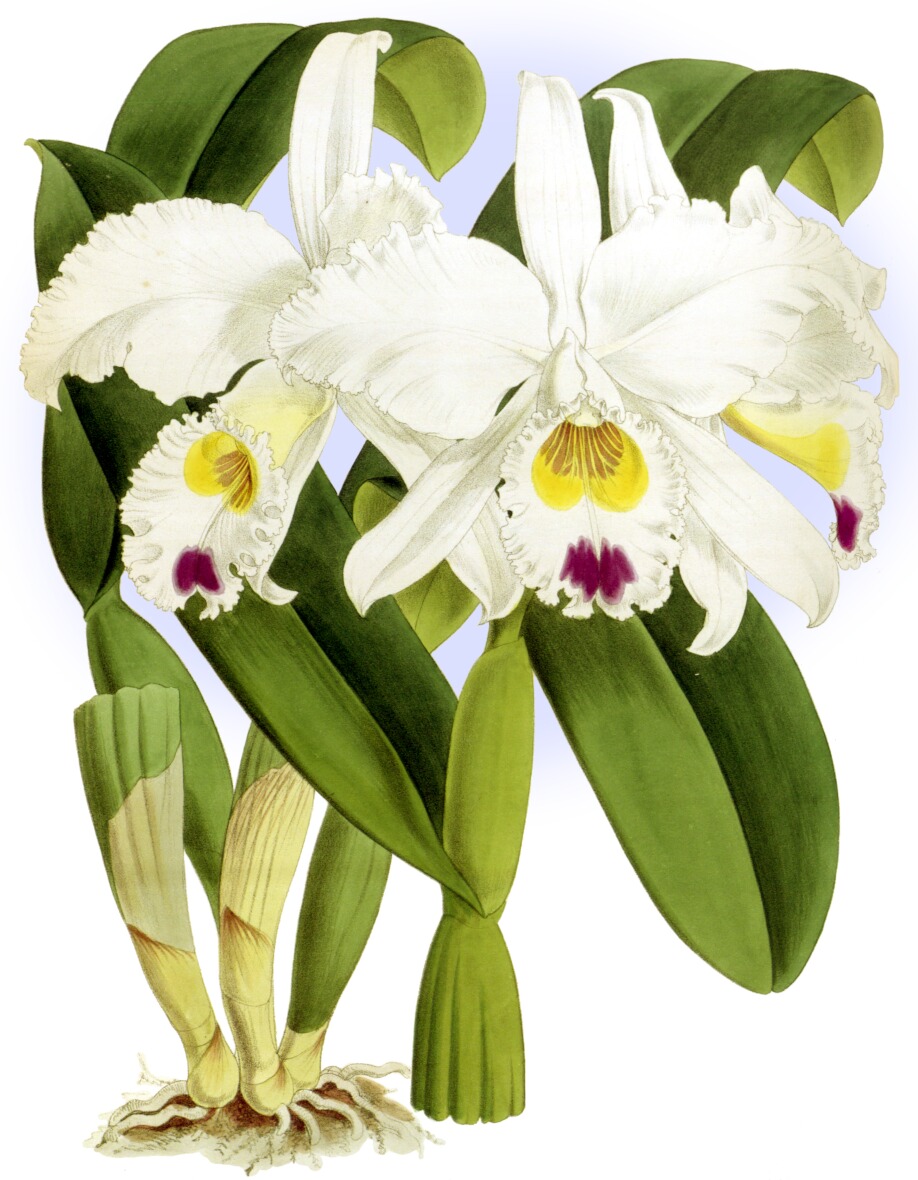
PL. 6. CATTLEYA MORGANÆ
12