CATTLEYA GUTTATA LEOPOLDII. [Plate 16.] Native of the Island of St. Catherine, Brazil.
Reading edition
CATTLEYA GUTTATA LEOPOLDII. [Plate 16.] Native of the Island of St. Catherine, Brazil.
Epiphytal. Stems (or pseudobulbs) elongate, fusiform, many-jointed, two to two and a half feet in height, bearing a pair of leaves at the apex. Leaves broadly-oblong obtuse, dark green, coriaceous. Scape terminal, issuing from a short ovate acute ancipitous spathe developed between the leaves on the more vigorous stems, and bearing a many-flowered raceme, with small lance-shaped bracts. Flowers fleshy, in dense racemes, “sometimes as large as a man’s head;” sepals cuneate-oblong acute, the lateral ones subfalcate, of a light cinnamon or orange-tinted brown, spotted thickly with crimson; petals similar in form and colour, but rather broader and wavy; lip three-lobed, the lateral lobes semi-ovate, acute in front, rolled over the column, the middle lobe cuneate-flabellate and bilobed, of a bright magenta colour, the disk tuberculate with lines of elevated papillae.
Cattleya guttata Leopoldii, Linden and Reichenbach fil., Pescatorea, t. 43.
Cattleya Leopoldii, Hort. Verschaffelt; Lemaire, Illustration Horticole, ii. 69.
Epidendrum elatius, var., Reichenbach fil., MSS.; Id., in Walpers’ Annales Botanices Systematicæ, vi. 319.
This noble plant is remarkable for the large mass of richly-coloured flagrant blossoms which terminates the flower-scape, and is very much superior to the old Cattleya guttata, which was introduced to our collections some fifty years ago, and of which a fine figure was published in the Transactions of the Horticultural Society, ix. t. 8. The variety Leopoldii differs from the type, in its much larger flowers, and in the rich olive or reddish-brown colour of its sepals and petals, which are freely spotted with dark crimson. C. guttata Leopoldii is, moreover, of much more recent introduction than the type, having been imported to the gardens of Belgium by M. Ambroise Verschaffelt, through his collector, M. Devos, in 1850. It was by him dedicated to his Majesty the late King of the Belgians. As will be seen from our illustration, it is a very great improvement on the typical form. We are indebted to H. Shaw, Esq., of Buxton, for the opportunity of securing our figure, the plant having flowered in his choice and valuable collection during the month of August in the present year, producing a spike of eleven fine flowers, each measuring three inches in diameter. This must be regarded as a very valuable Orchid, since it blossoms during the late summer months, when flowers are comparatively scarce in our Orchid houses; while for exhibition purposes, again, it is of great value.
The plant now before us is a strong grower, like Cattleya guttata, and sometimes produces as many as thirty flowers in a spike. A plant bearing a spike of this noble character was exhibited some years ago by Mr. Page, then gardener to the late 31 W. Leaf, Esq., of Streatham, and was a most wonderful object. The stems grow from twenty to thirty inches in height, and are furnished at the apex with a pair of broad leathery leaves of a dark green colour. It produces its flowers from the top of the bulb after it has finished its growth. The sepals and petals are of a lively cinnamon-brown, spotted with rich deep crimson; while the lip is of a bright magenta, with the basal lobes of a paler rose colour. The blossoms last some two or three weeks in perfection.
Cattleya guttata Leopoldii requires the same treatment as that recommended for other Cattleyas under Plates 3 and 6. Being a tall-growing plant, pot culture will be found to suit it best.
M. Massange’s Orchids.—Château de Baillonville, the country seat of Mons. D. Massange de Louvrex, is situated in the Ardennes, about 6 miles from Marche, and some 80 miles from Brussels. The collection of Orchids at the Château is very large, one of the finest in Belgium. In the house devoted to East Indian Orchids there are some grand specimens of Vandas, Aërides, and Saccolabiums. During a visit in July last, we noticed in bloom a very fine variety of Vanda tricolor planilabris, the flowers of which were very large, with fine broad sepals and petals, the markings being well defined and the colour bright. Here was also a grand plant of V. Cathcartii, about four feet high, in perfect health. Cypripediums are, moreover, treated with great success in this house; indeed, we noticed some plants of C. caudatum with extraordinary growths upon them, one plant having leaves as much as eighteen inches long, and quite distinct in the character of its growth, being almost erect. In the Cattleya house were some fine examples of Cattleya labiata, the true autumn-flowering variety; also C. Warnerii in abundance, and C. Mendelii. Zygopetalum Gautieri, the best variety, with dark blue flowers, was also open. Cælogyne Massangeana, had a spike of twenty-three flowers; this species is a grand subject for treating as a basket plant, the spikes being of a drooping character; we have seen it bearing as many as twenty-seven flowers on a spike. There were, moreover, in the same house, some enormous plants of Cattleya Trianæ, marvels of cultivation, with good specimens of Lælia elegans, L. anceps, L. Perrinii alba, L. elegans prasiata, L. Stelzneriana, Cattleya Dowiana, &c., all in perfect health, and doing well. In the Odontoglossum houses there was not much in flower, but the plants were looking remarkably well and making enormous bulbs. Here we noticed the largest plant of Restrepia antennifera we have ever seen; the plant probably measured as much as eighteen inches across, and had some hundreds of leaves. Masdevallias were well represented, and there were some good varieties in flower: amongst others was a grand plant of M. macrura, as well as M. Houtteana and M. trochilus, forming good specimens. We saw a splendid specimen of Odontoglossum citrosmum roseum with nine flower-spikes, a marvel of good cultivation. Altogether, we believe, this is the most select collection of Orchids in Belgium, and great credit is due to Mr. Wilkie, the gardener, for the way in which he cultivates his plants; his employer, however, spares no expense in providing the appurtenances necessary to good cultivation.—H. Williams.
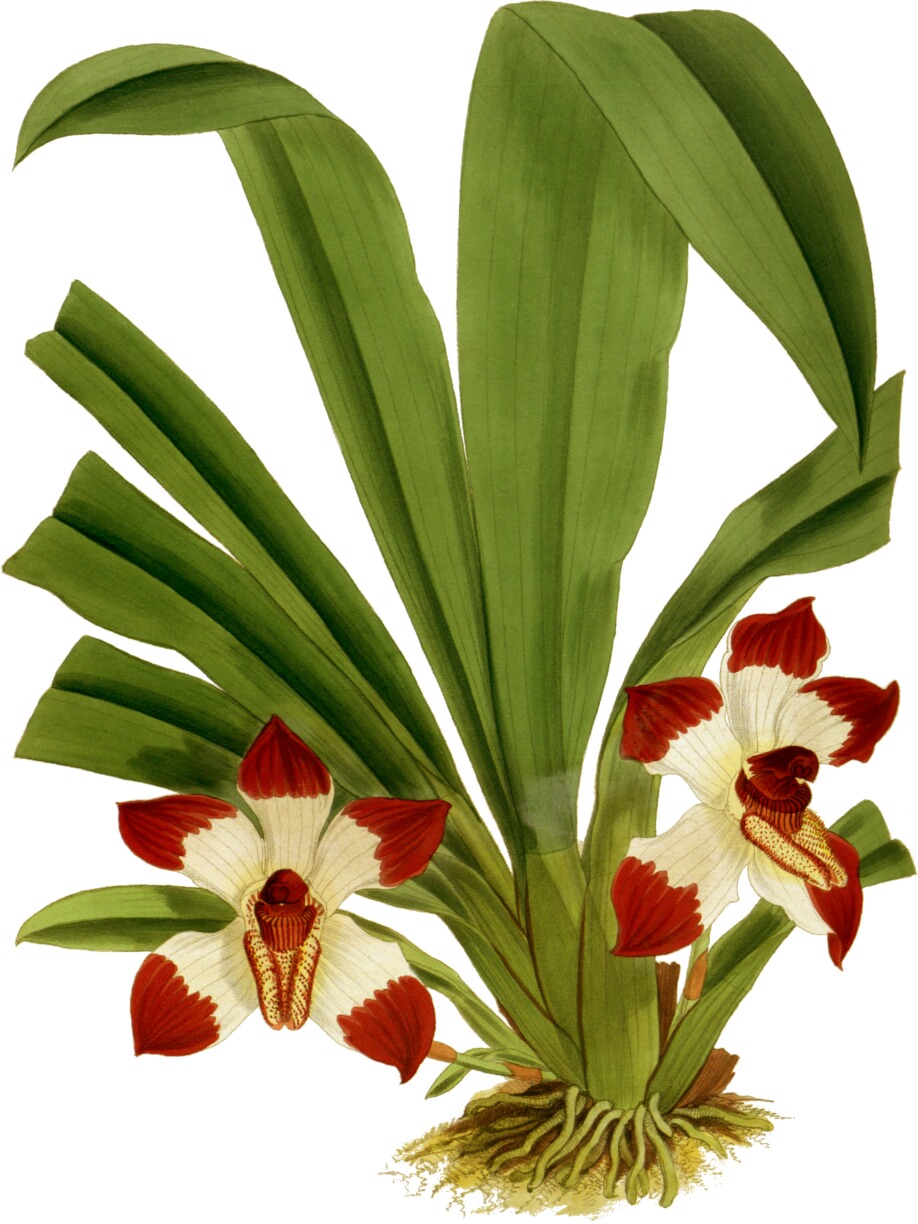
PL. 17. PESCATOREA KLABOCHORUM.
32