AËRIDES LOBBII. [Plate 21.] Native of Moulmein.
Reading edition
AËRIDES LOBBII. [Plate 21.] Native of Moulmein.
Epiphytal. Stems erect, densely foliose, producing the stout aërial roots from between the leaf bases. Leaves evergreen, close set, distichous, leathery in texture, loriform, channelled, obliquely bilobed at the apex, of a deep green colour, obsoletely spotted with purple, paler on the under surface. Racemes axillary, many-flowered, long, branched, cylindrical, pendulous. Flowers very numerous, medium-sized, fragrant, the sepals and petals white, flushed with rosy purple and spotted with deeper rose-purple, the broader lip with a bar of rosy purple, darkest in the centre, from base to apex, and bordered with white; sepals and petals elliptic-oblong, nearly equal, incurved; lip much larger, clawed, the claw hollowed out and coadunate with the base of the column, the limb ovate or somewhat lozenge-shaped, wavy at the margin; spur arcuate, somewhat compressed laterally. Column short, in form resembling the neck and beak of a bird, with the front edge produced and folded over the stigmatic cavity.
Aërides Lobbii, Hort. Veitch; Lemaire, Illustration Horticole, xv., t. 559; Williams, Orchid Growers’ Manual, ed. 5, 67; Rand, Orchids, 149; Britten & Gower, Orchids for Amateurs, 177.
This very beautiful brightly-coloured plant was discovered in Moulmein by Mr. Thomas Lobb, who sent it to the Messrs. Veitch & Sons, of Chelsea, about the year 1856. It is of remarkably free-flowering and decorative character, and is no doubt one of the most beautiful species of this fine genus of Orchids, being valuable alike on account of its compact-growing habit, and the strikingly ornamental nature of its inflorescence. There appear to be several varieties of this plant distributed through our Orchid collections, all of them handsome and deserving of cultivation, but that which we now illustrate, from a finely grown, elegantly branching spike, kindly sent to us by C. J. Hill, Esq., of Nottingham, and referred to in the note published under Plate 15, is the finest form, and the most freely bloomed specimen we have met with. We were, in truth, charmed with the size and colour of the flowers of this plant, when recently inspecting Mr. Hill’s collection, the long spikes of blossom which were produced by so small a plant being quite extraordinary.
There is no genus of Orchids that surpasses Aërides in having handsome evergreen foliage, so that, even when not in blossom, they are exceedingly pretty objects; while to this it must be added, that their flower-spikes are beautiful, and their 41 flowers deliciously fragrant; some, of course, are more handsome than others, but all are worth growing: in fact, we have never seen an indifferent Aërides. They have every good quality that a plant of this character can possess, and they are of easy cultivation, so that anyone who has a stove may manage them successfully. They do not require so much heat as some persons imagine; the temperature need not be above 65° in the winter; more is, indeed, required in summer, but even then sun-heat should be fully utilised, and very little fire-heat should be used.
Aërides Lobbii blooms in June and July, and lasts for three or four weeks in beauty. The plant, from which our illustration was taken, was but a foot in height, and the magnificent flowering racemes we saw upon it were fully two feet six inches in length, with two branches each a foot in length. The sepals and petals are white, spotted with bright rose colour; the lip is also of a bright rose colour, slightly veined and margined with white. The flowers are deliciously fragrant.
The plant being very compact in growth, occupies but little space, so that anyone having a small vacant place in the Orchid-house or plant stove, might readily grow it. It will thrive either in a basket suspended from the roof of the house, or in a pot planted in sphagnum moss, with good drainage, and a moderate supply of water during the summer season, while in winter only just sufficient should be given to keep the moss damp. The plants do not, however, like to be dried up, as this often causes them to loose their bottom leaves, which is a great disfigurement. They require plenty of light, but do not like to be exposed to the burning sunshine. Canvas should therefore be used as a shading during all the bright sunny portion of the day, but when the sun has, in some degree, lost its burning heat the blinds may be raised. Never allow water to get into the hearts of the plants in winter. In summer a fine rose should be employed to syringe them, which operation should be done about three o’clock in the afternoon, when the house is closed.
They should be always kept free from insects. Scale, thrips, and many other insects are to be reckoned amongst their enemies, and cockroaches, if allowed to attack them, will often eat away their young roots and flower-spikes.
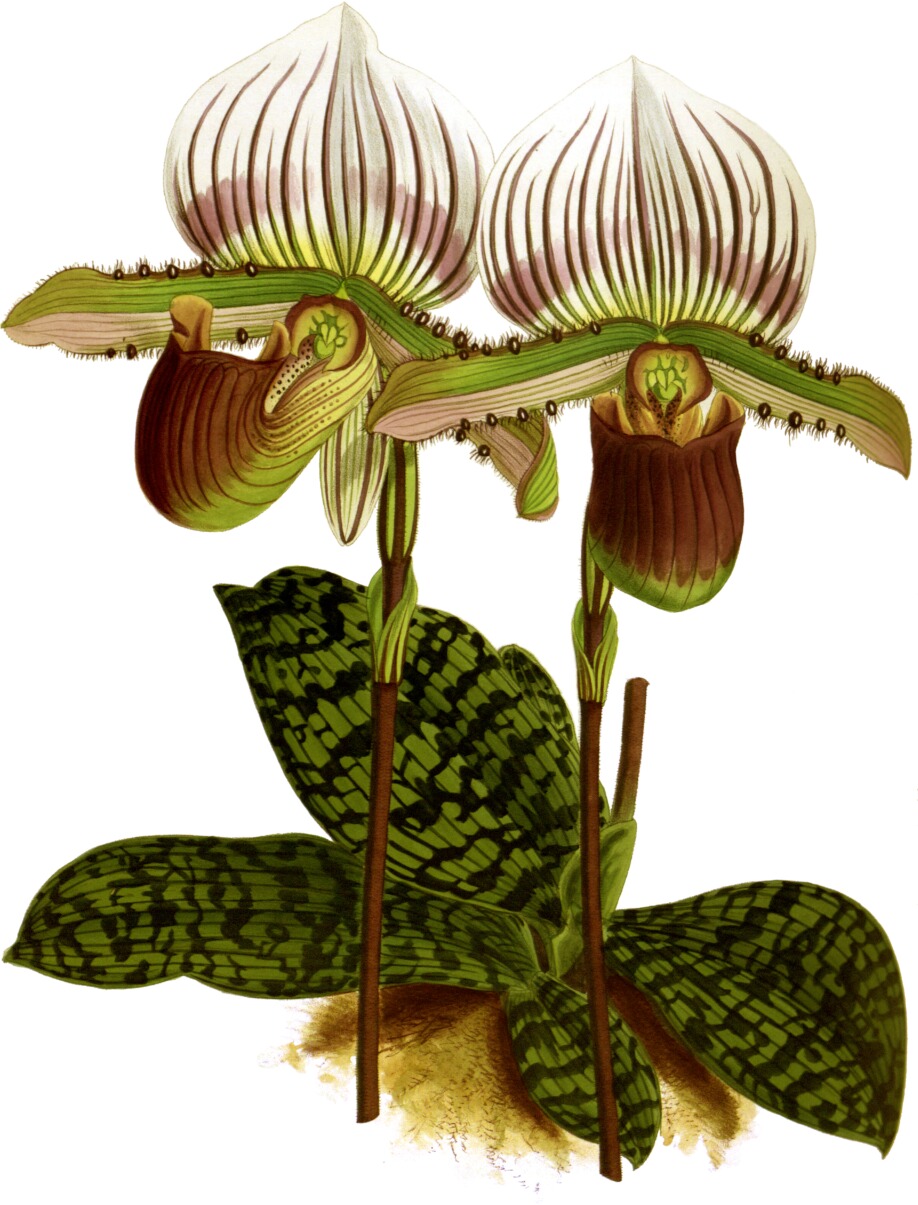
PL. 22. CYPRIPEDIUM LAWRENCIANUM.
42