THE TWEED
Reading edition
SIR THOMAS DICK LAUDER
THE great valley which affords a course for the Tweed, when taken in conjunction with those minor branch valleys which give passage to its various tributaries, may be called the great Scoto-Arcadian district of pastoral poetry and song. Who could enumerate the many offerings which have been made to the rural muses in this happy country? for where there are poetry and song, happiness must be presupposed, otherwise neither the one nor the other could have birth.
During those barbarous times, when border raids were in continual activity, and when no one on either side of the marches, or debatable land, could lay down his head to sleep at night, without the chance of having to stand at his defense, or perhaps to mount and ride ere morning, the valleys of the Tweed and its tributaries must have witnessed many strange and stirring events and cruel slaughters. To defend themselves from these predatory incursions the Scottish monarchs erected strong castles along the lower part of the course of the Tweed, and the chain of these places of strength was carried upwards, quite to the source of the streams by the various land owners. These last were either Towers or Peels—these different names being given, rather to distinguish the structures as to their magnitude and importance, than from any great difference of plan—the Tower possessing greater accommodations and being much the larger and more impregnable in strength of the two. These strongholds, being intended for the general advantage and preservation of all the inhabitants of the valley, were built alternately on both sides of the river, and in a continued series, so as to have a view one of another; so that a fire kindled on the top of any one of them, was immediately responded to, in the same way, by all the others in succession; the smoke giving the signal by day and the flame by night—thus spreading the alarm through a whole country of seventy miles in extent, in the provincial phrase, from “Berwick to the Bield,”—and to a breadth of not less than fifty miles carrying alarm into the uppermost parts of every tributary glen.
Availing ourselves of the quaint language of Dr. Pennecuick, we now beg to inform our readers that “The famous Tweed hath its first spring or fountain nearly a mile to the east of the place where the shire of Peebles marches and borders with the stewartry of Annandale—that is Tweed’s Cross, so called from a cross which stood and was erected there in the time of Popery, as was ordinar y, in all the eminent places of public roads in the kingdom before our Reformation. Both Annan and Clyde have their first rise from the same height, about half a mile from one another, where Clyde runneth west, Annan to the south, and Tweed to the east.” There is some little exaggeration, however, in the old Doctor here—for there is, in reality, no branch of Clyde within two miles of Tweed’s Cross, or Errickstane Brae. Tweed’s Well is not very far from the great r oad; and the site of Tweed’s Cross is 1,632 feet above the level of the sea. “Tweed runneth for the most part with a soft, yet trotting stream, towards the north-east, the whole length of the country, in several meanders, passing first through the Paroch of Tweeds-moor, the place of its birth, then running eastwards, it watereth the parishes of Glenholm, Drumelzear, Broughton, Dawick, Stobo, Lyne, Mannor, Peebles, Traquair, Innerleithen, and from thence in its course to the March at Galehope-burn, where, leaving Tweeddale, it beginneth to water the forest on both sides, a little above Elibank.”
THE TWEED
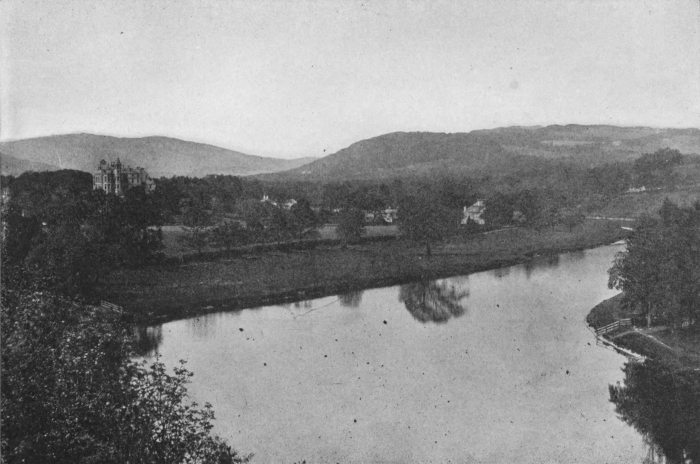
The Banks of the Tweed abound in simple rural charms as you proceed downwards from Elibank Tower, and they partake of that peaceful pastoral character which its green sided hills bestow upon it.
We now come to that part of the course of the Tweed, extending from its junction with the united rivers Ettrick and Yarrow to the mouth of Gala Water. The estate of Abbotsford makes up a large part of the whole. The part of it that borders the Tweed consists of a large and very beautiful flat haugh, around the margin of which the river flows gently and clearly over its beds of sparkling pebbles.
The angling from Gala Water foot to Leader foot is all excellent, both for salmon and trout, when the river is in proper condition; and then the beauty and interest of all the surrounding features of nature and the silent grandeur of the holy pile of ruin are such that even the unsuccessful angler must find pleasure in wandering by the river-side, quite enough to counterbalance the disappointment of empty baskets.
Sir Walter Scott says:—
“If thou would’st view fair Melrose aright, Go visit it by the pale moonlight; For the gay beams of lightsome day Gild but to flout the ruins grey. When the broken arches are black in night, And each shafted oriel glimmers white; When the cold lights’ uncertain shower Streams on the ruined central tower; When buttress and buttress alternately, Seemed framed of ebon and ivory; When silver edges the imagery, And the scrolls that teach thee to live and die; When the distant Tweed is heard to rave And the howlet to hoot o’er the dead man’s grave; Then go—but go alone the while— Then view St. David’s ruined pile; And, home returning, soothly swear Was never scene so sad and fair.”
Before leaving this section of the Tweed, we must not forget to mention that the Knights Templars had a house and establishment on the east side of the village of Newstead. It was called the Red Abbey. Before concluding this part of our subject, it appears to us to be very important, if not essential, to call our readers’ especial attention to the singular promontory of Old Melrose on the right bank of the river. It is a high bare head, around which the river runs in such a way as to convert it into a peninsula. Here it was that the first religious settlement was made. This monastery was supposed to have been founded by Columbus or by Aidan, probably about the end of the Sixth Century. It would appear that it was built of oak wood, thatched with reeds, the neck of land being enclosed with a stone wall. It is supposed to have been burned by the Danes. The name given to it was decidedly Celtic and quite descriptive of its situation—Maol-Ros, signifying Bare Promontory—and from this the more recent Abbey and the whole of the more modern parish of Melrose have derived their name.
We now come to a very beautiful, nay, perhaps, we ought to say the most beautiful part of the Tweed, where it meanders considerably, as it takes its general course in a bold sweep round the parish of Merton. On its north side the ground rises to a very considerable height in cultivated and wooded hills. From several parts of the road that winds over it, most magnificent views are enjoyed up the vale of the Tweed including Melrose and the Eildon Hills; and then at the same time, these rising grounds and the southern banks, which are likewise covered with timber, give the richest effect of river scenery to the immediate environs of the stream.
We scarcely know a place anywhere which is so thoroughly embowered in grand timber as Dryburgh Abbey. The most beautiful fragment of the ruin is that which is called Saint Mary’s Aisle, which formed the south aisle of the transept; and let it not be approached save with that holy awe which is inspired by the recollection of the illustrious dead! for here repose the ashes of the immortal Sir Walter Scott!
Below Dryburgh Lord Polwarth’s property of Merton begins and runs for about two miles down the Tweed. As you approach the place of Mackerston, the immediate bed of the stream becomes more diversified by rocks, both on its side and in its channel. The Duke of Roxburgh’s fishings stretch for nearly four miles to a point about half a mile below Kelso.
Nothing can surpass the beauty of the scene when looked at from Kelso bridge. And then when it is taken from other points, the bridge itself, the ruined abbey, the buildings of the town, with the wooded banks and the broad river form a combination of objects, harmonizing together, which are rarely to be met with. Each particular description of scenery requires to be judged of and estimated according to its own merits. You cannot, with any good effect or propriety, compare a wild, mountainous and rocky highland scene with a rich, lowland district. But this we will say, that, of all such lowland scenes, we know of none that can surpass the environs of Kelso; for whilst the mind is there filled with all those pleasing associations with peace and plenty, which such scenes are generally more or less calculated to inspire, there are many parts of it which would furnish glowing subjects for the artist. Here the Tweed is joined by the Teviot; and we shall finish this part of our subject by those beautiful lines from Teviot’s own poet, Leyden, in his Scenes of Infancy:—
“Bosomed in woods where mighty rivers run, Kelso’s fair vale expands before the sun; Its rising downs in vernal beauty swell, And, fringed with hazel, winds each flowery dell; Green spangled plains to dimpling lawns succeed And Tempe rises on the banks of Tweed. Blue o’er the river Kelso’s shadow lies, And copse-clad isles amid the waters rise.”
Like a gentleman of large fortune, who has just received a great accession to it, the Tweed, having been joined by the Teviot, leaves Kelso with a magnitude and an air of dignity and importance that it has nowhere hitherto assumed during its course, and which it will be found to maintain, until it is ultimately swallowed up by that grave of all rivers—the sea. A few miles brings it to the confines of Berwickshire, and in its way thither it passes through a rich country.
Just before quitting the confines of Roxburghshire the Tweed receives the classic stream of the Eden, which enters it from the left bank. The Eden is remarkable for the excellence of the trout, which are natives of the stream, but they require very considerable skill and great nicety of art to extract them by means of the angle from their native element.
And now we must congratulate our kind and courteous reader, as well as ourselves, that the romantic days of border warfare have been long at an end; for if it had been otherwise, our noble companion the Tweed, which has now brought us to a point where he washes England with his right hand waves whilst he laves Scotland with his left, might have brought us into some trouble. As he forms the boundary between England and Scotland from hence to the sea, we must in order to preserve him as a strictly Scottish river, say little about his right bank, except what may be necessary for mere illustration. But as we see before us the truly dilapidated ruins of what was once the strong and important fortress of Wark Castle, we must bestow a few words upon it.
Wark was the barony and ancient possession of the family of Ross, one of whom, William de Ross, was a competitor for the crown of Scotland in the reign of Edward I. of England. It continued in that family to the end of the Fourteenth Century, when it appears to have become the possession of the Greys, who took their title from the place, being styled the Lords Grey of Wark, in the descendants of which family it has continued to the present time.
The Scottish banks of the river from the Eden water to Coldstream are richly cultivated and partially wooded by hedgerows and the plantations of several properties. The view down the course of the stream, which runs down wooded banks of no great height, and is crossed by the noble bridge of Coldstream, is extremely beautiful. The village of Coldstream itself is very pretty with its nice modern cottages and gardens; but it is likewise interesting from some of its old buildings. Coldstream was remarkable for its convent of Cistercian nuns, of which Mr. Chambers gives us the following interesting account:—Previous to the Reformation Coldstream could boast of a rich priory of Cistercian nuns; but of the buildings not one fragment now remains. The nunnery stood upon a spot a little eastwards from the market-place, where there are still some peculiarly luxuriant gardens, besides a small burying-ground, now little used. In a slip of waste ground, between the garden and the river, many bones and a stone coffin were dug up some years ago; the former supposed to be the most distinguished of the warriors that fought at Flodden; for there is a tradition that the abbess sent vehicles to that fatal field and brought away many of the better orders of the slain, whom she interred here. The field, or rather hill, of Flodden, is not more than six miles from Coldstream, and the tall stone that marks the place where the king fell, only about half that distance, the battle having terminated about three miles from the spot where it commenced.
General Monk made this his quarters till he found a favourable opportunity for entering England to effect the Restoration; and it was here that he raised that regiment that has ever afterwards had the name of the Coldstream Guards.
The River Till is an important tributary to the Tweed from its right bank. The Till runs so extremely slow that it forms a curious contrast with the Tweed, whose course here is very rapid, giving rise to the following quaint verses:—
“Tweed said to Till, What gars ye rin sae still? Till said to Tweed, Though ye rin wi’ speed, And I rin slow, Yet where ye drown ae man I drown twa.”
We must now proceed to make our last inroad into England—an inroad, however, very different indeed from those which used to be made by our ancestors, when they rode at the head of their men-at-arms, for the purpose of harrying the country and driving a spoil. We go now upon a peaceful visitation of Norham Castle, certainly the most interesting of all objects of a similar description on the whole course of the Tweed.
The ancient name of the castle appears to have been Ubbanford. It stands on a steep bank, partially wooded and overhanging the river. It seems to have occupied a very large piece of ground as the ruins are very extensive, consisting of a strong square keep, considerably shattered, with a number of banks and fragments of buildings enclosed within an outer wall of a great circuit; the whole forming the most picturesque subject for the artist. It was here that Edward I. resided when engaged in acting as umpire in the dispute concerning the Scottish crown. From its position exactly upon the very line of the border, no war ever took place between the two countries without subjecting it to frequent sieges, during which it was repeatedly taken and retaken. The Greys of Chillingham Castle were often successively captains of the garrison; yet as the castle was situated in the patrimony of St. Cuthbert, the property was in the see of Durham till the Reformation. After that period it passed through various hands.
The parish of Ladykirk, which now comes under our notice, upon the left bank of the Tweed, was created at the Reformation by the junction of Upsetlington and Horndean. James IV. had built a church which he dedicated to the Virgin Mary, whence it received its name.
As we proceed downwards, the scenery on the Tweed may be said to be majestic, from the fine wooded banks which sweep downwards to its northern shores. The surface of the water is continually animated by the salmon coble shooting athwart the stream.
A very handsome suspension bridge, executed by Captain Samuel Brown of the Royal Navy here connects England with Scotland, and at some distance below, the Tweed receives the Whitadder as its tributary from the left bank.
When we begin to find ourselves within the liberties of Berwick, we discover that we are in a species of no man’s land. We are neither in England nor in Scotland, but in “our good town of Berwick-upon-Tweed.” We have never passed through it without being filled with veneration for the many marks that yet remain to show what a desperate struggle it must have had for its existence for so many centuries, proving a determined bravery in the inhabitants almost unexampled in the history of man. It always brings to our mind some very ancient silver flagon, made in an era when workmen were inexpert and when the taste of their forms was more intended for use than for ornament, but of materials so solid and valuable as to have made it survive all the blows and injuries, the marks of which are still to be seen upon it; and which is thus infinitely more respected than some modern mazer of the most exquisite workmanship.
Escaping from Berwick-bridge the Tweed, already mingled with the tide, finds its way down to its estuary, the sand and muddy shores of which have no beauty in them.
And now, oh silver Tweed! we bid thee a kind and last adieu, having seen thee rendered up to that all-absorbing ocean, with which all rivers are doomed to be commingled, and their existence terminated, as is that of frail man, with the same hope of being thence restored by those well-springs of life that are formed above the clouds.