THE IRRAWADDY
Reading edition
EMILY A. RICHINGS
THE mighty Irrawaddy, which traverses the entire length of Burma, impresses itself on popular imagination as the living soul of the land, moulded and coloured through countless ages by the influence of the majestic river. If Egypt be the gift of the Nile, Burma is scarcely less the gift of the Irrawaddy, deepened by myriad tributary streams, and flowing in ever-widening volume from forest cradle to fan-shaped Delta. The source of the historic stream is still veiled in mystery, as it winds through impenetrable jungle and untrodden mountains until it becomes navigable for the last thousand miles to the sea. Manifold traditions encompass the great river with that atmosphere of glamour which invests Burma with romantic charm.
The song of the river breathes of nomadic hordes and contending races, of old-world kings, mythical warriors, and legendary saints, until the dominant Burmese united in the Irrawaddy Valley, and the tribes wandering down the lateral tributaries were absorbed or subjected by the ruling power.
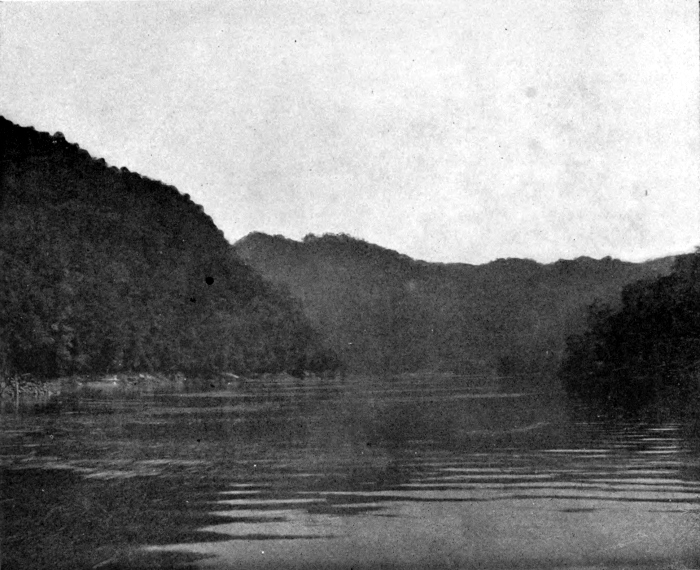
THE IRRAWADDY
The modern voyager generally takes the downward course of the river, journeying by train to Katha, through the palm-studded plains and dense forests skirting the blue hills which divide Burma from the Shan States on the borders of Siam. Under the hovering mists of dawn giant teak and feathery bamboo, looped together with coils of all-embracing creeper, make a rich tangle of matted foliage. Bhamo, the head of navigation as regards the great steamers of the Irrawaddy Flotilla, and the frontier town on the borders of China, lies along the yellow sand-bank of the foreshore. The Siamese name, signifying “City of Pans,” is derived from the local manufacture of iron and earthenware jars, cauldrons, and pitchers, dating from primitive times. Bhamo, formerly a walled Shan town, fiercely contested both by China and Burma, was captured four times by the Chinese, easily reinforced from their own frontier only thirty miles away. The town of 12,000 inhabitants, protected by an English battery and a police force of Indians and Kachins, is still the meeting-place of converging races. Chinese, Moslems, and Hindus possess their own quarters in the squalid city, where the astute Celestials retain the largest share of local trade, importing cotton and salt, or exporting honey, hides, ochre and chestnuts, with thousands of cooking pans. Blue robes, sun-hats and pigtails, grey roofs with upcurved eaves, and tinselled banners waving round the tarnished red of a Joss-house bristling with weird figures, transport our thoughts to the Middle Kingdom, reached by the sandy track beyond the ruined walls. Tom-toms beat in the Hindu quarter, and dark figures glide past with jingling anklets and filigree nose-rings, or lie supine on rickety charpoys in the open street. A muezzin chants from the minaret of a tiny mosque, and the bearded sons of Islam spread their prayer-carpets in the dust, prostrating themselves in obedience to the voice which summons them to prayer on these alien shores. Beneath the banyan trees of an arcaded court a marble Buddha dreams amid the shadows, and kneeling Shan women offer their morning orisons at the crumbling altar. Tall black head-dresses and dark-blue skirts, embroidered with many-coloured wools, mark a distinct racial type. Silver cylinders weigh down dusky ears, silver hoops encircle sunburned necks, and the glittering chain of a silver needle-case hung from the waist-belt of an almond-eyed girl denotes her rank as a Shan lady. The intelligent faces are bright and animated, but every smile discloses teeth blackened with betelnut. The men of the party sip tea and smoke their silver pipes under the green boughs, leaving the devotional exercises to their womankind. A Burman in rose-coloured turban and plaid kilt lolls upon a stone parapet, and Kachin women, with mops of rough hair and furtive faces washed in grease, pass the gateway with loads of elephant-grass on their backs, bringing a barbaric element into the scene.
Pagoda, Joss-house, and Buddhist temple stand in friendly proximity, and no war of sect or creed disturbs the harmony of life under the tolerant British rule; but the Buddhism of the Shan and the Nature-worship of the Kachin show many points of contact.
The arrival of the Irrawaddy steamer, towing cargo “flats” in its wake, is the event of the week, and rustic barges thread the narrow defile above Bhamo, bringing their contingent of produce and passengers from distant villages on the confines of civilization. One of the great “flats” is a floating market, where Burman and Kachin, Shan and Chin, display their varied merchandise to the motley throng of customers. Gaudy silks and cottons, rude pottery and quaint lacquer-work, barbaric toys and trinkets, fruit, vegetables, and sweetmeats, with household utensils of every kind, fill the dusky space of the covered deck with brilliant colour. Indolent Burmese doze and smoke on gaily-striped quilts, while their wives chaffer and barter with business-like aplomb; for the Burmese woman is the breadwinner of the family, and retains most of the commercial transactions of the country in her capable hands. A pretty girl in white jacket and apple-green skirt, with a pink pawa floating on her shoulders, sits on a pile of yellow cushions and smokes her big cheroot of chopped wood and tobacco in meditative calm. Diamonds glitter in her ears, and ruby studs fasten her muslin bodice, for she goes as a bride to some distant riverside town, and carries her “dot” on her back. Strings of onions and scarlet chillies hang from the rafters above bales of fur from China. Children flit up and down, like many-coloured butterflies, in quaint costumes brightened with pink scarfs and tiny turban, miniature replicas of their elders, for no special garb of childhood exists in Burma, and the general effect suggests an assemblage of gaily-dressed dolls. Shan women in tall black turbans stand round a harper as he twangs the silken strings of a black and gold lyre with sounding-board of varnished deerskin. The weird fractional tones of native music, discordant to European ears, harmonize with the semi-barbaric environment as the musician chants some heroic legend of the mythical past. Presently he approaches a mattress of white and scarlet, occupied by a woman whose brown Mongolian face is blanched to the pallor of age-worn marble by chronic pain, and sings a wild incantation over the sufferer, who by the advice of a fortune-teller undertakes the weary journey to pray for healing at the Golden Pagoda of Rangoon. The charm apparently succeeds, for the tired eyes close, and as the song dies off in a whispering cadence a peaceful slumber smoothes the lines of pain in the troubled face. Family parties sit round iron tea-kettles, and girls bring bowls of steaming rice from the rude galley where native passengers cook their food.
Past green islets in sandy reaches, hemmed in by bold cliffs conveying vague suggestions of Nile scenery, the great steamer pursues her way. Above dark clumps of banyan and tamarind, the golden spires of Buddhist monasteries, or the shining tee of village pagodas, invest the changing landscape with the unique individuality of Burma, distinct in character from the Indian Empire, though politically comprised within it. A magical peace and purity, suggesting a world fresh from the Creator’s hand, transfigures hill and dale with ineffable lucidity of atmosphere and delicacy of colour. The solemnity of the deep gorges piercing the profound gloom of virgin forest supplies a contrasting note of haunting mystery, the loneliness of these upper reaches merely accentuated by occasional signs of human life and activity in the vast solitudes through which the river flows. As the steamer swings round a projecting rock, the grotesque forms of two colossal leographs—the hybrid lion and gryphon of Burmese mythology—rear their white bulk against a green tuft of towering palms at the gate of a Buddhist temple flanking the grey cone of a tall pagoda. Yellow-robed monks lean on the balustrade of an island monastery hidden like a bird’s nest amid the thick foliage, and beautiful even in decay. The broad-eaved roofs, with their carved and gilded pinnacles, are miracles of art, for the historic foundation was formerly renowned throughout Upper Burma, and on festivals even the dog-fish, for which this reach of water is famous, were decorated with strips of gold-leaf, and tamed to come at the call of the monks. Farther on a yellow procession descends a long flight of rocky steps cut in the face of a steep cliff crowned by a monastic pile bristling with gilt finials and vermilion spires. At the foot of the mountain stairway a huge funeral pyre of forest trees attracts groups of villagers, who land from a fleet of carved and decorated boats in festal array, for a monk is to be cremated after the invariable custom of Buddhist orders, and the ceremony is observed as a general holiday. The light-hearted Burmese only extract pleasure from the gruesome spectacle, for what matters this little incident in the manifold cycles of progressive existence reserved for the reincarnating soul?
Stockaded villages line the foreshore, and hilltops glitter with the golden tee of clustering shrines. The sublime defiles of the glorious river, with their frowning cliffs and toppling crags, widen into the dreamy calm of land-locked reaches, where pagodas multiply on every point of vantage, in monumental testimony to the zeal and devotion of the Burmese past. The nomadic races of Burma impressed their character on the multitude of ruined cities and deserted capitals buried under the veil of verdure in the tropical jungle, or covering hill and plain with decaying splendour. In a shadowy channel beneath overhanging rocks the wrecked yacht of the luckless King Theebaw lies overturned, the lapsing water rippling against red funnel and gilded poop. No effort is made to raise the melancholy derelict, a fitting emblem of past sovereignty. At the sacred heights of Sagaing, transformed by the white and golden spires of graceful pagodas into ideal loveliness, a pothoodaw, or “man of both worlds,” in semi-monastic garb with yellow parasol, awaits the arrival of the steamer.
The gentle humility of this old pothoodaw contrasts favourably with the aggressive importance of a village “head-man,” or local magistrate, who pushes him aside, and struts along the narrow wharf in tartan silk and spotless muslin, an obsequious attendant carrying his master’s red umbrella and silver betel-box. Yellow-robed brethren dismount from creaking bullock-wagons lined with hay, and await the coming steamer to bear them to the cremation ceremony up-stream. Palm-leaf fans are raised to the brown faces, but two youthful novices satisfy their curiosity concerning European womankind by peeping through the interstices of the sun-dried fronds. Other waiting passengers set out the huge pieces of a clumsy chessboard on a pile of flour bags; for time is no account on these dreamy shores, and two hours must elapse before the Bhamo boat swings in sight.
Evening turns the noble river into a sheet of flaming gold; pink clouds lie like scattered rose-leaves in the path of the sinking sun, and through the deepening veil of twilight the red fires twinkling outside reed-thatched huts of tiny villages supply local colour to riverside life. Jungle-grown Ava and ruined Amapura lie on the water’s brink; the Pagan, grandest of ancient capitals, covers a wide plain with the imposing architecture of a thousand pagodas, the colossal Ananda Dagon soaring like a huge cathedral above multitudinous domes and spires, gold and crimson, white and grey, of the deserted metropolis; for the tide of life swept away from royal Pagan seven hundred years ago. The white tents of the Government elephant camp cover a stretch of sand above the bathing place of the herd, and the officer in charge gives a fascinating account of his adventurous life; though many perils attend the capture of the three hundred elephants annually required by authority, and in the past year fifteen hunters have fallen victims to the dangers which beset horse and rider from sharp tusks, trampling feet, falling trees, and tangling creepers in the dark recesses of primeval forest. The typical denizen of Burmese woods possesses a sacred character in popular estimation, and carven elephants loom through the tropical greenery of the shores, supporting tapering pagoda or pillared portico.
The steamer stops before the unfinished temple and colossal Bell of Mingoon, cracked by earthquake, but the second largest in the world, the grandeur of the uncompleted design memorializing the frustrated ambition of a Burmese king who desired to be immortalized as a Phaya-Taga, or “Pagoda-Builder,” rather than by memories of war and conquest. The spiritual idealism which colours Burmese idiosyncrasy tinges the story of the past, and a modern writer aptly epitomizes one aspect of British rule as “an attempt to turn poetic philosophers into efficient policemen.” The charm of this freshwater cruise is enhanced by frequent opportunities of landing at riverside villages, visits to Burmese farms, and strolls through picturesque markets or beneath the palms and tamarinds of country roads leading to mouldering pagodas and forgotten shrines. The inhabitants of these verdant shores are true “children of the river”—the mystic flood which supplies their wants and moulds their character, affording them an “education of contact” with the outside world to soften the crude asperity of mental isolation. The mother plunges her little ones into the eddying waters so early that even in helpless infancy they become amphibious as the croaking frogs in the iris beds at the river’s edge. Merry bathing parties display their skill in diving, swimming, or fishing by hand in the crystal depths; and graceful girls, like brown Naïads, disport themselves beneath the drooping boughs which kiss the ripples of some sheltered creek fit for a fairy’s haunt. Parrots call from the trees, and kingfishers flit across the shallows in flashes of emerald light. Luxuriance of vegetation and depth of colour increase with every hour of the downward voyage. Gold mohur and scarlet cotton-tree dazzle the eye as they tower up into the burning blue of the tropical sky, and when the crescent moon sinks beneath the horizon myriads of glittering fireflies suggest, in the beautiful words of an Oriental poet, that “the night is adrift with her stream of stars.”
Thabetkein, the busy port of the ruby mines sixty miles away; Yandoon, the malodorous fish-curing town à la mode de Burma, which buries the native hors d’œuvre to eat it in decay; and beautiful Prome, asleep in the moonlight, are visited in turn, the character of the scenery changing as the wide Delta opens up before the advancing steamer in branching channels, like numerous rivers springing from the parent Irrawaddy. Above us rises the sacred cliff of Guadama, an ancient resort of religious pilgrimage, with countless statues of Buddha carved to inaccessible heights in the living rock. The romance of this watery world turns over a new page on entering the great Bassein Creek, the last stage of the thousand mile course. Elephants feeding in the Jungle, and requiring a whole day for a full meal, crash through the canes regardless of the passing steamer. Peacocks drag their gorgeous trains over pink river-grass and golden sands. Grey egrets preen their soft plumage at the water’s edge, and purple hornbills rest on swaying palms. The Delta is alive with craft—rice boats and launches, cargo-boats and steamers. The barbaric fenaw, with swelling sails and twenty oars; the curving native barge, and the graceful Sampans, flitting like brown-winged moths across the stream. Boys, tattooed from head to foot in elaborate patterns, descend side-creek and canal in a rude dug-out—the hollow tree which forms the primitive boat—and the green tunnels of foliage show houses of plaited mats, raised on piles and reached by ladders.
Miles of malarious marsh have been reclaimed by Government from the new land ever silting up above the level of the water, and forming the rich rice-fields of this alluvial soil. Riverside towns and villages become more frequent in the lower reaches, and miniature markets of country produce make patches of brilliant colour on the sandy shore. Silken-clad girls, with flower-decked heads, sit beneath pink and green umbrellas, shading piles of golden plantains and pineapples. Bamboo stalls of curious lacquer-ware and trays of clay Buddhas, packets of gold-leaf, and sheaves of incense-sticks appeal to the religious instincts of pilgrims bound for the Golden Pagoda of distant Rangoon. The trade here, as elsewhere, is monopolized by the Burmese women, though many pink-turbaned admirers lie on the sand, smoking, flirting, and singing with the characteristic dolce far niente of masculine life. The long fresh-water cruise floats us from wilderness to the sea, from dreamland to reality. Rice-mills line the shores, ocean-going ships rush towards the forest of masts encircling busy Rangoon, and huge teak-rafts, floated down from distant woods, and sometimes two years on the way, reach their moorings at the Ahlone timber-yards. Elephants, working with military precision, drag the giant trunks by chains from the river’s brink and pile them up with mathematical exactness, pushing them with their heads until perfectly level. Even commercial Burma can never be commonplace, for beyond the motley throngs of the cosmopolitan port, the golden spire of the Shway Dagon, queen of pagodas and goal of the Irrawaddy voyager, idealizes the city clustering round the sacred hill, and created by the central sanctuary of Burma’s ancient faith.