THE INDIAN RIVER
Reading edition
L. C. BRYAN
THIS river, or sound, spans a region of a hundred and forty miles from north to south, is salt, and yet almost without tide, neither rising nor falling more than a few inches by the winds; lies upon the very shore of the Atlantic, and from one to seven miles wide—a most placid, safe and beautiful inland sea in the very teeth of a wild tempestuous ocean.
Unlike the St. John’s or any other possible river, having no considerable rise or fall, its bordering lands are not overflowed, and unlike other seacoast waterways, it is not cumbered with interminable salt marshes. Its waters beat upon a bold, often abrupt shore, diversified into high and low lands of every grade and covered with the luxuriant vegetation common to warm climates.
Wonderfully beautiful is Indian River. There is no other such sheet of water in the world. Nature, with lavish hand, spread its waters and adorned its shores. The design of the Great Master Artist is seen in the narrow strip of land as a levee separating the river from the Atlantic, and in the forest on the levee as a great wind-break to curb the fierce winds of the ocean. Properly speaking, it is not a river, but a sound, or arm of the sea. Its centre is on an air line north and south 140 miles long, while its banks curve in and out in beautiful bays and grottoes. A few small creeks empty into it from the west, while the water empties into it from the Atlantic through Indian River Inlet and Jupiter Inlet.
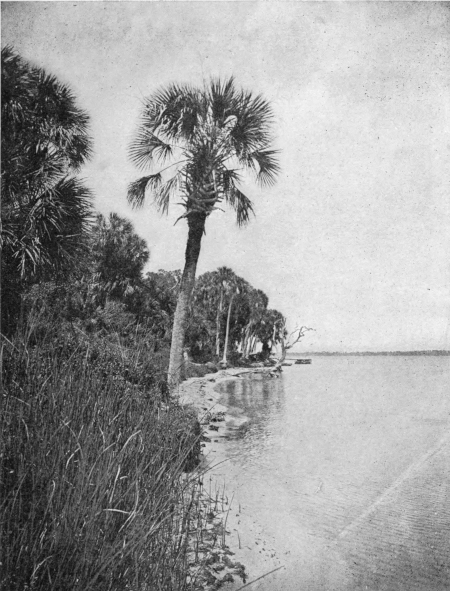
Copyright, 1901, by Detroit Photographic Company
THE INDIAN
It is a sea without its dangers, a river without a current, seldom calm, but always in motion from the winds. From this constant motion its water is kept pure. The winds of winter, coming from the north-west, are softened and warmed by the waters of the upper St. John’s River, and the pine forests on the west of the hammocks of this river, and the winds of summer coming from the east, are tempered and cooled by the Gulf Stream, making the climate most delightful in winter and summer, and, perhaps, most to be desired of any in America.
Of the Indian River we find the following from the able pen of ex-Governor Gleason:
“Indian River, as it is called, is a sound, and lies parallel to the Atlantic, separated from it by a narrow strip of land varying from a few rods to three miles in width; it is a sheet of pure tide water, salt, clear and transparent. It has two inlets from the ocean—Indian River Inlet, about 100 miles from its north head, and Jupiter Inlet at its extreme southern end. From its north head to within twenty-five miles of Jupiter Inlet, it is from one to six miles wide; from Jupiter Inlet to the mouth of the St. Lucie River, a distance of about twenty-five miles, it is from one-fourth of a mile to a mile in width, and is known as Jupiter Narrows. It is affected very little by the tide and the current moves by the wind. Being in the region of the trade winds, with almost a constant breeze from the east during the daytime, it affords peculiar facilities for sailing up and down the river, and the people take advantage of it. Every house is either on the river bank or a short distance up some navigable stream flowing into it, and has a boat landing. It is the Venice of America, and one can seldom look out upon the water without seeing boats sailing both ways. The river is well supplied with the finest oysters, sea-turtles, and a great variety of fish, among which are mullet, cavalli, snapper, blue fish, sheepshead and sea-trout. The manatee is caught at the mouth of the St. Lucie and Jupiter Inlet. Some of them weigh from 1,500 to 2,000 pounds and are very grand eating. They are found nowhere else in the United States, their principal habitat being near the mouths of the streams flowing into the Caribbean Sea, where they feed upon a peculiar grass called manatee, which grows at the bottom of most tide-water streams in the tropics.”
Merritt’s Island, which is about forty miles long and contains about thirty thousand acres is situated in the northern part of the river. The water on its east side is from one-fourth of a mile to six miles wide, and is known as Banana River. The shores of Indian River, both on the west side of Merritt’s Island and on the main land, are free from swamps and marshes, and rise at an angle of from twenty to twenty-five degrees to an elevation of from twenty-five to fifty feet. In many places the banks are high bluffs. The country on Merritt’s Island, and the west shore has the appearance of an endless park, the timber being principally scattered pines, with an undergrowth of palmettos and grass, interspersed with an occasional forest of palm, live oak and other hard wood timbers.
The orange belt is from one to three miles in width, and is principally on the west side near the river. West of the orange belt are the St. John’s prairies, which are unfit for orange culture, but afford fine pasturage, and are good for vegetables and the culture of sugar-cane and hay.
The river south of Indian River Inlet, on the eastern shore, is skirted with a narrow belt of mangrove timber of only a few rods in width, which is very dense and almost impenetrable. It is a deep green the entire year, and presents a beautiful appearance. The strip of land adjacent to the ocean between Jupiter Inlet and the mouth of St. Lucie River, is known as Jupiter Island, and is about half a mile wide and twenty miles long. It has some excellent land and is elevated from fifteen to thirty feet above the sea. The river here, at Jupiter Narrows, is less than half a mile wide. The western bank is from forty to fifty feet high and covered with a dense low scrub of live oak bushes, not more than two or three feet high, and when viewed from the Island, these heights remind one of the green pastures of the north—they are always the same colour, a beautiful green. This portion of the river is full of oysters and the inlet is the finest fishing on the coast. On the bank of the river, at various places, are large mounds of clam and oyster shells; the largest of them near Jupiter Inlet, is nearly a quarter of a mile long and about forty feet high.
At the north end of the river are some fine live oak and palm hummock lands, very rich and suitable for orange groves, sugar-cane and garden vegetables. The climate from October to May is a perpetual Indian summer, commingled with the balmiest days of spring, seldom interrupted by storms and only with occasional showers, while most of the time there is a gentle breeze coming inland from the even-tempered waters of the Gulf Stream. The prevailing winds are easterly, being the trade winds, which extend as far north as Cape Canaveral and are perceptible as far north as New Smyrna and St. Augustine. The nights are cool even in summer—the atmosphere invigourating and health restoring.
Mineral and other springs are frequent, many of them possessing medicinal properties. Game is abundant—bear, deer, quail and wild turkeys on the land, ducks on the lakes and rivers, and green turtle and fish in the waters. All of these, with its beautiful building sites, its superior surf bathing and boat sailing, the absence of swamps and marshes, will eventually cause the banks of this magnificent sheet of water to become one vast villa of winter residences.