THE AVON
Reading edition
JOHN WILSON CROKER
THERE are Avons and Avons. Of course, Shakespeare’s Avon is the famous stream which takes precedence of all others. It rises at Naseby, in the yard of a small inn near the church. So for two things is that village of Naseby renowned. A good many years ago a hospitable agriculturist, resident near Naseby, asked me to come over and see the battle-field and source of the Avon. I came and saw. The battle-field, truth to say, impressed me in no degree more than the river-head; I saw a quantity of ploughed land, undulating in true Northamptonshire fashion. Doubtless grim old Oliver and hot Prince Rupert saw a good deal more; and that heavy land is responsible for many oaths on the part of the prince, and prayers from the ever-prayerful lips of the Roundhead general. But Naseby field is very much like all the rest of Northamptonshire. There is not a hill in the country, or a brook that a boy cannot leap, or a church spire that a boy cannot throw a stone over, or enough level ground for a game of cricket. Yet it is a capital hunting county nevertheless.
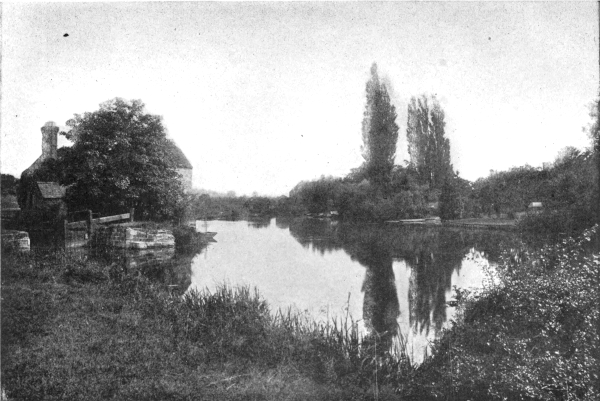
THE AVON
Descending the Avon from Naseby, we pass through much dreary Northamptonshire scenery. At a village called Catthorpe, we are reminded of a certain poetaster named Dyer. Poetry was in a poor state when the author of Grongar Hill could be considered a poet. He was an amiable clergyman, who wrote mediocre verse; but Horace’s opinion of such verse is peculiarly popular in the present day. The first town of any consequence which the pedestrian reaches is Lutterworth; and concerning Lutterworth there is little to be said, except that Wicliffe was once its rector; and the ashes of the great reformer were disinterred by certain ecclesiastical vultures, and thrown into the brook which runs into the Avon at Lutterworth. So says Fuller, whom Wordsworth has followed: “This brook hath conveyed his ashes into Avon, Avon into Severn, Severn into the narrow seas, they into the main ocean. And thus the ashes of Wicliffe are the emblem of his doctrine, which now is dispersed all the world over.”
The next town is Rugby; an immortal town, forever connected with the greatest of school-masters.
The scenery about Avon begins to improve near Newnham Regis; a small village, remarkable for having nothing of the church left except the tower. The rector of Church Lawford is also vicar of King’s Newnham; and as the two villages cannot count five hundred inhabitants, we perhaps need not regret the destruction of the ancient church.
The city of Coventry lies not very far from the Avon. It is, I think, the dirtiest place in England, Bristol and Birmingham not excepted. In days gone by it had great fame, this Coventria civitas; and its earl, Leofric, who used to stride about his hall among his dogs,
“His beard a foot before him, and his hair A yard behind,”
was a worthy ancestor of Lord Palmerston; and we all remember who wrote,
“I waited for the train at Coventry; I hung with grooms and porters on the bridge, To watch the three tall spires.”
What strikes me in this city of Coventry—when I look at those noble spires, which Tennyson has immortalized (St. Michael’s is second to Salisbury only), and at the splendid city-hall—is the wonderful change between the past and the present. It is now one of the most sordid and miserable towns in the empire. What generous and magnificent inhabitants must it have had when the spires of St. Michael’s and Trinity were raised heavenwards! I’ll be hanged if Godiva the beautiful would have
“Unclasped the wedded eagles of her belt”
for the present population of Coventry. I fear that among its makers of watches and ribbons there are goodly number of “low churls, compact of thankless earth.”
The beauty of Avon begins where it enters the park of Stoneleigh Abbey, seat of Lord Leigh. The first baron, when Mr. Chandos Leigh, published some elegant poetry. His title to the estate was at one time questioned; and an inventive attorney produced a most marvellous case against him, accusing him and Lady Leigh of pulling down one side of Stoneleigh Church, to get rid of some genealogical testimony furnished by the Monuments, and of causing a huge stone to be dropped on some men who were engaged in building a bridge across the river Sow, it being important to suppress their evidence; I forget how many murders this lawyer (who very justly suffered imprisonment) charged against one of the gentlest and most amiable of men. Of the old abbey nothing is left but a gateway; and the great mansion of the Leighs, though doubtless magnificent and luxurious within, has no external beauty. But the park is redolent of As you like it. All this Warwickshire woodland breathes of Shakespeare. Under these stately oaks, the noblest I have ever seen, beside this sparkling river, how sweet it were to moralize with melancholy Jaques, to while away the golden time with joyous Rosalind! As the traveller lies beneath a patrician tree, amid the magical noontide, well might he fancy the mellow voice of Amiens in the distance, cheering the banished Duke with music. Of Stoneleigh village I have only to say, that when last there I found it impossible to obtain a glass of ale; Lord Leigh having an objection to that wholesome liquid. An English village without ale is awful to think of.
Two miles through field and woodland, and we are at Kenilworth. Wise were the monks when they settled down in that green valley. Very quaint is the village that clusters round the old church; traditions of monastic and baronial times linger there; the exteriors of several of the antique houses made me wish to catch a glimpse of the interiors and their inhabitants, which I was not lucky enough to do. They are just the sort of houses where a good dinner and a bottle of rare port is the order of the day. The end of the village near the church is quite another affair; instead of seeming coeval with the castle and the priory, it appears to have sprung up simultaneously with the railway-station. Extremes meet at Kenilworth: in these modern villas you would expect to find no inhabitant less active than a commercial traveller; in the old houses at the other end you would hardly be startled by an interview with Sir Walter Raleigh or rare Ben Jonson.
Of course I ought to describe Kenilworth Castle; but I cannot do it, that’s a fact; besides which, the thing has been done a hundred times. It is a glorious ruin; and as one lies on the turf on a summer day in the shadow of its grey stonework, watching the flying clouds, and the choughs in the ivy, and the little river shimmering through the meadows, and the immoveable old towers decaying in their stately strength, there descends upon the spirit a mystic and unutterable feeling, worth more than all the poetry ever written, ay, or all the claret ever pressed from Bordeaux grapes.
Avon winds back into Stoneleigh Park after leaving Kenilworth, and passes the little village of Ashow, where I tasted the juiciest mulberries I ever ate,—blood-ripe as those wherewith the laughing Naiad Ægle stained the temples of Silenus. Cool and peaceful is that pleasant village, where Avon murmurs softly amid reedy islets. Passing onward, we see a cross upon a wooded hill: there poor Piers Gaveston was beheaded, some five centuries and a half ago. There is a capitally written inscription on the cross. Somewhat farther is Milverton Church, with a quaint wooden tower: they say it is not worth while to build a stone one, as the lightning strikes it so often. But Guy’s Cliff!
Perhaps I had better let those three words stand as sole suggestion of what that exquisite residence is. The strange legend of Guy of Warwick, vanquisher of Colbrand the Dane, and of the Dun Cow, hovers around this delightful old place. But I don’t know whether Mr. Bertie Percy’s poetic dwelling is not surpassed by the mill close thereto.
Few places I have seen dwell in my memory like this beautiful old mill, surrounded by a wealth of water, a luxury of leafage. If there be mills in fairy-land, they are built on this pattern. If the miller’s daughter, “so dear, so dear” to the Laureate that he plagiarized from Anacreon for her sake, had any actual existence, it must have been at a mill like this of Guy’s Cliff.
I scarce dare approach Warwick after Nathaniel Hawthorne. The reaction from a fast, loud, vulgar, sordid life, makes the most refined and poetic natures of America dreamers of dreams. Such, with especial emphasis, was Hawthorne. To him the ideal was more real than reality. What visions he saw in Warwick, where the great castle “floats double” in the lucid Avon; where a strange old-world tranquillity broods over the famous Earl of Leicester’s antique hospital! After Windsor (and I do not forget Alnwick), I think Warwick the noblest castellated building in England. Built into the solid rock, it overhangs Avon with a wild sublimity. As you look down from the windows of the great hall upon the river far beneath, you think that thus may Guinevere and Lancelot have looked, when the angry Queen cast into the water the nine great diamonds, while the doomed barge bore to her burial the lily maid of Astolat. Why over that old broken bridge, green with the ivy of a thousand years, may not the blameless King have passed, and Merlin the sage, and Tristram of Lyonnesse, leading Iseult of Ireland? Who knows? Are these things fables? Are ye enchanters, Alfred Tennyson and Matthew Arnold?
The Earl of Warwick’s courtesy throws the castle open to the public two or three days a week. Rumour says that the late Earl’s housekeeper, whose monument may be seen in Warwick Church, left her master sixty thousand pounds, accumulated by visitors’ fees! At the very gateway you are met by wonders,—an iron porridge-pot of the great Sir Guy, holding a hogshead or two, I suppose. The old knight must have had a rare appetite for breakfast. There is also his sword, a gigantic weapon, which I defy Jacob Omnium to wield with both hands. As for the contents of the castle, I will not say a word about them; though of historical portraits, Vandykes and Rubenses, there is a fine collection. I commend the traveller upon looking out upon Avon from those wondrous rooms, to call back, if he can, the heroic and poetic times when it was possible to build such a castle; when it seemed fit habitation for those who dwelt in it,—for Neville the Kingmaker, to wit, who fills a marvellous page, brilliant with gold and stained with blood, in England’s history; and who well deserved to be found in Shakespeare’s peerless portrait-gallery.
Warwick town is very quaint, and has two old-fashioned hostelries, the Warwick Arms and the Woolpack, at either of which a hungry and thirsty traveller will find ample refreshment of the right sort. From the top of Warwick Church tower there is a magnificent view over a rich country. The church’s chief glory is the Beauchamp Chapel, just 400 years old, a perfect poem in stone, an absolute triumph of the good old artist-workmen, who find no rivals in the days when artists are never workmen, and workmen never artists. Its dead inhabitant was last of the Beauchamp Earls, and that crowned saint, Henry VI., conferred the earldom upon the Kingmaker; thus commencing the third line of its holders, for the first Earl was a Newburgh, or Neuburg, of the Conqueror’s creation; then, two centuries later, it passed through a female to the Beauchamps; two centuries more, and the last Beauchamp was succeeded by a Nevil; on Nevil’s death, “false, fleeting, perjured Clarence” had the earldom, whose son, last of the Plantagenets, ended the fourth line, when he and Perkin Warbeck died on Tower Hill; next came the Dudleys, creatures of Henry VIII., the elder of whom, Lady Jane Grey’s father-in-law and worst enemy, is better known as Duke of Northumberland; then Lord Rich, whose great grand-son married Cromwell’s daughter, was created Earl of Warwick by James I.; and finally George II. conferred the title on Greville, Earl Brooke, ancestor of the present Earl. Thus six families at least have held this famous earldom.
The traveller will of course turn aside to Leamington, town of fashion and frivolity, about a mile and a half from the poetic stream. Leamington owes its existence, as anything beyond a village, to one Dr. Jephson, who hit on the brilliant notion that the mineral waters of the place would cure all possible diseases. A great hotel sprang up, the Regent, which for years was a kind of hospital for Dr. Jephson’s patients. This medical genius is quite deified in the town. There are pleasant gardens dedicated to him, to which none are admitted save subscribers of a guinea, or something of the sort. It is a downright apotheosis (or apodiabolosis) of physic. But other causes concurred to bring Leamington into the first rank of pleasure towns: there is capital hunting in the neighbourhood, and a first-rate pack of hounds. It is almost the metropolis of archery, a pastime which young ladies wisely patronize, since a pretty girl cannot look prettier than in her toxophilite costume of Lincoln-green. Nothing can be more beautiful than the walk by the margin of Avon through Lord Warwick’s park. After passing through several pleasant villages, full of Warwickshire quaintness, we reach Charlecote House, the seat of the Lucy family. It has always appeared to me that Haydon more admirably than any man expressed the feeling which is produced in poetic minds by the places sacred to Shakespeare. Painting under the stress of a noble ambition, with the sad certainty that the age could not perceive his greatness, had injured his health; instead of joining “the vulgar idlers at a watering-place” he sought change of scene at Stratford. How the man enjoyed it, and how vigorously he depicts his enjoyment! “To Charlecote,” says he, “I walked as fast as my legs could carry me, and crossing the meadow, entered the immortalized park by a back pathway. Trees, gigantic and umbrageous, at once announce the growth of centuries: while I was strolling on, I caught a distant view of the old red-bricked house, in the same style and condition as when Shakespeare lived; and on going close to the river-side, came at once on two enormous old willows, with a large branch across the stream, such as Ophelia hung to. Every blade of grass, every daisy and cowslip, every hedge-flower and tuft of tawny earth, every rustling, ancient and enormous tree which curtains the sunny park with its cool shadows, between which the sheep glitter on the emerald green in long lines of light, every ripple of the river with its placid tinkle,
“Giving a gentle kiss to every sedge It overtaketh in its pilgrimage,”
announced the place where Shakespeare imbibed his early, deep, and native taste for forest scenery. Oh, it was delightful, indeed! Shakespeare seemed to hover and bless all I saw, thought of, or trod on. Those great roots of the lime and the oak, bursting, as it were, above the ground, bent up by the depth they had struck into it, Shakespeare had seen—Shakespeare had sat on.
In the same spirit of delight, and with the same realizing power, did the great painter—one of those
“Mighty poets in their misery dead,”
“of whom the world was not worthy”—enjoy Stratford itself. Thus does he write of what he felt as sunset descended on the church where lies all that was mortal of God’s greatest human creature. “I stood and drank into enthusiasm all a human being could feel; all that the most ardent and devoted lover of a great genius could have a sensation of; all that the most tender scenery of river, trees, and sunset sky together could excite. I was lost, quite lost; and in such a moment should wish my soul to take its flight (if it please God) when my time is finished.” God willed otherwise; that great soul took flight in a moment, not of delight, but of agony.
There seem to be always American visitors at Stratford. The refined and thoughtful Americans, like Washington Irving and Hawthorne, have by the intensity of their reverie, thrown a halo of fresh beauty around many places sacred to genius. But too many of these trans-atlantic travellers merely visit a place like Stratford just to say they have been there; and people of that kind are singularly unpleasant to meet. There is a story that one Yankee offered an enormous sum of money for Shakespeare’s house, to take it to the States for exhibition.
I must hurry on. Village after village, quaint and beautiful, lie along the margin of Avon; the keen eye will notice whence Shakespeare drew his choicest descriptions of nature; the longest summer-day will not be too long to loiter around the vicinity of Stratford. One of the best proofs that Avon River flows through rich and lovely country is the multitude of monastic institutions which have left their names to the villages, with here and there a noble tower or graceful gateway.
Founders of abbeys loved a pleasant river flowing through fertile meadows; salmon and trout and eels for fast-days were as important as beeves and deer for festivals. So there are more conventual remains between Naseby and Tewkesbury than in almost any equal distance of which I have knowledge; and the glory of those old ecclesiastic foundations is peculiarly realized as the noble bell-tower of Evesham Abbey rises above the town. The great monastery had lasted more than a thousand years when the ruthless hand of Henry VIII. fell upon it. The bell-tower and a most delightful old gateway are the only relics of it left.
The pilgrim through the beautiful Vale of Evesham comes upon another battle-field, where, 600 years ago, fell a famous leader of the Commons against the Crown. Simon de Montfort fought for the right, so far as we can judge at this remote period; but his antagonist was the greatest general of the day, and afterwards became England’s greatest king. He was but twenty-six when he won the immortal victory known as the Murder of Evesham. If Montfort gave England its first parliament, Edward gave us Wales and Scotland, and made the priests pay taxes in defiance of the Pope. A poetic prince, as well as a gallant; for did he not, when Eleanora the Castilian died in Lincolnshire, cause Peter l’Imagineur to build a stately cross wherever her corpse rested on its way to Westminster? Thanks to the poetry of a railway company, London sees the last and stateliest of those crosses rebuilt in what was once the quiet village of Charing.
There was another abbey at Pershore, which takes its name from its abundant pear-trees. Bredon Hill, not far from this town, is worth climbing, for its fine view towards the Malverns. At the village of Strensham the author of Hudibras was born. I must not be retarded by reminiscences of that most humorous writer of wonderful doggerel; but pass on to Tewkesbury, last of the towns on the Avon, which here falls into the wide and shining Severn. Tewkesbury had also its abbey and its famous battle; it has, moreover, its legend of that unfortunate gentleman, Brictric of Bristol, who, somewhere about the noon of the Eleventh Century, made love to Matilda, daughter of Count Baldwin of Flanders, and then jilted her. ’Twas the unluckiest action of his life. For Matilda married a certain fierce and resolute Duke of Normandy, who used to thrash her occasionally; and this same duke became King of England by the strong hand; and then Matilda coaxed him (nothing loth, I guess) to seize all Brictric’s wide demesnes, and imprison their owner. So the poor fellow died in Winchester Castle; and his manors in half-a-dozen counties, as may be seen by Domesday book, passed into the hands of the queen. So much for the spretæ injuria formæ.