THE MISSISSIPPI
Reading edition
ALEXANDER D. ANDERSON
IN the early days of European discoveries and rivalries in the Mississippi Valley its comprehensive river system played a prominent part on the stage of public affairs. The discovery of the river, in 1541, by De Soto and his Spanish troops, was about a century later followed by explorations by the French under the lead of Marquette, Joliet, La Salle and others, who entered the valley from the north. La Salle, during the years 1679-83, explored the river throughout its whole length, took possession of the great valley in the name of France, and called it Louisiana in honour of his King, Louis XIV. Then resulted grand schemes for developing the resources of the valley, which a French writer characterized as “the regions watered by the Mississippi, immense unknown virgin solitudes which the imagination filled with riches.” One Crozat, in 1712, secured from the King a charter giving him almost imperial control of the commerce of the whole Mississippi Valley. There was at that date no European rival to dispute French domination, for the English of New England and the other Atlantic colonies had not extended their settlements westward across the Alleghanies, and the Spanish inhabitants of New Spain or Mexico had not pushed their conquest farther north than New Mexico. Crozat’s trading privileges covered an area many times as large as all France, and as fertile as any on the face of the earth. But he was equal to the opportunity, and, failing in his efforts, soon surrendered the charter.
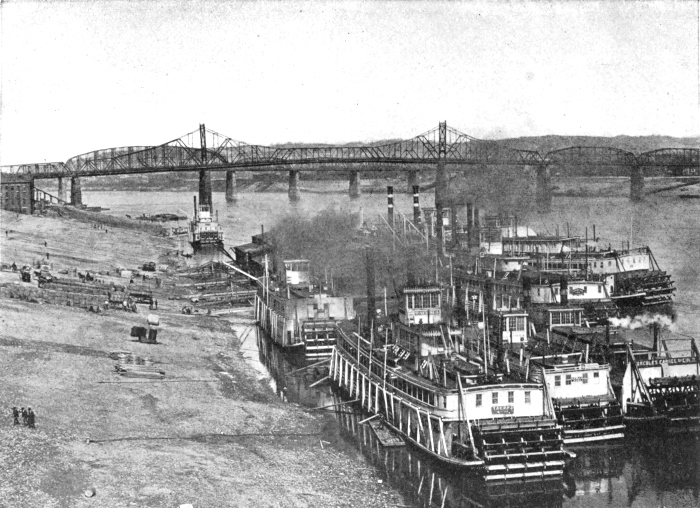
Copyright, 1904, by Detroit Photographic Company
THE MISSISSIPPI
John Law, a Scotchman, at first a gambler, and subsequently a bold, visionary, but brilliant financier, succeeded Crozat in the privileges of this grand scheme, and secured from the successor of Louis XIV. a monopoly of the trade and development of the French possessions in the valley. In order to carry out his wild enterprise he organized a colossal stock company, called “The Western Company,” but more generally known in history as the “Mississippi Bubble.” According to the historian Monette “it was vested with the exclusive privilege of the entire commerce of Louisiana and New France, and with authority to enforce its rights. It was authorized to monopolize the trade of all the colonies in the provinces, and of all the Indian tribes within the limits of that extensive region, even to the remotest source of every stream tributary in anywise to the Mississippi.” So skilful and daring were his manipulations that he bewitched the French people with the fascinations of stock gambling. The excitement in Paris is thus described by Thiers:
“It was no longer the professional speculators and creditors of the Government who frequented the rue Quincampoix; all classes of society mingled there, cherishing the same illusions—noblemen famous on the field of battle, distinguished in the Government, churchmen, traders, quiet citizens, and servants whom their suddenly acquired fortune had filled with the hope of rivalling their masters.”
The rue Quincampoix was called the Mississippi. The month of December was the time of the greatest infatuation. The shares ended by rising to eighteen and twenty thousand francs—thirty-six and forty times the first price. At the price which they had attained, the six hundred thousand shares represented a capital of ten or twelve billions of francs.
But the bubble soon burst; and its explosion upset the finances of this whole kingdom. Some years later, in 1745, a French engineer named Deverges made a report to his Government in favour of improving the mouth of the Mississippi, and stated that the bars there existing were a serious injury to commerce.
But France met with too powerful rivalry in the valley, and in 1762 and 1763, after a supremacy of nearly a hundred years, was crowded out by the English from the Atlantic colonies and the Spaniards from the south-west, the Mississippi River forming the dividing line between the regions acquired by those two nations. The Spanish officials, for the purpose of promoting colonization, and to aid in establishing trading-posts on the Mississippi, Missouri, Arkansas, Red, and other rivers in the western half of the valley, granted to certain individuals, pioneers, and settlers, large tracts of land. They made little progress, however, in peopling their new territory.
But whatever progress was made under the successive supremacies of France and Spain, the Mississippi and its navigable tributaries supplied the only highways of communication and commerce.
In the year 1800, soon after Napoleon I. became the civil ruler of France, he sought to add to the commercial glory of his country by re-acquiring the territory resting upon the Mississippi which his predecessors had parted with in 1763.
To quote the language of a French historian: “The cession that France made of Louisiana to Spain in 1763 had been considered in all our maritime and commercial cities as impolitic and injurious to the interests of our navigation, as well as to the French West Indies, and it was very generally wished that an opportunity might occur of recovering that colony. One of the first cares of Bonaparte was to renew with the court of Madrid a negotiation on that subject.”
He succeeded in these negotiations, and by secret treaty of St. Ildefonso, in 1800, French domination was once more established over the great river.
Two years later, the commerce of the river had grown to large proportions. Says Marbois, of that period: “No rivers of Europe are more frequented than the Mississippi and tributaries.” A substantially correct idea of their patronage may be obtained from the record of the foreign commerce from the mouth of the Mississippi, for nearly all of the commodities collected there for export had first floated down the river.
Marbois well illustrates the intense indignation at this order on the part of the Western people by attributing to them the following language: “The Mississippi is ours by the law of nature; it belongs to us by our numbers, and by the labour which we have bestowed on those spots which before our arrival were desert and barren. Our innumerable rivers swell it and flow with it into the Gulf Sea. Its mouth is the only issue which nature has given to our waters, and we wish to use it for our vessels. No power in the world shall deprive us of this right.”
Of Morales’s order James Madison, then Secretary of State, wrote the official representative of the United States at the court of Spain:
“You are aware of the sensibility of our Western citizens to such an occurrence. This sensibility is justified by the interest they have at stake. The Mississippi to them is everything. It is the Hudson, the Delaware, the Potomac, and all the navigable rivers of the Atlantic States formed into one stream.”
At this time Thomas Jefferson was President, and in view of the uneasiness of the Western settlers, he hastened to send to France a special ambassador to negotiate for the purchase of the Louisiana Territory. The opportunity was a favourable one, for France was then in danger of a conflict with Great Britain. The latter country had become alarmed at and jealous of Bonaparte’s commercial conquests, and he, apprehending war and fearing that he could not hold Louisiana, had about determined to do the next best thing—dispose of it to one of England’s rivals.
Marbois, the historian of Louisiana, from whom we have above quoted, was chosen by Napoleon to represent France in the negotiations with the representative of the United States sent by Jefferson. His account of the cession—the consultation between Napoleon and his ministers—and of his remarks and motives, forms one of the most instructive and interesting chapters of modern history. Napoleon foreshadowed his action by the following remark to one of his counsellors:
“To emancipate nations from the commercial tyranny of England it is necessary to balance her influence by a maritime power that may one day become her rival; that power is the United States. The English aspire to dispose of all the riches of the world. I shall be useful to the whole universe if I can prevent their ruling America as they rule Asia.”
In a subsequent conversation with two of his ministers, on the 10th of April, 1803, on the subject of the proposed cession, he said in speaking of England: “They shall not have the Mississippi which they covet.”
In accordance with this conclusion, on the 30th day of the same month, the sale was made to the United States. When informed that his instructions had been carried out and the treaty consummated, he remarked:
“This accession of territory strengthens forever the power of the United States, and I have just given to England a maritime rival that will sooner or later humble her pride.”
Under the stimulating influence of American enterprise the commerce of the valley rapidly developed. In 1812 it entered upon a new era of progress by the introduction for the first time upon the waters of the Mississippi of steam transportation.
The river trade then grew from year to year, until the total domestic exports of its sole outlet at the sea-board—the port of New Orleans—had during the fiscal year 1855-56 reached the value of over $80,000,000. Its prestige was then eclipsed by railways, the first line reaching the Upper Mississippi in 1854, and the second the Lower Mississippi, at St. Louis in 1857. Says Poor:
“The line first opened in this state from Chicago to the Mississippi was the Chicago and Rock Island, completed in February, 1854. The completion of this road extended the railway system of the country to the Mississippi, up to this time the great route of commerce of the interior. This work, in connection with the numerous other lines since opened, has almost wholly diverted this commerce from what may be termed its natural to artificial channels, so that no considerable portion of it now flowed down the river to New Orleans.”
The correctness of this assertion may be seen by reference to the statistics of the total domestic exports of New Orleans during the year ending June 30, 1879. They were $63,794,000 in value, or $16,000,000 less than in 1856, when the rivalry with railways began.
But since 1879 the river has entered upon a new and important era. The successful completion of the jetties by Capt. Jas. B. Eads inaugurated a new era of river commerce and regained for it some of its lost prestige.
Another step of great importance to the welfare of the Mississippi was taken about this time. The control of its improvement was transferred by Congress to a board of skilled engineers known as the Mississippi River Commission. The various conflicting theories of improvement which have for years past done much to defeat the grand consummation desired will now be adjusted in a scientific and business-like manner.
Again, the rapidly growing popular demand throughout the United States for more intimate commercial relations with Mexico and the several sister nations of Central and South America, which lie opposite the mouth of this great River System, is stimulating the long-neglected longitude trade and thereby creating a new demand for new transportation on the longitudinal water-ways which comprise the Mississippi and its tributaries.
The Mississippi and tributaries considered as a drainage system, extend nearly the whole length of the United States from Canada to the Gulf, and across more than half its width, or from the summit of the Rocky Mountains to that of the Alleghanies.
Steamers can now transport freight in unbroken bulk from St. Anthony’s Falls to the Gulf of Mexico, a distance of 2,161 miles, and from Pittsburg to Fort Benton, Mont., 4,333 miles. Lighter craft can ascend the Missouri to Great Falls, near where that river leaves the Rocky Mountains.