THE RHONE
Reading edition
ANGUS B. REACH
FEW travellers have much fancy for the most rapid of the great European streams. If they at all make its personal acquaintance, it is with knapsack on back, and iron-shod bâton in hand—when they stand upon the mother-glacier, and watch the river-child glide brightly into air—or perhaps it is near fair Geneva, that, loitering on a wooden bridge, they mark the second start in life of the strong river, and, if they be philosophers, lament the clamorous and not cleanly Arve. Later in the river’s career—the pellucid waters of the snow are again and still more fatally fouled by the slow-running Saone which comes down by Lyons, heavy and fat with the rich mud of Burgundy. At the point of junction there, also, the tourist sometimes goes to observe the coalition of the streams, and to find out, that instead of the bigger river cleansing the smaller, the smaller utterly besmirches and begrimes the greater. So pondering over the moral, he too often takes little further heed of the Rhone; or if he does, it is as a mere beast of burden. He is bound south, and he knows that the “swift and arrowy Rhone” will add wings to the speed of steam; that stepping on board the long, long steamboat from the noble quays of Lyons at summer’s dawn, he will step ashore amid the clamour of the uproarious Avignon porters by the summer’s eve. But the day’s flight—through rocks, and vines, and corn-lands, and by ancient towns and villages, and through old bridges of stone, and modern bridges of boats, is to the conventional traveller usually nearly a blank. How different from the Rhine; no legends in the handbook, no castles, no picturesque students, no jolly Burschen choruses over pipes and beer. The steamer flies southwards. If she be one of the quickest of the Rhone fleet, and the river be in good order, she could carry you between sunrise and sunset, from the land where the chestnut and the walnut most abound, through the zone where the mulberry is almost exclusively the tree; next past the region where men are clipping, and twisting, and trimming the olive, at once sacred and classic, and, finally, fairly into the flats, where tropical rice grows out of fever-haunted swamps in the African-like jungles of the Camargue. During this flight, it is to be noted, that you have descended upwards of 600 feet, in fact, that you have been steaming down a modified water-fall, and have measured in a day, a run from a climate which may be described as temperate, to one which is, to all intents and purposes, torrid.
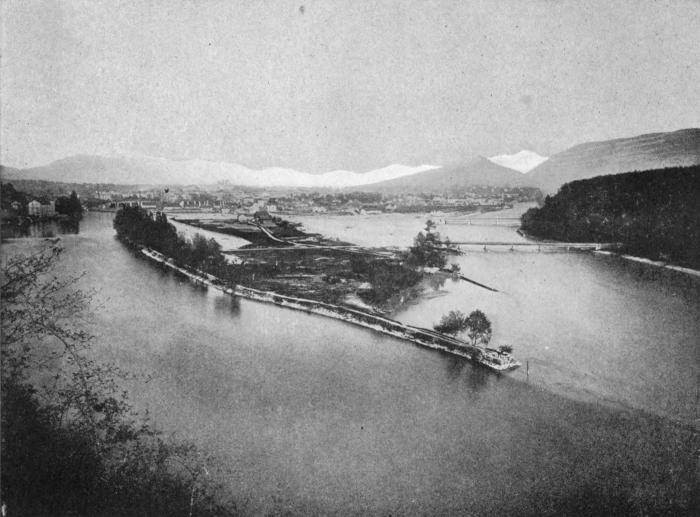
THE RHONE
And in this run must we not have passed some rather curious objects, some rather striking points of scenery? May not there have been nooks, and ravines, and old towers within that sterile, yet viney land, burnt by the hot kiss of the sun, which are worthy of a traveller’s afternoon? There are many such. The masonry of Rome still stands by the stream, and ancient rock-perched ruins there are, telling grim tales of the old religious wars of France; tales going back to the Albigenses and Count Raymond of Toulouse, and in later days dealing with the feuds which Ivry put an end to, but which were renewed when the peasants of the wild hills of the Cevennes, in their white camisas, Langue d’ Oc for shirts, worn over their clothes as uniforms, held out the long and obstinate contest of the dragonnades, and frequently beat even Marichale Villars, with the best of the cavaliers of the Grand Monarque. But there are still other points of interest connected with the Rhone itself—parts and pendicles of the river. First, look at the current. Did you ever see a blacker, fiercer, more unmercifully minded looking stream? Take care how you get into it. There is drowning in its aspect. A sudden sweep down that foaming current, and all would be over. No swimming in these deadly whirling eddies. Once they embrace you in their watery arms, down you go, never stopping, even to die, to the sea, whither the Rhone is ever, ever rushing, ploughing its way through shingles, roaring round opposing rocks, sometimes carrying by assault a new channel through a green pasture, at others, when its sudden floods are out, rushing with a furious vengeance, at what at sunset was a fertile island, rich with the ripe corn, which to-morrow will be a torrent, and a few morrows afterwards—sand.
In spite of its fury of current, in spite of its sudden shiftings of sand and shingle banks, its sudden floods, its sudden fogs, the Rhone has been navigated from time immemorial.
Toiling hard and slowly up the stream an equipage goes crawling along, composed of half a dozen huge barges hauled by those struggling, splashing, panting horses on the bank. Before the introduction of steam, there were upwards of fifty of these barge squadrons. They floated down from Lyons to Beaucaire, opposite Arles, in two days, but difficult and dreary was the passage back. A month in summer, six weeks in winter were consumed in the tedious struggle with the ever-opposing stream.
But our boat is sweeping towards a rocky promontory. The contracted stream shoots rapidly through the defile; and, at the narrowest point, a chain bridge appears, connecting two small villages clustered beneath vine-covered steps. The crag above that on the right hand is castled most picturesquely; that on the left is crowned with a more genial diadem. The first village is Tournon, the second Tain. The latter is poor, shabby, dirty: the houses are rickety and slovenly. All the slope of the cliff is split up into squares, triangles, etc., and bounded by stone walls: and these are full of vines—the aristocracy of the grape—in short, Hermitage.
Descending the Rhone a little further, we find ourselves opposite Valence. About a mile from the river—the intervening space is corn-country, the fields dotted with mulberries—rises a bold and high peak of rocks, and on their summit, a nobly perched lyric of a castle.
Clamber up! The hill is steep, and tough to ascend, and the heath is slippery. Nevertheless, persevere, and be rewarded at length by entering the ruins, where you will perceive a half-crumbled cavernous looking recess in a thick wall. It seems to have been a fireplace. Approach cautiously! That fireplace has no back, and fuel flung in there will roll out at a hole behind, and find itself upwards of eight hundred feet high in the yielding air.
The castle once belonged to a Protestant lord, the Seigneur de Crussol, and when, after a successful foray across the river, amongst the Catholic population, he managed to secure a score or two of prisoners, high festival was held, and the unhappy captives, amid the brimming glasses and convivial jokes of the company, were flung into the chimney of Crussol, and found by the trembling peasantry indefinite masses of horror next morning.
These were wild old savage days; but let us go back for a few moments to days far more ancient though hardly more barbarous. Hannibal, coming from Spain, also crossed the Rhone; and, looking at that wild rushing river, so deep and broad, and perpetual in its current, we have often thought that the great Carthaginian performed a more brilliant exploit in getting his moorish cavalry, his war-elephants, and his undisciplined Spanish brigades, across the water, than across the mountains. No one knows the spot he selected for his ferriage. Imagine the leader with his troops encamped, and chafing at the broad river which lay between them and those distant snow-capped hills, beyond which was Italy. In three days, we are told, the feat was achieved. Apocryphal accounts tell us how the horses, mad with the terror of fire, swam wildly across the stream, and how the elephants trumpeted upon the rafts.
A wide champagne country, fertile to magnificent luxuriance—the rushing Rhone dotted with wooded islands; a city clustering on a hill and a castle crowning it, and we approach Avignon. Here the traveller usually leaves the river (if he be antiquarian and historic) and examines the noble churches, towers, bastions and dungeons with which the Avignon Popes beautified the city; or, if he be sentimental and romantic, he prepares his feelings, works them—hard work it usually is—into a proper frame, and proceeds to Vaucluse. A pretty spot it is in itself, with its grottoed rocks and limpid waters; and certainly the name of Petrarch may fairly enough add a certain degree of interest to the scene.
The last point of interest is the delta of the river; the several mouths through which, after its rapid course from the lake of Geneva, the Rhone at length pours itself into the sea. The Carmargue, as this strange swampy district is called, is seldom or ever trodden by English foot. It has no attractions for the ordinary sightseer, but it has many for the lover of aspects of nature, of a strange and unwonted character, and of which few are to be seen in Europe. Proceeding from Arle, along a muddy, clayey road, through a perfect flat intersected by numerous draining ditches, you gradually find yourself arriving in a region where the earth appears to be losing its consistence and melting into mud beneath your feet. Forests of swamp-growing trees, willows, and marsh-mallows stretch around; and as you emerge from them you come upon a boundless plain, an enormous stagnant flat—mud and water and water and mud for scores and scores of square miles, but intersected as far as the eye can reach, by a network of clay walls, upon which you can make your way, gazing in wonder upon the perfect sublimity of the apparent desolation. But there is no desolation in the case. These swamps are rice-fields. If you paid your visit during the summer, the grain will be growing out of the tepid water; if during the autumn, you will see withered beds of the straw left for manure, slowly rotting in the soil. At long distances crawling figures appear. These are the labourers employed by the Company which grows the rice, and whose stations for draining out the surplus water, which would otherwise perhaps overwhelm the whole district, may be fixed by their lofty siphon tubes breaking the dead flatness of the several lines of view. And yet there is a dreary death-like beauty about all this silent land. Shelley has sung such; Tennyson has done it more elaborately and better, and we find traces of the sentiment in “Eothen.” The vast and the drear have a sublime of their own, and in this dismal waste of laid-out world we feel it. Even ugliness is made respectable by extent, and we leave the swamps with an impression of lorn, melancholy grandeur looming in our minds.