THE MERRIMACK
Reading edition
HENRY D. THOREAU
WE were thus entering the state of New Hampshire on the bosom of the flood formed by the tribute of its innumerable valleys. The river was the only key which could unlock its maze, presenting its hills and valleys, its lakes and streams, in their natural order and position. The Merrimack, or sturgeon river, is formed by the confluence of the Pemigewasset, which rises near the notch of the White Mountains, and the Winnipiseogee, which drains the lake of the same name, signifying “The smile of the Great Spirit.” From their junction it runs south seventy-eight miles to Massachusetts, and thence east thirty-five miles to the sea. I have traced its stream from where it bubbles out of rocks of the White Mountains above the clouds, to where it is lost amid the salt billows of the ocean on Plum Island Beach. It was already the water of Squam and Newfound Lake and Winnipiseogee, and White Mountain snow dissolved, on which we were floating, and Smith’s and Baker’s and Mad Rivers, and Nashua and Souhegan and Piscataquong, and Suncook and Soucook and Contoocook, mingled in incalculable proportions, still fluid, yellowish, restless all, with an ancient, ineradicable inclination to the sea.
So it flows by Lowell and Haverhill, at which last place it first suffers a sea change, and a few masts betray the vicinity of the ocean. Between the towns of Amesbury and Newbury it is a broad, commercial river, from a third to half a mile in width, no longer skirted with yellow and crumbling banks, but backed by high green hills and pastures, with frequent white beaches on which fishermen draw up their nets. I have passed down this portion of the river in a steamboat, and it was a pleasant sight to watch from its deck the fishermen dragging their seines on the distant shore, as in pictures of a foreign strand. At intervals you may meet with a schooner laden with lumber, standing up to Haverhill, or else lying at anchor or aground, waiting for wind or tide, until, at last, you glide under the famous Chain Bridge, and are landed at Newburyport. From the steeples of Newburyport you may review this river stretching far up into the country, with many a white sail glancing over it like an island sea, and behold, as one wrote who was born on its head-waters, “Down out at its mouth, the dark inky main blending with the blue above, Plum Island, its sand ridges scalloping along the horizon like the sea-serpent, and the distant outline broken by many a tall ship, leaning, still, against the sky.”
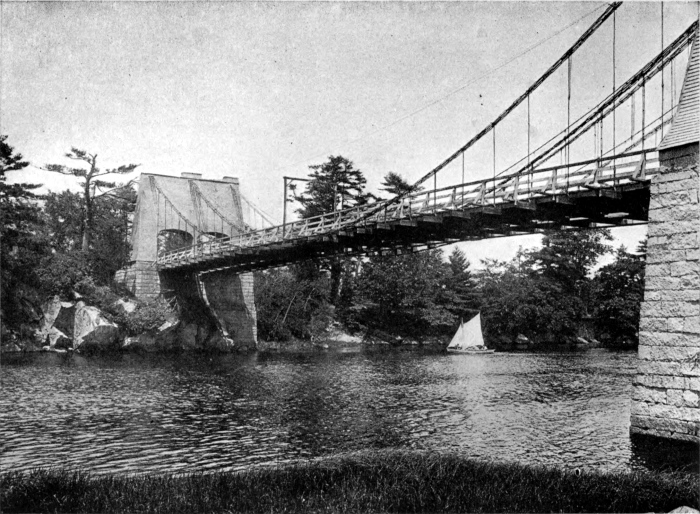
Copyright, 1900, by Detroit Photographic Company
THE MERRIMACK
Rising at an equal height with the Connecticut, the Merrimack reaches the sea by a course only half as long, and hence has no leisure to form broad and fertile meadows, like the former, but is hurried along rapids, and down numerous falls, without long delay. The banks are generally steep and high, with a narrow interval reaching back to the hills, which is only rarely or partially overflown at present, and is much valued by the farmers. Between Chelmsford and Concord, in New Hampshire, it varies from twenty to seventy-five rods in many places, owing to the trees having been cut down, and the consequent wasting away of its banks. The influence of the Pawtucket Dam is felt as far as Cromwell’s Falls, and many think that the banks are being abraded and the river filled up again by this cause. Like all our rivers, it is liable to freshets, and the Pemigewasset has been known to rise twenty-five feet in a few hours. It is navigable to vessels of burden about twenty miles; for canal-boats, by means of locks, as far as Concord in New Hampshire, about seventy-five miles from its mouth; and for smaller boats to Plymouth, one hundred and thirteen miles. A small steamboat once plied between Lowell and Nashua, before the railroad was built, and one now runs from Newburyport to Haverhill.
Unfitted to some extent for the purposes of commerce by the sand-bar at its mouth, see how this river was devoted to the service of manufactures. Issuing from the iron regions of Franconia, and flowing through still uncut forests, by inexhaustible ledges of granite, with Squam, and Winnipiseogee, and Newfound, and Massabesic Lakes for its mill-ponds, it falls over a succession of natural dams, where it has been offering its privileges in vain for ages, until at last the Yankee race came to improve them. Standing at its mouth, look up its sparkling stream to its source,—a silver cascade which falls all the way from the White Mountains to the sea,—and behold a city of each successive plateau, a busy colony of human beavers around every fall. Not to mention Newburyport and Haverhill, see Lawrence, and Lowell, and Nashua, and Manchester, and Concord, gleaming one above the other. When at length it has escaped from under the last of the factories, it has a level and unmolested passage to the sea, a mere waste water, as it were, bearing little with it but its fame; its pleasant course revealed by the morning fog which hangs over it, and the sails of the few small vessels which transact the commerce of Haverhill and Newburyport. But its real vessels are railroad cars, and its true and main stream, flowing by an iron channel farther south, may be traced by a long line of vapour amid the hills, which no morning wind ever disperses to where it empties into the sea at Boston. This river was at length discovered by the white man “trending up into the land,” he knew not how far, possibly an inlet to the South Sea. Its valley, as far as the Winnipiseogee, was surveyed in 1652. The first settlers of Massachusetts supposed that the Connecticut, in one part of its course ran north-west, “so near the great lake as the Indians do pass their canoes into it over-land.” From which lake and the “hideous swamps” about it, as they supposed, came all the beaver that was traded between Virginia and Canada—and the Potomac was thought to come out of or from very near it. Afterwards the Connecticut came so near the course of the Merrimack that, with a little pains they expected to divert the current of the trade into the latter river, and its profits from their Dutch neighbours into their own pockets.
Unlike the Concord, the Merrimack is not a dead but a living stream, though it has less life within its waters and on its banks. It has a swift current, and, in this part of its course, a clayey bottom, almost no weeds, and comparatively few fishes. We looked down into its yellow water with the more curiosity, who were accustomed to the Nile-like blackness of the former river. Shad and alewives are taken here in their season, but salmon, though at one time more numerous than shad, are now more rare. Bass, also, are taken occasionally; but locks and dams have proved more or less destructive to the fisheries. The shad make their appearance early in May, at the same time with the blossoms of the pyrus, one of the most conspicuous early flowers, which is for this reason called the shad-blossom. An insect called the shad-fly also appears at the same time, covering the houses and fences. We are told that “their greatest run is when the apple-trees are in full blossom. The old shad return in August; the young, three or four inches long, in September. These are very fond of flies.” A rather picturesque and luxurious mode of fishing was formerly practised on the Connecticut, at Bellows Falls, where a large rock divides the stream. “On the steep sides of the island rock,” says Belknap, “hang several arm-chairs, fastened to ladders, and secured by a counterpoise, in which fishermen sit to catch salmon and shad with dipping nets.” The remains of Indian weirs, made of large stones, are still to be seen in the Winnipiseogee, one of the head-waters of this river.
It cannot but affect our philosophy favourably to be reminded of these shoals of migratory fishes, of salmon, shad, alewives, marsh-bankers, and others, which penetrate up the innumerable rivers of our coast in the spring, even to the interior lakes, their scales gleaming in the sun; and again, of the fry which in still greater numbers wend their way downwards to the sea. “And is it not pretty sport,” wrote Captain John Smith, who was on this coast as early as 1614, “to pull up twopence, sixpence, and twelvepence, as fast as you can haul and veer a line?”—And what sport doth yield a more pleasing content, and less hurt or charge, than angling with a hook, and crossing the sweet air from isle to isle, over the silent streams of a calm sea.