THE SHANNON
Reading edition
ARTHUR SHADWELL MARTIN
THE greatest body of running water in the British Isles has long claimed and received the love, admiration and praise of natives and foreigners. Its banks are fringed with ruins of castles, round towers, abbeys and churches, and its islands and hills reek with historical associations, pagan folklore and mediæval tradition. Steamers now run practically from its mouth to its source, and to the tourist all its beauties are now displayed. The enthusiasm of foreigners over the beautiful stream equals that of Erin’s own sons. Writing in 1844, Johann Georg Kohl said:
“Well may the Irish speak of the ‘Royal Shannon,’ for he is the king of all their rivers. A foreigner, when he thinks of some of our large continental streams, may at first consider the epithet somewhat of an exaggeration, but let him go down this glorious river and its lakes, and he will be at no loss to understand that royal majesty, in the matter of rivers, may be quite independent of length or extent.
“The British Islands certainly can boast of no second stream, the beauties of whose banks could for a moment be compared to those of the Shannon.
“At his very birth he is broad and mighty, for he starts on his course strong with the tribute of a lake (Lough Allen), and traverses the middle of Ireland, in a direction from north-east to south-west. Thrice again he widens out into a lake; first into the little Lough Boffin, then into the larger Lough Ree, and lastly, when he has got more than half way to the ocean, into the yet longer Lough Derg. Below Limerick he opens into a noble estuary, and when at length he falls into the sea between Loop Head and Kerry Head, the glorious river has completed a course of two hundred and fourteen English miles. The greater part of the Shannon runs through the central plain which separates the mountainous north from the mountainous south.
“It was on a beautiful day that I embarked to descend the Shannon. Flowing out of a lake, and forming several other lakes in its progress, the water is extremely clear and beautiful. The movement is in general equable, excepting a few rapids which are avoided by means of canals. The banks, too, are pleasing to the eye. Large green meadows stretch along the sides of the river, and villages alternate with handsome country seats, surrounded by their parks. Herons abound along the margin, and many of these beautiful birds were continually wheeling over us in the air, their plumage glittering again in the rays of the sun.
“We arrived at Banagher. Then gliding along by Redwood Castle and the beautiful meadows of Portumna, we left the town of Portumna to our right, and entered the waters of Lough Derg. The steamer in which we had hitherto travelled was of small dimensions, with a wheel under the stern, to allow of its passing through some canals of no great breadth; but on the broad lake a new and larger vessel prepared to receive us. The two steamers came close to one another, to exchange their respective passengers, and their manœuvre, as they swept round on the wide water, pleased me much.
THE SHANNON
“Of the lakes that like so many rich pearls are strung upon the silver thread of the Shannon, Lough Ree and Lough Bodarrig, lying in a level country, and in a great measure surrounded by bogs, present little that is pleasing to the eye. Lough Allen is situated almost wholly within the mountainous districts of the north, and a large portion of Lough Derg is made picturesque by the mountains of the south. Like all Irish lakes, Lough Derg contains a number of small green islands, of which the most renowned is Inniscaltra, an ancient holy place, containing the ruins of seven venerable churches of great antiquity, and the remains of one of those remarkable columnal erections known in Ireland under the name of “round towers.” We passed the sacred isle at the distance of a mile and a half, but we could very distinctly make out all its monuments by the aid of a telescope.”
It is not every visitor to Shannon’s shores that has unqualified praise for the scenery. Thus speaking of the sites selected by the saints of old for their retreats, Cæsar Otway exclaims: “What a dreary place is Glendalough! what a lonely isle is Inniscaltra! what a hideous place is Patrick’s Purgatory! what a desolate spot is Clonmacnoise! From the hill of Bentullagh on which we now stood, the numerous churches, the two round towers, the curiously overhanging bastion of O’Melaghlin’s Castle, all before us to the south, and rising in relief from the dreary sameness of the surrounding red bogs, presented such a picture of tottering ruins and encompassing desolation as I am sure few places in Europe could parallel.”
The traveller who wants to see the most accessible beauties of the Shannon usually starts at Limerick and leaves the river at Athlone, though some go as far as Carrick on Shannon. The chief loughs traversed are Derg and Ree; and the only towns of any importance are Killaloe, Portumna and Athlone.
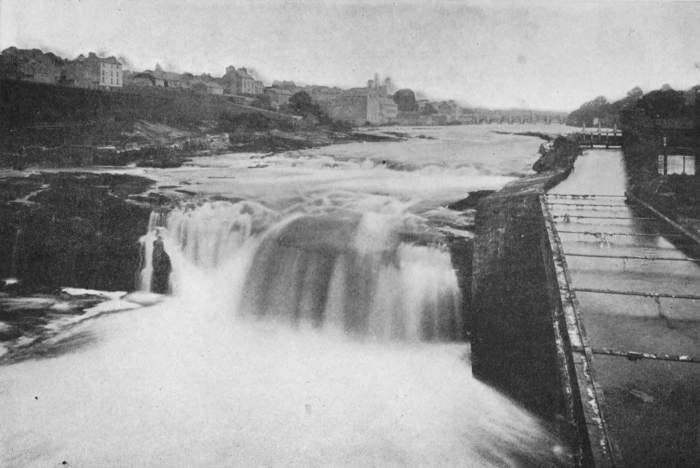
About eight miles above Limerick are the Rapids or Falls of Doonass, where the Shannon pours an immense body of water, which above the rapids is forty feet deep and 300 yards wide, through and above a congregation of huge rocks and stones that extend nearly half a mile, and offers not only an unusual scene, but a spectacle approaching much nearer to the sublime than any moderate-sized stream can offer even in the highest cascade.
Castleconnell is beautifully situated on the east bank. It has a popular Spa, and is a famous centre for salmon fishing. The castle, from which the town is named, stands on an isolated rock in the middle of the town. It was anciently the seat of the O’Briens. When Ginkell, William the Third’s General, took the castle, he caused it to be dismantled. Castleconnell is famous for its salmon fishing and eel weirs. The Castleconnell fishing rods are famed all over the world.
Eight miles above Castleconnell near the entrance to Lough Derg is Killaloe.
The navigation from Limerick to Killaloe is carried on by canal so as to avoid the rapids of Killaloe and Castleconnell. Killaloe is a charmingly placed village, but it is probably best known as the place above all others in Ireland dear to the heart of the angler. The fine old cathedral, on the site of a much older church, dates from the Twelfth Century. The Choir is used as the parish church. Commencing at Killaloe is Lough Derg, an expansion of the Shannon to the proportions of a lake. The Duke and Duchess of Cornwall and York made a trip up Lough Derg to Banagher in the summer of 1897, and the route is now known as the “Duke of York” route.
As every one knows, the Shannon is much the largest river in the United Kingdom. Its breadth, where it expands into the long narrow lakes that mark so much of its course, stretches to as much as thirteen miles. Lough Derg, the first of these expanded stretches, is twenty-three miles long, and exceedingly picturesque. Its shining surface, overshadowed by blue hills, is broken here and there by woody islands famous in history and song. Killaloe itself takes its name from the ruined church on the island below the twelve-arched bridge (“the church on the water”). The salmon fisheries here are very important and profitable, and—which is probably more interesting to the traveller—the river is free to every one who possesses a rod and line.
It was here, at the lower end of Lough Derg, that Brian Boru’s palace of Kincora once stood, in the Ninth Century. The mound on which it was built is all that remains of a place that displayed, 1,200 years ago, the utmost glory of the fierce, proud Irish kings. The ruined castle of Derry crowns another small islet; and Holy Island, thirty acres in extent, is a spot full of interest. Like Glendalough, it was chosen out, early in the Christian era, for a retreat of piety and learning. One cannot but observe the excellent taste in scenery displayed by the monks of ancient days, in selecting these peaceful refuges from a stormy world. What can be more lovely than the vale of the seven churches, or than Innisfallen Island? and Holy Island compares not at all ill with these still more famous places. St. Caimin, in the early part of the Seventh Century, settled here, and built a monastery, which soon became famous for its learning. Seven different churches afterwards grew up on the island, and one of the most beautiful round towers in Ireland still raises its head seventy feet above the waters of the lake, among the ruins of these sacred places. This part of the lake is crowded with islands, and the ruined castles and monasteries are very numerous. At the town of Portumna, some miles further on, another stop is made, as the castle and abbey are particularly well worth seeing. This was another spot celebrated for its learning. The monastery of Tirdaglass, whence many manuscripts issued, was founded by St. Columba in the Sixth Century. At Clonmacnoise, further on, the traveller may see the cradle of the ancient art and learning of Ireland, and the most important seat of religion in early days. St. Cearan (early Sixth Century) is especially associated with the spot; the great cathedral was built in his honour, and the holy well, dedicated to the Saint, is still the object of constant pilgrimage. Round towers, ancient Irish crosses, ruined churches and monasteries, are here in abundance. The ancient city of Clonmacnoise has disappeared altogether. This is a place of the greatest possible interest to antiquarians, and even ordinary travellers will find much pleasure in the beauty of the picturesque ruins.
At Banagher is the fortified bridge of seven arches, protected by two towers and a battery. This is all the more interesting, for, not being an antiquity in any sense, it was finished in 1843, as a matter of fact.
Above Lough Derg, the country is fertile, but not especially striking until Lough Ree is reached. This second great expansion of the river fairly rivals the first in beauty. Of its twenty-seven islands, the most attractive is Inis Clothran, on which the famous Queen Maev of Connaught spent her declining years. She is said to have built a splendid stone house for herself here, and lived on the island until she died, at the age of a hundred and two. Some ruins still remain to mark the spot, although the date of Queen Maev goes back nearly two thousand years. Antiquarians consider that Shakespeare’s fairy Queen Mab was a development of the many legends told about this powerful, wicked, and fascinating Queen of far-off days.
Portumna, at the head of the lake, commands fine views of Lough Derg, and the hilly land to the west. After leaving this town the scenery becomes dull and monotonous till we reach Meelick, where the river is so devious that a canal rejoins the Shannon at the mouth of the Little Brosna. Immediately above, the stream begins to divide and becomes very tortuous till Banagher is reached.
At the upper end of Lough Ree is Lanesborough, a small town with a fine bridge of six arches and a swivel arch. From this point the sail to Tarmonbarry presents little beauty or interest. The country is generally a wide extent of bog, abounding in remains of trees and the extinct Irish elk. Opposite Tarmonbarry, the Royal Canal, communicating with Dublin, joins the Shannon. When the river again widens into Lough Forbes, the Seven Churches of Kilbarry come into view: only three and part of a round tower are now standing. Lough Forbes is triangular in shape, and the shores are low boggy land not destitute of a certain quiet beauty. Lough Boderg shaped like a T is the only remaining sheet of water before reaching Carrick on Shannon where the tourist’s voyage generally ends.