THE SEINE
Reading edition
A. BOWMAN BLAKE
FEW persons outside of France have any acquaintance with, or knowledge of, the rare beauties of Seine scenery. The river has thus far escaped the vulgarity of becoming a common tourist’s high-road. The general impression is current that the Seine, being destitute of the legendary romance of the vine-clad Rhine, the vivid and somewhat spectacular scenic effects of the Italian lakes, or even the lawn-like finish of the Thames, offers no attractions to either amateur or tourist. This opinion only proves the falsity of opinion based upon superficial knowledge. From the artistic point of view, perhaps, no other one river in Europe possesses a character of scenery so preëminently beautiful, or so replete with the charm of contrast, or rich in variety; for the picturesque portions of the noble river are by no means confined to the grandeur and wildness of the Fontainebleau forests, or of the animated quays and crumbling Mediæval houses of the ancient city of Rouen. To one in search of scenes which shall unite the charms of beautiful river scenery with the added note of pastoral and village rusticity, almost every turning of the river will reveal a mine of wealth. It is a characteristic of the scenery of the Seine that it is eminently sketchable at almost every point. For it is more than a purely picturesque, it is an essentially poetic river. A conclusive proof of its superiority in point of artistic resources and suggestivement is, perhaps, that no other European river scenery has had so overwhelming an influence upon modern Art. During the past forty years, in which the Seine and its tributaries have been the principal camping-ground of the best French landscape-painters, the peculiarities of its scenery, and the features of its rustic life, have formed the taste, and developed a wholly original mode of treatment of genre and landscape in the modern French school. The two principal characteristics of the scenery of the Seine are its naturalness, and its possessing in the highest degree that individuality which marks its landscapes as distinctively French. The Seine could never be mistaken at any point for other than a French river. The Parisian masters, in transferring to their canvasses the peculiarities of the river and shore aspects, have produced a school of landscape as essentially national in character as that which marks the Dutch and Flemish masterpieces of two hundred years ago. The low wide meadows, the stately poplars, the reedy shores, and the delicate atmosphere which veils the jumble of roofs, and the quaint towers and turrets that are lanced from the Seine shores, have already become as familiar features of modern French landscape, as the cone-shaped hills of Flanders and the flat windmill-dotted fields of Holland, which makes the character of the landscape in Dutch and Flemish canvasses.
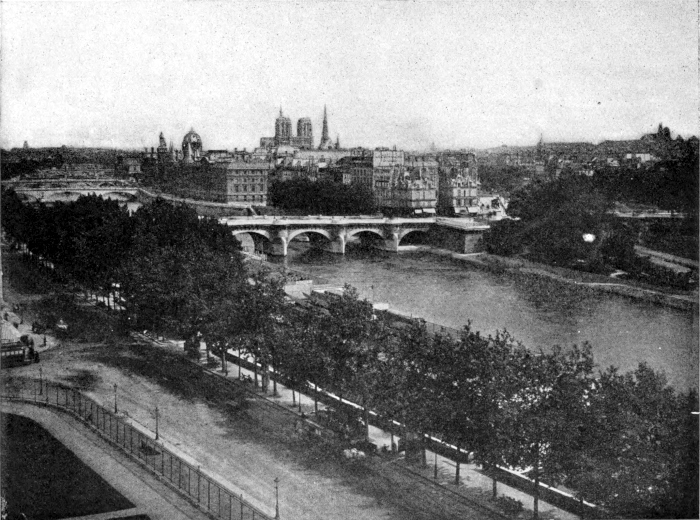
THE SEINE
I have spoken of the naturalness of the Seine landscape. It is this which makes its lasting charm. Along these banks Nature neither rises to the sublime nor does she appear in too wild or dishevelled a state. There is a happy blending of the cultivated and the uncultivated, of course tamed and yet enjoying the wilder abandon of freedom. Nowhere are the scenes too grand or too wide for the pencil; the hills suggest, but do not attain, the majestic; the wide, flat fields and the long stretches of meadows are broken into possible distances by a gently sloping ground, or an avenue of tall poplars. The villages and farm-houses dotted along its banks wear a thoroughly rustic air; the villas and châteaux crowning its low hills become naturally a part of the landscape by their happy adaptation, architecturally, to the character of their surroundings; while the not infrequent ruins of monastery or ancient castle group charmingly with the fluffy foliage and dense shrubbery.
Perhaps the impressionist’s most ideal landscape would be found among the villages of the upper Seine, that part of the Seine which flows between Fontainebleau and Rouen, as beyond Rouen the river takes on a stronger and bolder character both in its breadth and in the quality of its scenery.
First in point of beauty among the villages contiguous to Fontainebleau, is Grètz, a little village not directly upon the Seine, but upon its tributary, the Loing. Grètz can be reached in an hour’s drive from the town or palace of Fontainebleau. This charming village must have grown here, close to the low sweet level of the winding river’s banks, with a view to its being sketched. Not a feature necessary to the making of a picture is wanting. The village street lies back some distance from the shore, the backs of the houses fronting on the river, the village and river life made one by the straggling rose, fruit, and vegetable gardens running down between their high stone-wall enclosures to the very edges of the swiftly flowing streams. As one views the village from the mid-stream, one has the outlined irregularity of the village houses limned against the sky. To the right, between the tall grenadier-like poplars, or the higher branches of the willow, rises a beautiful group of old buildings; the blue spaces of the sky are seen through the arches and ruins of the old château of La Reine Blanche, that queen having made, centuries ago, Grètz her dwelling place. The massive, simple lines of the castle’s Norman tower contrast finely with the belfry of the still more ancient church close beside it, the dark façades of these old buildings being relieved by the gay touches of colour upon the adjacent houses. A queer old bridge appears to leap directly from the very courtyard of the château to the opposite shore, and on the bridge is constantly moving some picture of rustic life, peasants with loads of grapes or fagots, a herd of oxen laboriously dragging the teeming hay-cart, a group of chattering villagers, or the shepherd leading his flock to richer pastures. The river banks themselves are not wanting in the beauty of human activity. In the gardens, as our boat drifted along the banks, were half-a-dozen bent old women weeding, sowing, and plucking. Farther down, beyond the bridge, is the washerwomen’s stand, the bare arms, short skirts, and gay kerchiefs of these sturdy peasant women, with the bits of colour their home-spun linens yield, making delightful contrasts with the delicate arabesques which light foliage made against the sky.
The upper valley of the Seine, that portion of the river lying between Paris and Rouen, seems at a first glance to be a country as sterile in artistic resources as it is interesting to the average tourist. But the French artist, so far from finding the flat, wide stretches of field and meadow, the scanty foliage, and the scattered group of farm-houses which border the river banks, either too prosaic or too trite for his pencil, has discovered from a close study of this apparently common-place valley scenery a new feature of landscape beauty. This feature has been the present original treatment of the flat surfaces of ground and of large sunlit spaces. The character of all this valley scenery may be summed up in a few words; tilled fields running down to the water’s edge; wild uncultivated fields and rank dank meadows, their flatness broken here and there by a clustering group of low shrubbery, by rows of the slim, straight French poplars, or an avenue of stunted, bulbous-trunk willows, with their straight, reed-like branches. The entire landscape has but two lines, the horizontality of the meadows and the perpendicular uprising of the trees, except that far off in the distance run the waving outlines of the hills of Normandy. Such is the aspect of the country in which some of the first among contemporaneous French artists have found new sources of inspiration. Those wide, sunlit meadows, breathing the rich luxuriance of nature in undisturbed serenity; the golden spaces of the air shimmering like some netted tissue between tree and tree; the shadows cast by a single tree across the length of the field; an intimate knowledge and study of this landscape have taught the French brush the secret of its power in painting a flat picture, and in wresting from sunlight the glory of its gold. The peculiar qualities of the atmosphere at certain seasons of the year make the Seine valley entrancing, especially to Art Students. In the spring, nothing can exceed the delicacy, purity and fineness of the colouring of the foliage, and the tones of light are marvellous in their dainty refinement and suggestiveness. Nature seems to be making a sketch in outline of a picture, which summer is to fill in, so pure are the outlines of foliage and landscape in that wonderful medium of delicately coloured ether. In summer, sunlight fairly drenches the fields. Autumn colours, also, here seem richer, firmer, more glowing than in other parts of France, and the October twilights in their brilliance and duration approach an American tint.
The first breaks in the monotony of the valley scenery are the approaches to, and the immediate suburbs about, Rouen. The river banks just below are particularly picturesque. The river between Rouen and La Bouille assumes a character different from that which marks it above a city. It was my special good fortune to traverse this portion sometime before sunrise. We left the city behind us masked in grey mist, only the iron flèche of the cathedral piercing the cottony wrappings. On the motionless Seine not a ripple was astir, and the morning fog held leaves and trees in a close, breathless embrace. But at Croisset, with the shooting of the sun above the horizon came the melting hues and freshening breath of morning. As the clouds, slowly rolled apart, gave us glimpses of the magnificent panorama of Rouen set in its circlet of hills, the effect was that of the gradual lifting of a drop-curtain upon some fine scenic landscape. The river itself was a jewel of colour, reflecting the faintly tinted shipping along the wharves, the rich emerald of the trees, and the shadowy grasses along the shore. The steamer on its way steers in and out among a hundred little islands which give a magical effect of enchantment, so fairy-like and exquisite are their shapes and forms. With Croisset, Hautot, Loquence, and Sahurs, the majesty of the Rouen quays, wharves, spires, and cathedral towers gives place to the richer, softer beauty of rural village loveliness. But the most beautiful picture greeted our eyes as we approached La Bouille, which is picturesquely set against the greenery of a hilly back-ground, its bright, light-coloured houses so close to the water’s edge that the river was like a broken rainbow of colour, reflecting their tints in its ripples. Across the river was a magnificent expanse of meadow and tilled field, with a poplar now and then to serve as a sentinel guarding the bursting grain. The banks of the river are delightfully diversified by clusters of old thatched farm-houses, spreading fishing-nets, and old boats moored in tiny creeks. As we passed the last of the village houses, there were some wonderful effects of light and colour; all the confused indecision of light scurrying clouds piled above the meadows; the uncertain vagueness of a mist rolling still, like the skirts of a fleecy robe, over the distant river bends; and immediately above us the warmth, brilliance, and goldenness of sunrise in its early splendour. Couched amidst the mysterious shade of some dense foliage was the bending form of an old woman, filling her pitcher at the river-side, scarlet kerchiefed and dun skirted. Off in the grey distance was the figure of a peasant woman carrying her child upon her back, her tall, straight form magnified into strange attitude by the misty atmosphere. A brush capable of strong handling, and an eye trained to seize the more fleeting beauties of nature, would have found in this La Bouille picture a poem of colour and tenderness.
I have already mentioned the naturalness of the rustic life of the Seine fields and farm-houses. The sturdy simplicity of the Normandy peasant is his well-known characteristic. The farmers at the plough, the fishermen mending their nets, the shepherd tending his flocks, are not the least poetic of the elements which make the charm of this river scenery. There reigns here an Arcadian calm, a certain patriarchal simplicity. The complicated ingenuities and labour-saving machines of modern invention have not as yet become the fashion among the Normandy peasant-farmers, and thus every agricultural implement, seen out-of-doors, seems available for an artist’s purpose. The ploughs are marvels of ancient construction; oxen and horses are harnessed in ways known only to those who have learned the science as a secret handed down from sire to son; and carts, threshing-machines, rakes, and hoes have an air of venerability that matches well with the old gabled houses and worn rustic dress of the farmers. It is this aspect of age which imparts such beautiful low tones of colour to the pictures of human life along these shores. There are no flaring, flashing hues, no brilliant dashes of colour; instead, the tones of landscape, sky, atmosphere, and the human life blend in a beautiful harmony of soft low tints. In matters of toilet, the Normandy peasant’s taste is perfect. The farmers wear blouses of dark, sober blues; the women short skirts of dull green, brown or home-spun grey; their aprons are snuff-colour or lilac, and their close-fitting embroidered cap, or the coloured kerchief tied over their heads, brings into admirable relief their brilliant complexions, strong prominent features, and flaxen tresses.
In that morning’s journey from Rouen to Havre we enjoyed a delightful variety of out-door life. In the early sunrise hours there were visible the first symptoms of the farm-house in early rising. The farmer was seen striding over the dew-wet meadows to open barns or to drive forth the cattle; women were busy milking, and the children trudging to the river with pails and pitchers to be filled. Later, the fields were alive with the ploughmen’s cries, and men and women were starting out, rakes and scythes in hand, for their day’s work; children stood up to their chins in the yellow grain, in the midst of the scarlet coquelicots and the star-eyed daisies. Towards noon there was a pretty picture of a farmer wheeling along the river bank a huge load of green grass, atop of which were seated two round, moon-faced children whose laps and hands were full of the brilliant field-flowers. Behind them walked the mother with a rake slung over her shoulder, her short skirts and scant draperies permitting a noble freedom of step and movement, her head poised as only the head of a woman used to the balancing of heavy burdens is ever held. Hers was altogether a striking figure, and the brush of Vollen or of Breton would have seized upon her to embody the type of one of his rustic beauties, whose mingled fierceness and grace make their peasants the rude goddesses of the plough.
One of the chief charms of the Seine scenery is the variety and contrast its shores present. One passes directly from the calm and the rural naturalness of sloping meadows fringed with osiers, willows, and poplars, to the walled quays of Caudebec, with its spires, broad avenues, and garden-enclosed houses. Caudebec is characterized by an imposing château crowning its hillside, by beautiful gardens, terraces, its long row of “striped” houses stretching along its quays, and the beauty of its cathedral spire rising above the tree-trops.
Perhaps Villequier may be said to be the culminating point of beauty upon the Seine. Here the river seems only like a large lake, a fact which invests the landscape with its noble uprising hills and the beautiful, thickly wooded spurs of the hillocks, with something of the rounded finished aspect which belongs to lake scenery. The lovely village of Villequier itself peeps in and out of its encompassing trees as if with a conscious air of coquetry. The bright, gaily coloured houses grouped upon the water’s edge give a touch of Italian brilliancy to the scene, while its fine château of Villequier and the old Gothic spire of the village church add the noble lines to the ensemble.
This bay of Villequier is the beginning of the bolder beauty of the Seine scenery. Its quieter aspects lie above Villequier. The artist in search of striking scenes and a rich variety of contrasts will find this part of the river afford fine material. On the way to Quillebœuf and Tancarville the shores of the river assume a hundred different aspects. There is the forest of Bretonne, the lovely valley of the Bolbec, the beautiful château of Etalan, and the ruins of the Twelfth Century church. Quillebœuf itself stands boldly out into the river, perched upon a spur of rising ground, and is, perhaps, the most pretentious town upon the Seine. After Quillebœuf and Tancarville the loftier hills and thickly wooded shores of the river give place to wide, flat marshes and open valleys. The marshes just beyond Quillebœuf are, to our taste, its most distinguishing beauty; they run directly out to the most distant points of the horizon, and the rich yellow-green grass, with its brilliant bouquets of wild flowers scattered profusely over the flat treeless surface, makes a kaleidoscope of colour under the broad unbroken splendour of the noon-day sun. Cattle in large herds, horses, and sheep, pasture upon the rich meadows, so that the animal-painter finds here a superb landscape for the setting of his ruminating cows, fleecy sheep, or wild unbridled colts.
Just beyond these meadows the Seine loses all the character of a river. It has assumed, before its final plunge into the ocean, the turbulent, tumultuous aspect of a small sea, and like a lover wearing his lady’s colours, the river turns to the deeper greys and colder blues of the sea’s dark tint. The boat stops long enough at the wonderful old seaport town of Honfleur for one to catch a glimpse of its quaint turreted houses, its crooked narrow streets, its wharves with their picturesque assemblage of lateen-shaped sails. Then Havre is reached, and with those swarming quays and bright pebbly shores the Seine is lost in the great Atlantic.