THE TAGUS
Reading edition
ARTHUR SHADWELL MARTIN
THE Tagus rises in that maze of mountains between Cuenca and Tereul on the frontier of New Castile and Aragon. It is the largest river of the Iberian peninsula, having a length of 566 miles. It is of little commercial advantage, however, as a means of traffic and communication, because in Spain its shallows, rapids and cataracts render it unnavigable through much of its course; and only from Villavelha, eighteen miles within the Portuguese frontier does it become navigable for the remaining 115 miles to its mouth. It flows from its source first north-westwards for about thirty miles to its junction with the Gallo, where it turns to the south-west to Toledo, whence it flows westwards to the frontier of Portugal at Abrantes. There it again curves south-westwards and falls into the Atlantic ten miles below Lisbon.
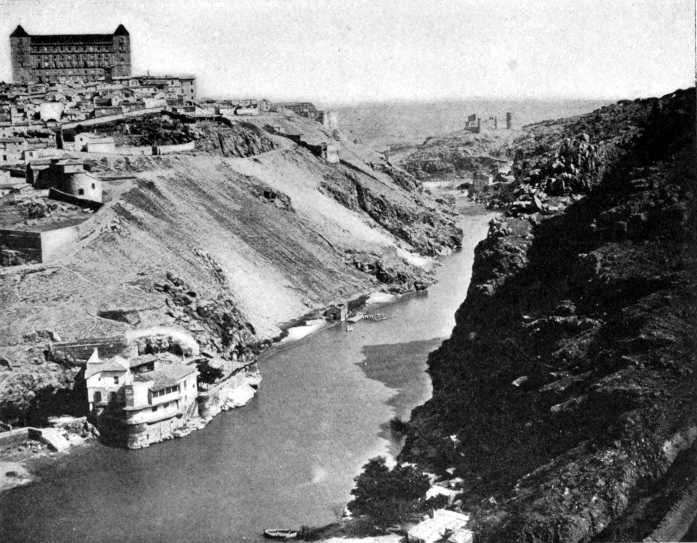
THE TAGUS
The waves of the Tagus, according to ancient historians, rolled with gold; it is even said that the sceptre of the kings of Portugal is made of the gold dust found in the deposit of this river. However, the Tagus is not now endowed with this auriferous virtue; and its banks in nowise deserve the brilliant descriptions indulged in by ancient and modern poets. They are generally escarpments and rocky gorges. The traveller, who follows the course of the stream through a country often bare, arid and uncultivated, or burnt up by the sultry rays of the sun, sees little but an impetuous water course, narrow and impeded with dangerous rocks, forming dangerous cataracts and rapids. The rocky cliffs that hem it in have little vegetation beyond a few evergreen oaks; and with a few rare exceptions, notably the valleys of Aranjuez and Talavera, which have been embellished with human art and culture there are few parts of Spain so poor and savage in character. In winter, the Tagus has a considerable rise, and covers the few plains to be found along its banks; but in summer, like most of the other Spanish rivers it dwindles to almost nothing; so that even below Santarem, from Alcantara to the confluence of the Zezere, navigation is interrupted by numerous cataracts.
“Of the various phases of its most poetical and picturesque course—first green and arrowy amid the yellow cornfields of New Castile; then freshening the sweet Tempe of Aranjuez, clothing the garden with verdure, and filling the nightingale-tenanted glens with groves; then boiling and rushing around the granite ravines of rock-built Toledo, hurrying to escape from the cold shadows of its deep prison, and dashing joyously into light and liberty, to wander far away into silent plains and on to Talavera, where its waters were dyed with brave blood, and gladly reflected the flash of the victorious bayonets of England,—triumphantly it rolls thence, under the shattered arches of Almaraz, down to desolate Estremadura, in a stream as tranquil as the azure sky by which it is curtained, yet powerful enough to force the mountains of Alcantara. There the bridge of Trajan is worth going a hundred miles to see; it stems the now fierce condensed stream, and ties the rocky gorges together; grand, simple, and solid, tinted by the tender colours of seventeen centuries, it looms like the grey skeleton of Roman power, with all the sentiment of loneliness, magnitude, and the interest of the past and present.
“How stern, solemn, and striking is this Tagus of Spain! No commerce has ever made it its highway—no English steamer has ever civilized its waters like those of France and Germany. Its rocks have witnessed battles, not peace; have reflected castles and dungeons, not quays or warehouses: few cities have risen on its banks, as on those of the Thames and Rhine; it is truly a river of Spain—that isolated and solitary land. Its waters are without boats, its banks without life; man has never laid his hand upon its billows, nor enslaved their free and independent gambols.”
Travellers and tourists never take in the river as a whole, but content themselves with keeping to the railroad, and visiting the more famous towns on the banks,—such as Toledo, Talavera, Aranjuez, Abrantes and Lisbon.
At Toledo, the Tagus ages ago forced its way through a romantic, rocky pass, 2,400 feet above the level of the sea. The walls of the gorge are 200 feet high. This ancient city stands on the north bank of the river which washes its walls on three sides and forms the great protection of the stronghold. Rushing around it, on the east, south and west, between rocky cliffs, it leaves only one approach on the land side, which is defended by an inner and an outer wall. Its magnificent cathedral still repays a visit notwithstanding the vandalism of its foes. The river, after passing Toledo, runs through a deep and long valley, walled up on either hand by lofty mountains. Those on the right bank are always capped with snow, and ranging nearly parallel with the course of the stream, divide the valley of the Tagus from Old Castile and the Salamanca country; the highest parts are known by the names of the Sierra de Gredos, Sierra de Bejar, and Sierra de Gata. In these sierras the Alberche, the Tietar, and the Alagon, take their rise, and, ploughing the valley in a slanting direction, fall into the Tagus.
Talavera de la Reyna is a delapidated ancient town surrounded with interesting old walls, and abounding in antique picturesque fragments. It is situated on the Tagus, seventy-five miles south-west of Madrid, in the centre of a fruit-growing district. It is famous for the great battle fought there in 1809 in which the French suffered a great defeat by Wellington.
Aranjuez is on the left bank of the river, twenty-eight miles south-west of Madrid, in a beautifully wooded valley. Here, for once, the stream runs smoothly between smiling banks.
Abrantes is finely situated on the river seventy miles above Lisbon. Its surrounding hills are covered with vineyards and olive groves; it is strongly fortified, and was an important position during the Peninsula war. Marshal Junot took this city as the title of his Dukedom.
Lisbon is built partly on the right bank of the Tagus and partly on hills behind. It extends for five miles along the estuary, which here forms a safe and spacious harbour.
The principal affluents of this neglected river are the Jarama, Guaddarama, Alberche, Alagon and Zezere from the north, and the Guadiela and Rio del Monte from the south.