THE LOIRE
Reading edition
VICTOR HUGO
I HAVE some recollection of having already said so elsewhere: the Loire and Touraine have been far too much praised. It is time to render justice. The Seine is much more beautiful than the Loire; Normandy is a much more charming “garden” than Touraine.
A broad, yellow strip of water, flat banks, and poplars everywhere—that is the Loire. The poplar is the only tree that is stupid. It masks all the horizons of the Loire. Along the river and on the islands, on the edge of the dyke and far away in the distance, one sees only poplars. In my mind there is a strangely intimate relationship, a strangely indefinable resemblance, between a landscape made up of poplars and a tragedy written in Alexandrines. The poplar, like the Alexandrine, is one of the classic forms of boredom.
It rained; I had passed a sleepless night. I do not know whether that put me out of temper, but everything on the Loire seemed to me cold, dull, methodical, monotonous, formal, and lugubrious.
From time to time one meets convoys of five or six small craft ascending or descending the river. Each vessel has but one mast with a square sail. The one that has the biggest sail precedes the others and tows them. The convoy is arranged in such a fashion that the sails grow smaller in size from one boat to the other, from the first to the last, with a sort of symmetric decrease unbroken by any unevenness, undisturbed by any vagary. One involuntarily recalls the caricature of the English family; one might imagine one saw a chromatic scale sweeping along under full sail. I have seen this only on the Loire; and I confess that I prefer the Norman sloops and luggers, of all shapes and sizes, flying like birds of prey, and mingling their yellow and red sails with the squall, the rain, and the sun, between Quillebœuf and Tancarville.
The Spaniards call the Manzanares “the viscount of waterways”; I suggest that the Loire be called “the dowager of rivers.”
The Loire has not, like the Seine and the Rhine, a host of pretty towns and lovely villages built on the very edge of the river and mirroring their gables, church-spires, and house-fronts in the water. The Loire flows through a great alluvion caused by the floods and called La Sologne. It carries back from it the sand which its waters bear down and which often encumber and obstruct its bed. Hence the frequent risings and inundations in these low plains which thrust back the villages. On the right bank they hide themselves behind the dyke. But there they are almost lost to sight. The wayfarer does not see them.
Nevertheless, the Loire has its beauties. Madame de Staël, banished by Napoleon to fifty leagues’ distance from Paris, learned that on the banks of the Loire, exactly fifty leagues from Paris, there was a château called, I believe, Chaumont. It was thither that she repaired, not wishing to aggravate her exile by a quarter of a league. I do not commiserate her. Chaumont is a dignified and lordly dwelling. The château which must date from the Sixteenth Century, is fine in style; the towers are massive. The village at the foot of the wooded hill presents an aspect perhaps unique on the Loire, the precise aspect of a Rhine village—of a long frontage stretching along the edge of the water.
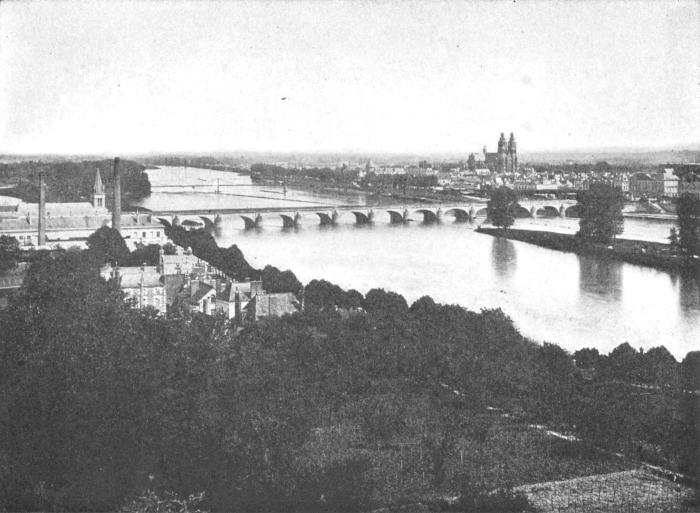
THE LOIRE
Amboise is a pleasant, pretty town, half a league from Tours, crowned with a magnificent edifice, facing those three precious arches of the ancient bridge, which will disappear one of these days in some scheme of municipal improvement.
The ruin of the Abbey of Marmontiers is both great and beautiful. In particular there is, a few paces from the road, a structure of the Fifteenth Century—the most original I have seen: by its dimensions a house, by its machicoulis a fortress, by its belfry an hôtel de ville, by its pointed doorway a church. This structure sums up, and, as it were, renders visible to the eye, the species of hybrid and complex authority which in feudal times appertained to abbeys in general, and, in particular, to the Abbey of Marmontiers.
But the most picturesque and imposing feature of the Loire is an immense calcareous wall, mixed with sandstone, millstone, and potter’s clay, which skirts and banks up its right shore, and stretches itself out before the eye from Blois to Tours, with inexpressible variety and charm, now wild rock, now an English garden, covered with trees and flowers, crowned with ripening vines and smoking chimneys, perforated like a sponge, as full of life as an ant-hill.
Then there are deep caves which long ago hid the coiners who counterfeited the E. of the Tours mint, and flooded the province with spurious sous of Tours. To-day the rude embrasures of these dens are filled with pretty window-frames coquettishly fitted into the rock, and from time to time one perceives through the glass the fantastic head-dress of some young girl occupied in packing aniseed, angelica, and coriander in boxes. The confectioners have replaced the coiners.